Tuesday, December 24, 2013

Happy Holidays!


Sepia ink and gouache on recycled paper, 229 x 193mm.
Opening the image in a new tab for full viewing is recommended. :)
Further details can be found here.

This illustration was commissioned by the Science Faculty of the University of Alberta for their holiday card this year. It revisits an older Holiday Hadrosaur theme of mine, only with an Edmontosaurus rather than a Parasaurolophus this time, for obvious reasons. A Pachyrhinosaurus and a pair of Troodon round off the sympatric saurian cast. If you are familiar with my work, you may also recognise the recurring turbaned figure in one of the handlers.

In the wake of completing this illustration, the discovery that Edmontosaurus actually had a rooster-like fleshy comb (old news to every Chasmosaurs reader by now, I'm sure) was finally published. You may imagine how I felt. And there was poor Victoria Arbour, co-author of the paper and the very person instrumental in securing me this commission, unable to breathe a word of it to me whilst I was working on the drawing. I have expediently decided that my Edmontosaurus here is female (her name is Cybele). I can stick with that for now.

Happy holidays!


Monday, May 13, 2013

The Valley of Gwangi

Ray Harryhausen died May 7th, 2013, at the age of 91. This is one of the things he left behind.


The year is 1969. America's long love affair with western movies is ending, and its tolerance for rubber creature features is waning as well. A middle-aged special effects technician named Ray Harryhausen has put together a film that, unfortunately, falls squarely in the middle of these two genres; a tale of cowboys and dinosaurs, of lassoed monsters and breakneck chases across the dusty desert. It is released to little fanfare and rapidly sinks into obscurity, just as its fellow westerns and monster movies have done. It's about to be the 70's, after all. America has weightier things on its mind. But The Valley of Gwangi, as it turns out, has charms of its own; charms enough to keep it from disappearing completely into pop culture oblivion.

Our story begins somewhere south of the Mexican border, around the dawn of the 20th century. T.J Breckenridge, a young woman of surpassing loveliness and somewhat wooden affect, is in deep water. Her traveling western circus has fallen on hard times, but T.J is still doing her best to make a go of it, touring small Mexican towns who are sure to be entranced by their increasingly shopworn acts. But circumstance throws two different twists at this fragile state of affairs. The first comes in the form of the dapper, fast talking Tucker, an independent operator (and T.J's former fiance) looking to buy up bits of the Wild West show's act. The other is altogether stranger; a mysterious little horse from a forbidden valley off in the desert, which has the potential to save the struggling circus.


Enter Professor Bromley, an English paleontologist of dubious morality. He's working out in the desert searching for remains of Eohippus, a tiny prehistoric horse, and he thinks he's found the fossil of a lifetime: a human leg bone with tiny horse tracks set in the matrix. Such a find should be impossible, which is why he flies into such paroxysms of glee when he sees the circus's newest attraction: a real, living, Eohippus! 


Not everyone is so thrilled, however. The town's Roma (which, incidentally, are not as out of place as you might think) are deeply worried by the appearance of the tiny horse. They are the ones who declared the forbidden valley off-limits, in fear of the ferocious and vindictive spirit that guards it--a spirit known only as Gwangi. If they don't get the little horse back to the valley soon, their matriarch warns, then the wrath of Gwangi will fall upon them all. So saying, the gypsies steal the Eohippus from T.J's circus and flee, making for the distant mountains that mark the border of the secret valley. Tucker, the Professor, and T.J's crew of carnies  all race after them, vying with each other for who can capture the precious little horse first.

But what waits for them beyond the mountains is far more impressive than any horse, tiny or not...

'

The Valley of Gwangi is clearly a direct descendant of King Kong. The requisite check marks are ticked off; superstitious locals? Yep. A prehistoric monster with a savage name? Check. A public escape, rampage and subsequent poignant death? Of course. However, it comes by the similarity honestly; Willis O�Brien himself, the stop-motion guru behind The Lost World and King Kong, came up with a rough treatment for the idea that he never managed to get off the ground.

Copyright Willis O'Brien

O'Brien's conception of Gwangi was apparently deeply old fashioned, as the above concept art attests, and not many details of what he had in mind have survived. Harryhausen, a prot�g�e of O�Brien�s, was the one who got the film made, and he himself was hugely influenced by King Kong. The finished film is thus a union of two fairly similar sensibilities, and it shows. 

Copyright Ray Harryhausen

Both Kong and Gwangi fit comfortably into a tradition you might call the �lost world� narrative; they focus on the discovery of an isolated prehistoric ecosystem, and the immediate consequences to life and limb for bringing a piece of that ecosystem back. Yet while the original Kong played the idea for as much fantastic horror as it could muster, Gwangi is much more understated. The nightmare jungles of Skull Island are replaced by the barren wastes of the desert, and where Kong scaled the heights of Manhattan, Gwangi�s rampage is limited to a little town of white adobe and a cathedral. Kong�s death requires airplanes at the heights of the world. Gwangi is killed by fire and a falling ceiling.


The end result of this is that The Valley of Gwangi feels weirdly believable. Yes, it centers around a lost valley of dinosaurs out in the Mexican desert, but if you�re willing to accept that (and if you�re reading this blog, it�s a good chance that you are) then the central plot of the film is filled with the kind of stumbling and foolishness you�d expect from real people placed in extraordinary circumstances. Guns are useless, for example, against the primeval might of the valley�s inhabitants�until one of the circus cowboys checks the cartridges and discovers, to his consternation, that whomever grabbed the rifles didn't bother to take the blanks out first. The Roma, for their part, are so affected by terror of Gwangi that they attempt to get rid of him as soon as possible�even though that entails freeing him in the middle of a packed stadium.


Even when Gwangi is released onto the dusty streets to wreak havoc, the vast majority of the damage is done by the fleeing crowd, with only a few people falling prey to the dinosaur�s jaws. The whole plot has the feeling of something that could actually have happened; a backwater little disaster unfolding out of the public eye, with no official authority to witness and record it. Unlike Kong, whose very public rampage and death must have shocked the world, the escape and subsequent death of Gwangi the Great seems destined to be ignored. An interesting bit of local folklore, perhaps, or a footnote buried in an obscure text.


Gwangi himself is a fantastic creation. Sculpted over an armature of ball and socket joints, moved minute centimeter by minute centimeter, the flicker of the camera breathes into him unbelievable vitality. Gwangi arrived in theaters in 1969, as the fabled Dinosaur Renaissance was beginning, and in many ways its title character embodies the changing times. While he is shaped in the mode of classic tail dragging carnosaurs, he moves with deceptive speed, trotting and even leaping across the screen. There is little of the reptilian stillness about him: even at rest, his tail slithers and twists in the air, dancing with malignant energy. He snarls and sneers in expressions that don�t quite reach his mad little eyes, his fingers twitching as he contemplates his prey. He could never be mistaken for accurate, now. There�s something vague about the specifics, his form a mix of the tyrannosaur and the allosaur, his tail too flexible, his form too hunched. But it doesn't matter. Gwangi may not look real, but by god, he looks alive.


This was the genius of Ray Harryhausen, of course. He poured his heart and soul into his rubber creations, and it shows; nothing in Gwangi seems as carefully labored over as the creatures of the forbidden valley, and nothing else in the film holds up quite as well. The Styracosaurus is bullish and stubborn, the Pteranodon a flapping menace, the Ornithomimus jumpy and comical. The human actors of the film acquit themselves acceptably, but Harryhausen's creations are indisputably the stars of the show. In a lot of ways, The Valley of Gwangi is representative of Harryhausen's life and work: a solid, unpretentious film, filled with unexpected charms and wonderful special effects. What more fitting tribute to the master could there be?


Ray Harryhausen died May 7th, 2013, at the age of 91. Gwangi, as always, abides.

Friday, January 4, 2013

Happy New Year


A little late in the proceedings, but not yet too late: a very happy New Year to all our readers from the Love in the Time of Chasmosaurs team; counter clockwise from right: David ('Anatotitan'), Asher (Dilophosaurus), Marc (Deinonychus) and me (Diplodocus).

I do recommend opening the image in a new tab for best viewing.

I would have liked to do more to this, but was obliged to call it finished, otherwise it might be March by the time I get to post it. It has already taken far longer than the rather lacklustre results would seem to warrant. I've taken a few liberties with the scale, of course (what Marc calls 'semi-authentic scale'). Nevertheless, I feel especially sheepish to be appearing so prominent, given that I'm the most ignorant and least qualified of the team. Perhaps I shall do another version someday which is more reflective of everyone's actual capacities...

Happy New Year!

Thursday, November 22, 2012

Thank You

thanks dino

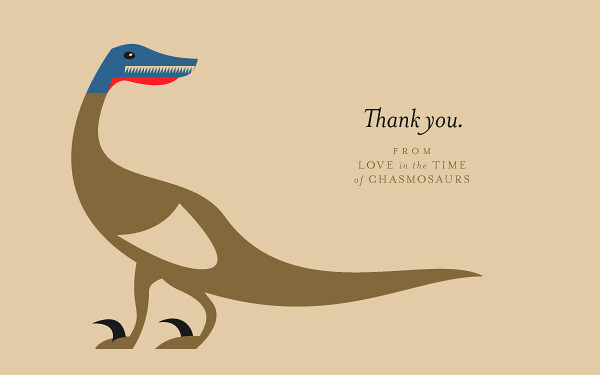
In the states, today is Thanksgiving. It's a time of year when the paleo corner of social media lights up with references to the dinosaurian lineage of Meleagris gallopavo. My contribution is this minimalist illustration of a vaguely deinonychosaurian theropod, inspired by a female Wild Turkey. I want to take a moment to thank the readers of Love in the Time of Chasmosaurs, the commenters, the sharers of links, and those of you who have kindly shared scans of old dinosaur books with us.

I would also like to personally thank Marc Vincent, Asher Elbein, and Niroot Puttapipat for their writings here; when I began school again I desperately wanted to keep LITC going, and because of the terrific writing of my co-bloggers, it is doing better than ever - perhaps not as frequently updated as before, but I am proud of the writing we share here, and I look forward to the day when I can pitch in at my pre-MFA studies level.

At any rate. Thank you.

Tuesday, October 23, 2012

The Return of Devil Dinosaur!

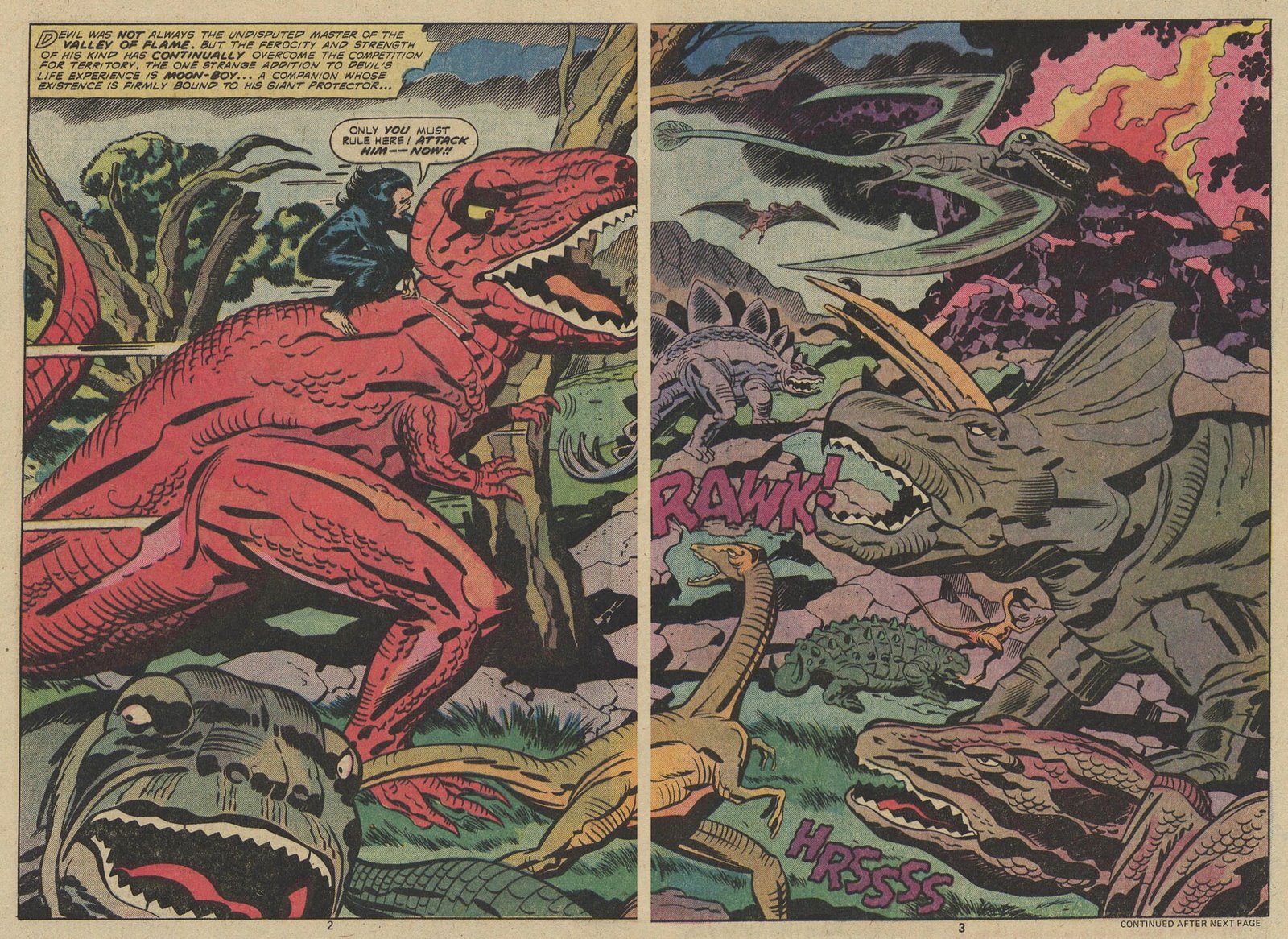
Once, long ago, a very brilliant man created a dinosaur for Marvel Comics. He painted it red, bestowed on it the gift of variable anatomy, and sent it on wild adventures that even today still quiver with childish insanity. But the audience faded away, and this monster, this Devil Dinosaur, faded away with them.

Then lots of things happened. If you don't read Marvel Comics, they won't make sense. If you do read Marvel Comics, they still won't make sense. It's really best not to worry about them. You could seek out Fallen Angels or Heroes for Hire, but that would only distract you from reading what may be the best Marvel comic to ever have a dinosaur in it.

I am referring, of course, to  Warren Ellis's Nextwave.


These are not the dinosaurs. They are bonus dinosaurs.

Imagine a radical guitar solo, somehow transcribed on paper through the medium of costumed pretty people hitting things, freed from the cruel shackles of continuity, character or sanity. Five minor Marvel characters, rejects and C-list superheroes, running through the dusty toy chests of Marvel intellectual property, seeking to stop the terrorist Beyond Corporation from product testing WMDs on the American populace. What evil mastermind could be behind this diabolical plot to destroy humanity? Who is responsible for the Samurai Gundam, the dragon with a pants fetish, and weaponized koalas? Who stands ready to be revealed as the greatest supervillain of all time?

Who indeed. 

I'm not sure what prompted Warren Ellis to chose Devil Dinosaur for the role of criminal mastermind, but I strongly suspect it was for the sole purpose of this image. There's something sublime in the juxtaposition of smoking jacket, ascot, pistol and fang. What better to symbolize the heights of patrician villainy? This incarnation of Devil Dinosaur is more then just old money. He is the oldest money. See the insouciance with which the pistol dangles from his tiny claws! See that plutocratic sneer arch over yellowing fangs! Devil Dinosaur is every inch the corrupt status quo, looming in aristocratic snobbery over the peons of the earth. A leftover from the Gilded Age...of Reptiles.

And as befits a patrician supervillain, he is also crazy racist.


In fact, this incarnation of Devil Dinosaur has something of a complex about monkeys. Perhaps it stems from the self loathing that comes from dressing in monkey-created smoking jackets, sipping monkey-created champagne, and waving around giant monkey-created pistols. "Stop making ideas!" he snarls at the superheroes. Ideas are antithetical to this denizen of the past. Like all aristocracy, Devil Dinosaur creates nothing. He merely lounges on the work of others, hating himself for doing so and proudly boasting of the paradise that will come when all of the underclasses are gone.


True freedom, posits Nextwave, can only be achieved by overthrowing the parasitic dinosaurian plutocracy and thwarting its evil designs on the common man. The only way to stop him, as with all corrupt aristocrats, is to kick his spherical mansion off of its floating war platform, let it bounce off the mountain below, and then explode.


Sic Semper Tyrannus, Devil Dinosaur.


Tuesday, September 4, 2012

He Was The Mightiest Of All!


This is The World That Was.

Volcanoes belch gobbets of lava into the permanent twilight, their Olympian fires raging above the steaming jungles, and amidst the shadowed tree trunks shamble a swarm of horrors. Strange cries echo through the twisting undergrowth, a deafening cacophony out of the deepest antediluvian hell. Every thing that lives, everything that breathes, hums with the same primal madness. Red skies above. Red blood below. Red, red, red, in bone and tooth and claw.

And then, silence. The volcano casts its red glow against the sky. The horrors recede, skulking backwards into the dark, their staring eyes wide and expectant. And out from the shadows, coming on gargantuan legs, tiny arms tucked against his craggy chest, teeth bared, eyes blazing, comes the reddest one of all.


It's a Tyrannosaurus. Yet it barely resembles the living creature that once stalked the world. It is instead something grander and stranger, an Ur-Tyrannosaur, the idea of the beast made flesh. A Devil Dinosaur.


Fast forward several million years and hop a few dimensions over. It is some time in the early 1970's, and Jack Kirby, the renowned king of comics, has begun playing with an idea. Creator or co-creator of heroes like Captain America, Thor, The Hulk, Iron Man, and the Fantastic Four, Kirby has been in something of a slump. For years he's been occupied with "The World That's Coming," beginning in the pages of DC Comics' OMAC and culminating in his post-apocalyptic serial Kamandi. But DC is going through troubled times--series being canceled left and right, explosive fights between editorial and the publisher. The bombast of the 60's is dying, and DC lurches toward social consciousness and hard traveling heroes. Mad ideas are out. Strange worlds are over. Comics are for grownups, these days.

But Jack Kirby isn't interested in realism. Short, bespectacled, a cigar smoldering in his mouth, he's always dreamed of wilder things. So he returns to Marvel Comics, to the company that he helped build, his restless mind already turning to a different subject. He pitches them a new series, one that explores the savage madness the distant past. A time when the earliest men still walked in the shadow of the dinosaur.


Devil Dinosaur #1 debuts in April 1978. On the cover, Devil Dinosaur charges forward, his tiny human hands clutching, yellow eyes blazing with a mad light. The hairy Killer-Folk cower in fear, their torches and spears dwarfed by the reptilian rage that speeds toward them with the force of a hurricane. On his back, Moon Boy's arms rise toward the sky, silently pushing his companion on. A boy and his dinosaur striking out against the world that hates and fears them: Vintage Marvel at its finest.

But even with the ever explosive Kirby at the reins, the first issue is surprisingly low on mad ideas--despite the impossibility of man and dinosaur truly living side by side, Kirby chooses to depict the setting with some restraint. In the back of the issue, he preemptively defends himself against charges of inaccuracy. Perhaps it is possible, he argues, for a world such as he has created to exist. "After all," he writes in the back-matter, "just where the Dinosaur met his end, and when Man first stood reasonably erect, is still shrouded in mystery."

From anybody else, this would be a ludicrous assertion. But the world Kirby is creating, like every world he has created, transcends mere fact. The world of Devil Dinosaur is a feverish pulp of television and comics and drive-in movies, as distinct from the real world as T. rex from a toy. No dinosaur skeleton could ever fit inside Devil Dinosaur's grotesque body. No prehistoric forest ever burned with the spatters of energy that Kirby inks over every vista. Reality and evidence are hindrances to a mind like Kirby's. It's clear that even pseudo-scientific speculation isn't enough to restrain him for long.

And it doesn't. Barely two issues have passed before the horizons of Devil Dinosaur's prehistoric world expand into stranger epochs. The spider god of the Killer-Folk. The valley of the malevolent ants. A prehistoric giant clad in ragged fur and a triceratops skull, swinging a stegosaurus like a club. There is talk of an animated spin-off, a television show for children. It's a natural transition--Devil Dinosaur is a child's id writ large across cheap paper, insane and logic-defying and gloriously energetic.


But even that's not enough. Kirby's pen takes Devil Dinosaur onward, upward, outward; attacking aliens, strange technology, Kirby krackle star-beasts of Lovecraftian size, the very cosmos taking life in a sea of staring eyes and claws and seething power. The World That Was and The World That's Coming are beginning to blend together. Devil Dinosaur goes into space. Devil Dinosaur magically rampages through the distant future of 1978. Devil Dinosaur stands supreme.


December 1978. Devil Dinosaur is canceled. The art is too stylized and strange, the writing too uneven and clunky. Comics buyers are ignoring it in droves. Low sales, that impossible enemy, do to the red giant what rival monsters and jet-pack aliens never could. Devil Dinosaur #9 is the last issue. The hoped-for animated spin-off never arrives.  A crossover between Devil Dinosaur and Godzilla is plotted in a last-ditch attempt to drum up some interest, but it comes and goes with nary a ripple.

Kirby moves on. It's what he does; he's had too many series canceled out from under him to weep over one more. Bereft of their creator's pen, Devil Dinosaur and Moon Boy are left rudderless in the backwaters of Marvel's continuity. The World That Was withers, a discarded toy in Marvel's toy-box, to be plucked out and desultorily played with and then cast back and forgotten. One more occasional guest star and another casualty of the changing comics industry. Too strange. Too weird. Comics are for grown ups, these days.

But for nine insane, glorious issues, Devil Dinosaur was the mightiest of all.


Next Time! The many faces of Devil Dinosaur! Random adventures! Smoking jackets! 


Thursday, August 30, 2012

Dinosaur Art: 'Time Machine Enough'


I am at a considerable disadvantage, following up David, Marc and Asher. Not only am I in possession of an inferior brain to those of the authors of this blog, I also happen not to have a copy of Dinosaur Art to hand, and am having to rely largely on my recollection of leafing through this gorgeous book from when Marc kindly shared his copy with me.

Given its title, I had initially imagined the book to be not dissimilar to Dinosaur Imagery in presenting almost a miscellany of renowned names in contemporary palaeo art. I was pleasantly surprised to learn of its focus on just ten artists, which affords a more in-depth look at their oeuvre and methods, as the others have already pointed out. This was especially welcome to me as an illustrator myself. On the purported premise of its featuring the very best in the genre, however, no doubt everyone will have their own quibbles as to who was left out of this exalted group. And in this, I have to agree with David that the absence of Mark Hallet and Michael Skrepnik is a notable one.

Ra�l Mart�n; Sauropods

Of the ten represented though, it heartens me to see that there does seem to be a degree of variety in terms of style and approach, and to see what might be regarded as 'newer' names in the palaeo art world sitting alongside the long-established greats. I confess at once that Robert Nicholls and John Conway, for instance, were artists whom I had only discovered within the last year or so. It is refreshing to contrast the latter's more stylised but highly atmospheric -- sometimes even elegiac -- digital illustrations with the exquisitely detailed and resolutely traditional gouache paintings of John Sibbick (to whom I kowtow); or to see two quite differing sides of the same coin in the works of Todd Marshall and Luis Rey, both of whom relish the opportunities for dramatic perspectives, postures, and wilder speculative features in their animals. Whilst Douglas Henderson's 'truly artistic approach to paleoart' breathtakingly ravishes every scientific and aesthetic sensibility with his evocative landscapes, convincingly populated by fauna. I do take Asher's point that the greater weight does still tend to fall on the naturalistic or photo-realistic approaches on the whole, and fully agree that the inclusion of William Stout would have added yet another facet of this world to this gem of a book.


Todd Marshall; Kaprosuchus


Allow me, if you will, a brief moment of self-indulgence from the perspective of a traditional artist. I readily admit that I myself am guilty of the 'hand-wringing' which David mentioned with regard to digital media changing the craft. The exquisite watercolours and coloured pencil pieces of  Julius Csotonyi were what made me fall in love with his work in the first place, and as much as I admire his stunningly wrought digital paintings, I lament that they seem to have supplanted his traditional work both in actual terms and insofar as they are represented in this book. A watercolour of Einosaurus is the sole instance of this here. I should so much have preferred several more in lieu of one or two of his less successful combinations of photography and digital painting.

Julius Cstonyi; Brachylophosaurus. Awarded The Lanzendorf PaleoArt Prize for Two-Dimensional Art (2010) by the Society of Vertebrate Paleontology


I do agree with Marc that a little more light could have been shed on some of the decisions for certain idiosyncratic features the artists gave to their depictions. Though the whole science and art of restoration are so broad that I see how difficult these would be to bring into each interview, and one which would be better served by focusing on an individual work in its entirety than by random questions in amongst each section. But this would require many more pages and much more expense. For me, the 'highlight taxon' for each artist as mentioned by David suffices comparatively well enough in this effort for the book's purposes. I also recall that at least one blog reader was concerned that more is not made of dinosaur lives and evolution itself; but this, too, would be to make even more of an attempt to be 'all things to all readers', as Asher aptly pointed out.

My overall opinion, however, is quite simple: secure yourself a copy of this book with what despatch you may! Of its production values, I have little else to add. As has already been mentioned, the quality of the printing is sterling and the book is a treasure, appealing fully to the bibliophile and the dinosaur art lover in me. I even had to remonstrate with Marc regarding his customary cavalier handling of books when he brought his copy along. Even if does not, indeed, quite succeed in being all things to all readers, what it does offer in terms of insight into the artists' processes together with the wealth and quality of the images ought to earn it a place on the bookshelf of any dinosaur enthusiast of whatever degree.

top social