Did you know that if you placed every dinosaur book written by Michael Benton end-to-end, they would stretch three times around the equator? Along with good ol' Dougal 'Dixie' Dixon, Benton is surely one of the most prolific authors of popular books on extinct saurians. Similarly to Dixon, the sheer number of Benton-authored books means that the quality of the illustrations contained within them varies greatly. While not dreadful, the art in The Penguin Historical Atlas of the Dinosaurs isn't particularly memorable; it's the sort of serviceable, highly Sibbick-inspired artwork you'd expect to see in a randomly selected dino book from the mid-'90s. That said, it's still interesting to spot all those beloved '90s tropes, some of which still refuse to die. (Oh, and I have cheated a bit - this book's from 1996, so isn't quite old enough to qualify for VDA. Then again...rules, who needs 'em?)
By far the best aspect of this book is the large number of maps on offer, each displaying the lie of the land and the distribution of different animal groups in a given time period. As one might expect given the title, these maps are the book's real emphasis, and do indeed provide a wonderful sense of the shifting continents through geological time. Arguably, the illustrations (produced by Ralph Orme, Steve Roberts and Peter Smith) are of secondary importance to the maps, but occasionally the artwork is brought to the fore, with entire pages dedicated to a single animal - as is the case with Plateosaurus, below.
The illustration's rather uninspiring - a gaggle of grey dinosaurs standing about in a largely barren landscape, their skins wrinkly in a highly '80s Sibbickian, Michelin Man sort of way. They're very droopy-tailed, and sport rather shapeless limbs - again, no doubt inspired by Sibbick's Normanpedia era work, as so much '90s dinosaur art was. On the other hand, it's worth noting that the plateosaurs remain firmly bipedal, unlike Sibbick's own. The German palaeontologist Friedrich von Huene concluded that Plateosaurus was a biped decades earlier, and while others have since argued in favour of an habitual quadrupedal posture, further work by the likes of Heinrich 'Caudofemoralis' Mallison has borne this out. So...hey, it's actually aged quite well! If you ignore everything else about the animals' postures.
The book moves on in chronological order, and in a mere few tens of millions of years the sauropodomorphs have graduated to their familiar, enormous, long-necked and inevitably grey forms - the Proper Sauropods (or 'Properpods'). Nothing to see here, folks - grey, elephant-skinned, Gurche/Sibbick/Jurassic Park-inspired business as usual. What's more unusual about this piece is the extensive use of airbrushing*, which is seldom seen in palaeoart and at least helps give this illustration a memorable feel - it seems somewhat hazy, as if one were standing in a fern-filled crater in the tropical heat, gazing up at the far-away heads of absurdly large reptiles. Given the way the weather's turned this summer where I live, it's not an unpleasant thing for me to imagine.
Come the Early Cretaceous, we're treated to a classic Wealden scene in which a very obviously Sibbick-inspired Iguanodon (now with forward-curving thumbs for greater stabbing efficiency!) steals centre stage, while brachiosaurs and (presumably) Hypsilophodon look on. It's always pleasing to see dinosaurs in a rainstorm (if nothing else, it helps to distract from the lack of vegetation), but the most curious thing about this illustration is the creature lurking in the middle-right. What exactly is this long-necked, small-headed, sharp-thumbed beast? I'm tempted to assume it's Baryonyx, in which case this is one of the strangest illustations of said dinosaur out there. Could the head be partially submerged? Maybe, but it doesn't look it. Weird.
Speaking of spinosaurs...here's a gloriously '90s Spinosaurus complete with neat, semicircular sail and generic 'carnosaur' head. Note also the short arms, which made perfect sense under the assumption that this was some sort of weirdo allosauroid. It's not the artist's fault that Science Marches On, of course, but it's always amusing to look back.
Equally outdated - but less obviously so, at least to most people - is this Quetzalcoatlus, which, once again, is heavily inspired by Sibbick's work - especially the head. Even the colour scheme on the noggin is a near-direct copy of Sibbick's. Mark Witton discussed the genesis and legacy of Sibbick's Quetz at Tetzoocon last year, but suffice it to say that the much-copied head nubbin is a mistake, and the jaws are also likely too short.
I'm quite sure that the book's Saurolophus (above) has also been copied from somewhere, although I can't quite place it - the original may have appeared in Dinosaurs! magazine. At least it's nice and colourful, as is the handsomely dappled hadrosaur in the background which, based on the accompanying caption, is presumed to be...Tsintaosaurus?! Could it be that (in spite of the text) this is another rare example of a flat-nosed Tsintaosaurus? Admittedly, it's just as probable that the foreground animal is intended to represent Tsintaosaurus (in spite of better matching Saurolophus), while the beast in the back is the 'lower crested' Saurolophus. But it would be cool to find another depiction of that seldom illustrated idea. Either way, this is one of the best illustrations in the book, featuring as it does imaginatively coloured animals and considered background detail (fallen branches! Footprints! A forest!).
As Dino Doomsday draws closer, the book wheels out the saurian big guns - namely, ceratopsian noble knight Sir Triceratopalot, and his dastardly foe of gnashing teeth and atrophied forelimbs, Sexy Rexy. The highly Sibbickian Triceratops in this scene aren't terrible, although there are a few perspective fudges afoot, particularly when it comes to the animals' faces and limbs. Rexy's unexpected lippiness is quite pleasing, but he does also possess a disconcerting '90s-style knobbly fizzog, which reminds me of nothing so much as a collectible model made by American toy manufacturer Safari back in the day. His head's also a little out of proportion with his body, which is unfortunate. Everyone likes to be reminded of how big Tyrannosaurus' head was - that's why it's always being thrust at you from book covers, typically with blood and/or slobber spraying everywhere.
Incidentally, this illustration is another example of the '90s trope involving ceratopsian parents encircling their young in order to protect them from predators, seemingly inspired by what people would do with covered wagons in the Old West [EDIT: And also some large herbivorous mammals, as pointed out by commenters. Not sure why westerns came to mind for me - I think they mentioned it in Dinosaurs! once. Or I just had one of Those Moments. It's been a long day]. It's a peculiar meme to appear so often, and I'd be interested to know the origin of it.
And finally...it's the end of the Cretaceous, which means flowering plants, modern-looking birds (is that a swallow?), and mammals...mammals everywhere. Scampering along the ground, peering over tree branches, and generally making a furry, smelly nuisance of themselves. Of course, we're also treated to the return of Triceratops and Rexy, who has turned a delightfully stripy green for this piece. It's difficult for illustrators to make a pleasing composition out of an image that is required to cram in as many different taxa as possible, but this artist has had a pretty decent stab at it. While Rexy is distractingly weird-looking, with his unduly long arms and bulbous derpy head that was seemingly made in a separate mould, the other creatures aren't so bad. I guess.
That's the thing about this book - the illustrations are altogether just so forgettable, for all the artists' best efforts. That's where you come in! Because I have a copy of Ladybird's Prehistoric Animals and Fossils going spare, it's surely Competition Time. I want you to draw me a group of Triceratops adults encircling their young, while tyrannosaur bandits circle around the perimeter. Please feel free to draw clothes and silly facial expressions on your saurians. Link to your entry in the comments, and this fairly mediocre prize could be yours!
*Thanks are due again to Niroot for pointing this out.
Showing posts with label vintageish dinosaur art. Show all posts
Tuesday, July 21, 2015
Wednesday, January 21, 2015
Vintage-ish Dinosaur Art: Travels with Dinosaurs
After a long break from the series, I'm back with my first Vintage Dinosaur Art post in almost two years. Inspired by the cartoony style of Marc's post on Dinosaurs! A Spot-the-Difference Puzzle Book, I scanned a recent acquisition of my own, Travels with Dinosaurs. The book itself has scant information about the publication, but searching the web leads me to a publication date of 1997, making this not-quite-vintage, but it certainly is in spirit, so off we go.
The book was written by children's author Vezio Melgari and illustrated by Giovanni Giannini and Violayne Huln�. There's sadly no indication how Giannini and Huln� collaborated on the illustrations, which strongly resemble the work of Richard Scarry. Melgari's story is about a group of young animals - mainly of the canine persuasion, with a cat or two thrown in the mix - who are taken on a virtual reality trip through time by the Professor Alfred S. Wolfsbane, "specialist in several sciences and wizard of the computer world." It was the nineties! Of course, for our purposes, we're more concerned with how the dinosaurs are presented than we are in the story.
The first trip is to visit the "floating giants," AKA sauropods. Though Apatosaurus is depicted in its classic mid-century habit of standing half-submerged in water, it is referred to by the correct name, and the text even makes reference to the obsolescence of "Brontosaurus". The spread is a good introduction to the book's primary color aesthetic and odd mix of outmoded and contemporary ideas, as well as its admirable dedication to including smaller fauna in the mix, generally well labeled, as in the fish swimming around the sauropods' legs here.

The sauropods of Travels with Dinosaurs: Apatosaurus, Diplodocus, and Brachiosaurus.
Next up are various hadrosaurs, singled out for their "strange heads", since the variety of hadrosaur headgear has always been a popular focal point of picture books. Most interesting here is "Anatosaurus", which by the late nineties had been officially folded into Edmontosaurus for about a decade. It's standing in a familiar Knightian bipedal position (and creeping up on a tree fern in an unsavory way). The landscape combines the old and new again, repeating the old trope of barren, volcano-populated landscapes but also nodding to the Cretaceous flourishing of angiosperms.

The strange heads: Edmontosaurus FKA Anatosaurus, Corythosaurus, and Parasaurolophus
Thyreophorans get their spotlight next. Stegosaurus is featured front and center, as expected, rearing on two legs and munching on foliage, an old tradition. Velociraptor makes an appearance, menaced by Ankylosaurus and high-tailing it back to Asia (and presumably its own time, a couple million years previous). At least it's recognizable as a velociraptor-ish animal, rather than a generic post-JP raptor. Kentrosaurus is stripped of its teeth, which was never the case; though its original description only included a single tooth, and only fragments of teeth or emerging teeth thereafter, I'm not sure that toothless Kentrosaurus was ever a big theory - gladly corrected if it was.

Ankylosaurus, Kentrosaurus, and Stegosaurus represent Thyreophora
Appropriately enough, Triceratops takes center stage for the ceratopsians, with fellow old standby horn-faces Monoclonius and Styracosaurus playing back up. Check out the pretty-well-rendered noggin morphology of the baby Triceratops, huddled in the lower right-hand corner.

Styracosaurus, Triceratops, and Monoclonius, natch
The carnivores, appropriately enough, are represented by those twin titans of terror, Tyrannosaurus and... Iguanodon. Yeah, Iguanodon, tearing into Mosasaurus. Prof. Wolfsbane calls it "one of the largest carnivores... among the land dinosaurs," only bested by Tyrannosaurus. I don't know where this came from, other than Louis Figuier's famous, anachronistic Megalosaurus v. Iguanodon battle, in which it can safely be presumed that Iguanodon is merely fighting for its life, not trying to nom on its opponent. If anyone knows of any other depictions of a predatory Iguanodon, please let me know what I've missed. It's almost as if Melgari smooshed Megalosaurus and Iguanodon into a single wuzzlesaur, with the stereotypical skulking gait and predatory nature of the former and the thumb-spike of the latter. I love the glee on the face of Rexy, as if he's just thrilled that Iguanodon has changed teams and wants in on the action.

The terrible predators, Tyrannosaurus and Iguanodon.
The book's pterosaurs were cast in the old-school, leathery-demon mold, with little attention paid to scale or temporal accuracy. And hey, since we're at the seaside, Ichthyornis prepares for a water landing, and there's a typical Hesperornis. Look at it dive.

"Hey, big bats!"
Archaeopteryx, in classic sparkleraptor garb, is relegated to a spread dedicated to various birds (and a couple tapirs). It's presumably the Cenozoic now, therefore we're green and fresh and inviting rather than volcanic and barren. Palaelodus stands in the background, pink and misspelled. Prof. Wolfsbane's son Walt has gone missing, and some of his supposed friends choose to imagine him chased down by a ravenous Tyrannosaurus, menaced by Mastodonosaurus, or best of all, fed by Brachiosaurus to Mosasaurus. Poor Prof. Wolfsbane, I can only imagine his reaction.

Birds, tapirs, and dark fantasies
The last spread I'll share is the "record breakers," in which dubious facts and stale old canards are transmitted to a willing and impressionable junior readership. Here, we learn that Allosaurus was the "fiercest and most voracious" dinosaur, because science, and it certainly does seem excited by those jammie dodgers. Ouranosaurus gets to have the longest crest, Tanystropheus is lumped in with dinosaurs because why not, and golly: Composognathus is the size of a chicken.

Science!
So to sum up: whimsical illustrations that combine old views, somewhat contemporary knowledge, and head-scratching inaccuracies. Had Melgari gone with a lighter adventure narrative that didn't purport to be an encyclopedia-lite, poetic license would have been understandable, but instead we have a book that is mostly memorable for its bizarre un-facts.
The book was written by children's author Vezio Melgari and illustrated by Giovanni Giannini and Violayne Huln�. There's sadly no indication how Giannini and Huln� collaborated on the illustrations, which strongly resemble the work of Richard Scarry. Melgari's story is about a group of young animals - mainly of the canine persuasion, with a cat or two thrown in the mix - who are taken on a virtual reality trip through time by the Professor Alfred S. Wolfsbane, "specialist in several sciences and wizard of the computer world." It was the nineties! Of course, for our purposes, we're more concerned with how the dinosaurs are presented than we are in the story.
The first trip is to visit the "floating giants," AKA sauropods. Though Apatosaurus is depicted in its classic mid-century habit of standing half-submerged in water, it is referred to by the correct name, and the text even makes reference to the obsolescence of "Brontosaurus". The spread is a good introduction to the book's primary color aesthetic and odd mix of outmoded and contemporary ideas, as well as its admirable dedication to including smaller fauna in the mix, generally well labeled, as in the fish swimming around the sauropods' legs here.

Next up are various hadrosaurs, singled out for their "strange heads", since the variety of hadrosaur headgear has always been a popular focal point of picture books. Most interesting here is "Anatosaurus", which by the late nineties had been officially folded into Edmontosaurus for about a decade. It's standing in a familiar Knightian bipedal position (and creeping up on a tree fern in an unsavory way). The landscape combines the old and new again, repeating the old trope of barren, volcano-populated landscapes but also nodding to the Cretaceous flourishing of angiosperms.

Thyreophorans get their spotlight next. Stegosaurus is featured front and center, as expected, rearing on two legs and munching on foliage, an old tradition. Velociraptor makes an appearance, menaced by Ankylosaurus and high-tailing it back to Asia (and presumably its own time, a couple million years previous). At least it's recognizable as a velociraptor-ish animal, rather than a generic post-JP raptor. Kentrosaurus is stripped of its teeth, which was never the case; though its original description only included a single tooth, and only fragments of teeth or emerging teeth thereafter, I'm not sure that toothless Kentrosaurus was ever a big theory - gladly corrected if it was.

Appropriately enough, Triceratops takes center stage for the ceratopsians, with fellow old standby horn-faces Monoclonius and Styracosaurus playing back up. Check out the pretty-well-rendered noggin morphology of the baby Triceratops, huddled in the lower right-hand corner.

The carnivores, appropriately enough, are represented by those twin titans of terror, Tyrannosaurus and... Iguanodon. Yeah, Iguanodon, tearing into Mosasaurus. Prof. Wolfsbane calls it "one of the largest carnivores... among the land dinosaurs," only bested by Tyrannosaurus. I don't know where this came from, other than Louis Figuier's famous, anachronistic Megalosaurus v. Iguanodon battle, in which it can safely be presumed that Iguanodon is merely fighting for its life, not trying to nom on its opponent. If anyone knows of any other depictions of a predatory Iguanodon, please let me know what I've missed. It's almost as if Melgari smooshed Megalosaurus and Iguanodon into a single wuzzlesaur, with the stereotypical skulking gait and predatory nature of the former and the thumb-spike of the latter. I love the glee on the face of Rexy, as if he's just thrilled that Iguanodon has changed teams and wants in on the action.

The book's pterosaurs were cast in the old-school, leathery-demon mold, with little attention paid to scale or temporal accuracy. And hey, since we're at the seaside, Ichthyornis prepares for a water landing, and there's a typical Hesperornis. Look at it dive.

Archaeopteryx, in classic sparkleraptor garb, is relegated to a spread dedicated to various birds (and a couple tapirs). It's presumably the Cenozoic now, therefore we're green and fresh and inviting rather than volcanic and barren. Palaelodus stands in the background, pink and misspelled. Prof. Wolfsbane's son Walt has gone missing, and some of his supposed friends choose to imagine him chased down by a ravenous Tyrannosaurus, menaced by Mastodonosaurus, or best of all, fed by Brachiosaurus to Mosasaurus. Poor Prof. Wolfsbane, I can only imagine his reaction.

The last spread I'll share is the "record breakers," in which dubious facts and stale old canards are transmitted to a willing and impressionable junior readership. Here, we learn that Allosaurus was the "fiercest and most voracious" dinosaur, because science, and it certainly does seem excited by those jammie dodgers. Ouranosaurus gets to have the longest crest, Tanystropheus is lumped in with dinosaurs because why not, and golly: Composognathus is the size of a chicken.

So to sum up: whimsical illustrations that combine old views, somewhat contemporary knowledge, and head-scratching inaccuracies. Had Melgari gone with a lighter adventure narrative that didn't purport to be an encyclopedia-lite, poetic license would have been understandable, but instead we have a book that is mostly memorable for its bizarre un-facts.
Wednesday, September 17, 2014
A Russian interlude
What's all this then? Well, I was recently contacted by Dave Hone, well-known palaeontologist, blogger, and exuberant fellow. Dave and I have met a few times, and he even lent me a pile of his old books on one such occasion. This time, Dr Dave had another treat for me. In a letter sealed with wax and carefully delivered by a dashing man in a hat, he had written:
Dating from 1999, B MNP ANHO3ABPOB is partly a straightforward, factual book about dinosaurs, and partly a puzzle/activity book with wordsearches, colouring pages, and amusing/disturbing chimeric animals (but more on that later). The illustrations draw obvious inspiration from the classics (Burian, mostly), but also from other sources. That jolly Triceratops, for example, is somewhere in between a Mark Hallett painting and a Dinamation robot. Like many dinosaur books from the '90s, it has a curious mix of the old and the new...but errs towards the old.
The fun begins on the title page, as a lo-o-ong Stegosaurus (how many plates?) faces off against a Generic Theropod (we may presume Allosaurus), while Pteranodon circle overhead because, well, you've got to have Pteranodon.
The book features the typical tour back in time, with a charming chart illustrating the changing fauna through the ages - complete with what appears to be a phytosaur, Paraceratherium, and a suitably sparkleraptor-style Archaeopteryx. On the right of the spread we have that Triceratops again, this time accompanied by a baby. D'awww.
The sauropods in this book have some seriously strange stuff going on, mostly pertaining to stumpy, sprawling limbs and snake-like bodies. In particular, the apatosaur on the right appears to be slithering about the place in an especially serpentine fashion. I do quite like the rather lairy orange on that Diplodocus, mind you, even if it doesn't really suit the conventionally Burianesque plain, wrinkly body. Stick some spines, dewlaps and all-round disc brakes on there, and we'd be onto a winner.
Further Burian-derivatives appear in the form of Sexy Rexy (above), reminiscent of the great man's Tarbosaurus. There's a definite perspective fudge going on here - as if the artist drew in Rexy and the top half of the hadrosaur, then realised they'd made the hadrosaur a little too diminutive. Either that, or Rexy's picking up the poor ornithopod with just one of his supposedly puny arms (although that shadow suggests otherwise). Either way, things aren't looking good for the blue guy - there are ribs on show and the Dino Damage piece has been lost down the back of the sofa. Rexy, on the other hand, is thoroughly enjoying himself.
And on the right...there's an Ankylosaurus. Love those backward-sweeping head horns.
While the book does feature those Mesozoic 'others' (token ichthyosaur, token plesiosaur, and bloody Pteranodon), they share a spread with an ornithomimosaur for reasons that elude me. Mostly because I don't speak Russian, in spite of the fact that I drank an awful lot of a stereotypically Russian beverage while at university. Noteworthy: the Pteranodon is again rather Burianesque, but with stunted wings, while a charming ammonite is illustrated alongside the ichthyosaur. You know, there's a giant concrete ammonite stuck on a roundabout in a town not too far from me. I should take a photo sometime.
As I've previously mentioned, the book features fun games and things to do, in addition to the educational bits. The above spread appears to be a board game of some sort, and is rather reminiscent of a game that I had as a child. Based on the positioning of the arrows, it appears that friendly dinosaurs (such as the amused-looking hadrosaur, the sauropod, and the Dachshund-stegosaur) help you on your way, while pointy-faced carnivores send you scurrying back towards the CTAPT.
You know, that plesiosaur's clearly outgrown his pond. Should've moved to Scotland, waited for a certain glacial lake to form millions of years later, and then jumped on in there.
All this, and I haven't yet mentioned the name of Dave's student, the one who actually owns the book! For shame. Thank you, Anastasia Doronina. Your dot-to-dot and colouring skills (as seen above) are without par.
There's something quite wonderful about the way children inevitably give carnivorous dinosaurs (and sabre-toothed stinky mammals!) blood-stained teeth. I mean, it's a bit of a shame that Anastasia didn't manage to complete this page, but I do appreciate the pretty flower, speculative ceratopsian frill patterning and allusions to horrible, bloody violence.
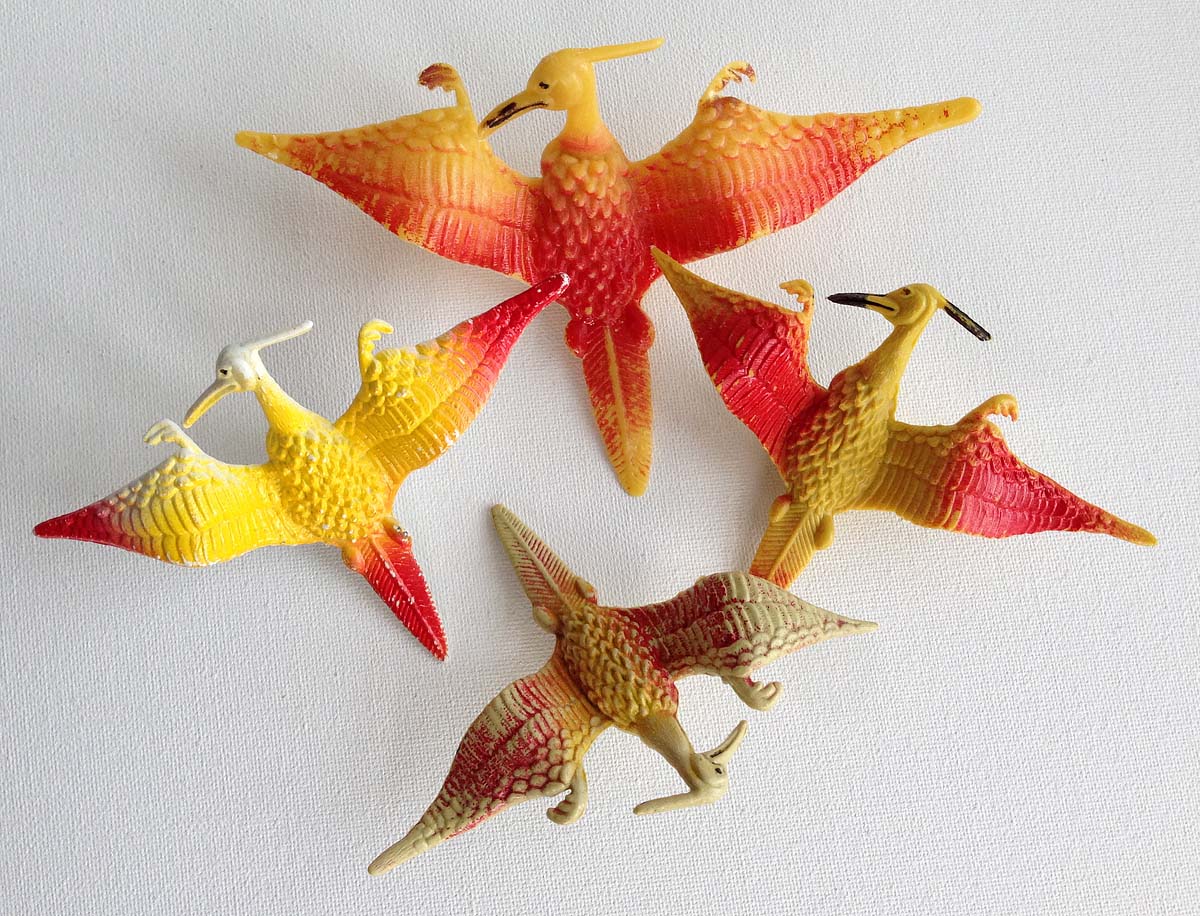
And finally...while these creatures wouldn't look too out of place in some of the more bargain basement dinosaur books out there, I'm quite certain this is a puzzle exercise with the aim being to identify which animals have been combined to produce these...things. So yes, they're deliberately wrong, which always takes away some of the fun. Nevertheless, I think they're brilliant, especially the Godzilla-like stegotheropod, the plesiosaur with sauropod legs, and the Pteranodon/bird. A lot of them resemble some of the more hideous cheapy dinosaur toys out there, especially the Pteranodon, which I'm pretty sure I owned as a child. Wonderful.
Many thanks again to Anastasia and Dave for sharing this one!
LATE UPDATE: Meanwhile, somewhere in Dinosaur Provincial Park...
While the 'letter' from Dave was an obvious joke, it is true that the matter of this book came up while Dave and his students (including Anastasia) were out in the field. Dave's sent me a photo from the trip, depicting a lovely stretch of Dinosaur Provincial Park.
"Dearest Marc,Or he might have just sent me an e-mail. But check it out - Russian vintageish dinosaur art! Hurrah.
I do hope this letter finds you well. On a recent field trip to the badlands of somewhere-or-other, one of my students mentioned a glorious 1990s dinosaur book filled with brightly coloured, haphazardly proportioned and occasionally obviously plagiarised dinosaurs, and I had to think of you. Please find a series of photographs enclosed.
Cordially yours,
Dr David Hone."
Dating from 1999, B MNP ANHO3ABPOB is partly a straightforward, factual book about dinosaurs, and partly a puzzle/activity book with wordsearches, colouring pages, and amusing/disturbing chimeric animals (but more on that later). The illustrations draw obvious inspiration from the classics (Burian, mostly), but also from other sources. That jolly Triceratops, for example, is somewhere in between a Mark Hallett painting and a Dinamation robot. Like many dinosaur books from the '90s, it has a curious mix of the old and the new...but errs towards the old.
The fun begins on the title page, as a lo-o-ong Stegosaurus (how many plates?) faces off against a Generic Theropod (we may presume Allosaurus), while Pteranodon circle overhead because, well, you've got to have Pteranodon.
The book features the typical tour back in time, with a charming chart illustrating the changing fauna through the ages - complete with what appears to be a phytosaur, Paraceratherium, and a suitably sparkleraptor-style Archaeopteryx. On the right of the spread we have that Triceratops again, this time accompanied by a baby. D'awww.
The sauropods in this book have some seriously strange stuff going on, mostly pertaining to stumpy, sprawling limbs and snake-like bodies. In particular, the apatosaur on the right appears to be slithering about the place in an especially serpentine fashion. I do quite like the rather lairy orange on that Diplodocus, mind you, even if it doesn't really suit the conventionally Burianesque plain, wrinkly body. Stick some spines, dewlaps and all-round disc brakes on there, and we'd be onto a winner.
Further Burian-derivatives appear in the form of Sexy Rexy (above), reminiscent of the great man's Tarbosaurus. There's a definite perspective fudge going on here - as if the artist drew in Rexy and the top half of the hadrosaur, then realised they'd made the hadrosaur a little too diminutive. Either that, or Rexy's picking up the poor ornithopod with just one of his supposedly puny arms (although that shadow suggests otherwise). Either way, things aren't looking good for the blue guy - there are ribs on show and the Dino Damage piece has been lost down the back of the sofa. Rexy, on the other hand, is thoroughly enjoying himself.
And on the right...there's an Ankylosaurus. Love those backward-sweeping head horns.
While the book does feature those Mesozoic 'others' (token ichthyosaur, token plesiosaur, and bloody Pteranodon), they share a spread with an ornithomimosaur for reasons that elude me. Mostly because I don't speak Russian, in spite of the fact that I drank an awful lot of a stereotypically Russian beverage while at university. Noteworthy: the Pteranodon is again rather Burianesque, but with stunted wings, while a charming ammonite is illustrated alongside the ichthyosaur. You know, there's a giant concrete ammonite stuck on a roundabout in a town not too far from me. I should take a photo sometime.
As I've previously mentioned, the book features fun games and things to do, in addition to the educational bits. The above spread appears to be a board game of some sort, and is rather reminiscent of a game that I had as a child. Based on the positioning of the arrows, it appears that friendly dinosaurs (such as the amused-looking hadrosaur, the sauropod, and the Dachshund-stegosaur) help you on your way, while pointy-faced carnivores send you scurrying back towards the CTAPT.
You know, that plesiosaur's clearly outgrown his pond. Should've moved to Scotland, waited for a certain glacial lake to form millions of years later, and then jumped on in there.
All this, and I haven't yet mentioned the name of Dave's student, the one who actually owns the book! For shame. Thank you, Anastasia Doronina. Your dot-to-dot and colouring skills (as seen above) are without par.
There's something quite wonderful about the way children inevitably give carnivorous dinosaurs (and sabre-toothed stinky mammals!) blood-stained teeth. I mean, it's a bit of a shame that Anastasia didn't manage to complete this page, but I do appreciate the pretty flower, speculative ceratopsian frill patterning and allusions to horrible, bloody violence.
And finally...while these creatures wouldn't look too out of place in some of the more bargain basement dinosaur books out there, I'm quite certain this is a puzzle exercise with the aim being to identify which animals have been combined to produce these...things. So yes, they're deliberately wrong, which always takes away some of the fun. Nevertheless, I think they're brilliant, especially the Godzilla-like stegotheropod, the plesiosaur with sauropod legs, and the Pteranodon/bird. A lot of them resemble some of the more hideous cheapy dinosaur toys out there, especially the Pteranodon, which I'm pretty sure I owned as a child. Wonderful.
Many thanks again to Anastasia and Dave for sharing this one!
LATE UPDATE: Meanwhile, somewhere in Dinosaur Provincial Park...
While the 'letter' from Dave was an obvious joke, it is true that the matter of this book came up while Dave and his students (including Anastasia) were out in the field. Dave's sent me a photo from the trip, depicting a lovely stretch of Dinosaur Provincial Park.
Tuesday, January 7, 2014
Vintageish Dinosaur Art: Dinosaur Worlds - Part 3
Although I've mostly focussed on the Steve Kirk spectaculars in Dinosaur Worlds so far, the supplementary illustrations (or "small featured creatures") definitely merit closer inspection. Many of them are the work of James Robins, a skilled and rather under-appreciated artist whose meticulous, often surprisingly prescient approach deserves praise aplenty.
Robins was one of the few artists working in the mid-'90s to depict theropod forelimbs in their correct 'neutral' position, as seen in the above Oviraptor (also shown below with a Big Red Button Tylocephale). There's even a small flap of skin akin to a patagium on the animal's forelimb. Just as with Wayne Barlowe's Oviraptor, the only reason this creation looks so jarringly wrong to us now, in a 'plucked chicken' sort of way, is that it is so good for its time. If you draw an oviraptorosaur honestly, based on as many references are as available to you, you won't be able to help but make it appear birdlike. It's a shame that mid-'90s (or perhaps, pre-Sinosauropteryx) conventions stopped Robins short of feathering the beast, but it's a lovely illustration nevertheless.
As proof that the Oviraptor wasn't simply a one-off, may I present this Liliensternus, complete with inward-facing palms (and vestigial digits, and speculative head crests). The strongly divergent 'thumbs' are a little odd-looking, but it's still a beauty; I love the alternating black and white bands on the tail.
Robins also turns his hand to non-dinosaurian archosaurs, and the results are really rather cool, if sometimes a little unusual. His take on a generic rauisuchian (or 'rausuchian', as the caption would have it) is uncommonly sleek and 'Paulian' - in that it resembles Paul's theropods - for a restoration of such an animal. Whatever one might think of it (and it probably could do with a few more osteoderms), it's certainly an interesting break from convention, and quite thought-provoking in that applies an artistic style normally restricted to dinosaurs to another archosaur clade. Rauisuchians certainly did display a few interesting anatomical convergences with theropod dinosaurs, in spite of being distantly related (insert Teratosaurus reference here).
Robins' Sarcosuchus is, as one might expect, rather more traditional. It might not have literally been a dirty great crocodile, but it certainly would have resembled one in life - to anyone viewing it from a reasonably safe distance, anyway. This is an excellently painted illustration that manages to exude menace - and more than that, personality - in spite of its 'diagnostic' purpose.
Excellent as Robins' pieces are, they don't constitute every non-Kirk illustration in Dinosaur Worlds. Unfortunately. Additional illustrations are credited to James Field, although the style of the illustrations seems to vary so much that it's hard to believe he was behind all of them. I mean, some of them are actually rather accomplished (like the cover), whereas others feature three-fingered tyrannosaurs haphazardly based on Dinamation robots.
Oh boy. BLOOD! GUTS! CERATOPSIAGEDDON! SUPERFLUOUS MANUAL DIGITS! Not to mention a landscape devoid of any vegetation whatsoever. The centrosaurs look rather familiar, too, particularly with that skin texture - but don't ask me where they came from. Hopefully, I'll end up buying the book featuring the originals for a pittance on eBay. It's what tends to happen.
Elsewhere, the same artist rather derails a series of theropod portraits that are intended to show off the animals' unusual facial adornments - by giving Allosaurus a Monitor Lizard Face in true retro-Zallingerian fashion, rather than the adorable lacrimal hornlets it surely should have. Note also the slightly-wrong-crested Monolophosaurus (an early appearance for this dinosaur in a children's book), alongside "OH HAI!" Carnotaurus. Since the artist had at least some recourse to skeletal references - given the other heads on show here - it's surprising that Allosaurus should end up hornless.
Rather less surprising is that poor old Archaeopteryx receives yet another pretty dreadful portrait to add to the ever-growing heap. The plumage on this one doesn't so much resemble feathers as fishlike scales on a Chinese dragon; note also that, as the artist was presumably copying from a single source, the animal is inevitably shown with its wings outstretched. It does help make the 'sinking' picture unintentionally amusing (it's swimming, surely? I mean, you can almost hear the appropriate soundtrack). Worth contrasting with Kirk's from the same book, I think.
Still, I'd hate to go out on a downer, so here's another Robins - this time, taking a peek under the skin of Tyrannosaurus (in similar fashion to his previously featured Plateosaurus). Again, I'd hate to comment on the arrangement of the various internal organs, but the skeleton looks pretty damn good for 1996 - I'm sure those neutrally positioned forelimbs help. Robins certainly knows his stuff, and I'd love to see some of his more recent work - for whatever reason, it's been eluding me these last few years. If anyone can help me find some latter day Robins, I'd be very grateful. For I am astonishingly lazy.
Next week: something else! Hopefully. I seem to be spending my entire life filling in forms at the moment. But I'll try.
Robins was one of the few artists working in the mid-'90s to depict theropod forelimbs in their correct 'neutral' position, as seen in the above Oviraptor (also shown below with a Big Red Button Tylocephale). There's even a small flap of skin akin to a patagium on the animal's forelimb. Just as with Wayne Barlowe's Oviraptor, the only reason this creation looks so jarringly wrong to us now, in a 'plucked chicken' sort of way, is that it is so good for its time. If you draw an oviraptorosaur honestly, based on as many references are as available to you, you won't be able to help but make it appear birdlike. It's a shame that mid-'90s (or perhaps, pre-Sinosauropteryx) conventions stopped Robins short of feathering the beast, but it's a lovely illustration nevertheless.
As proof that the Oviraptor wasn't simply a one-off, may I present this Liliensternus, complete with inward-facing palms (and vestigial digits, and speculative head crests). The strongly divergent 'thumbs' are a little odd-looking, but it's still a beauty; I love the alternating black and white bands on the tail.
Robins also turns his hand to non-dinosaurian archosaurs, and the results are really rather cool, if sometimes a little unusual. His take on a generic rauisuchian (or 'rausuchian', as the caption would have it) is uncommonly sleek and 'Paulian' - in that it resembles Paul's theropods - for a restoration of such an animal. Whatever one might think of it (and it probably could do with a few more osteoderms), it's certainly an interesting break from convention, and quite thought-provoking in that applies an artistic style normally restricted to dinosaurs to another archosaur clade. Rauisuchians certainly did display a few interesting anatomical convergences with theropod dinosaurs, in spite of being distantly related (insert Teratosaurus reference here).
Robins' Sarcosuchus is, as one might expect, rather more traditional. It might not have literally been a dirty great crocodile, but it certainly would have resembled one in life - to anyone viewing it from a reasonably safe distance, anyway. This is an excellently painted illustration that manages to exude menace - and more than that, personality - in spite of its 'diagnostic' purpose.
Excellent as Robins' pieces are, they don't constitute every non-Kirk illustration in Dinosaur Worlds. Unfortunately. Additional illustrations are credited to James Field, although the style of the illustrations seems to vary so much that it's hard to believe he was behind all of them. I mean, some of them are actually rather accomplished (like the cover), whereas others feature three-fingered tyrannosaurs haphazardly based on Dinamation robots.
Oh boy. BLOOD! GUTS! CERATOPSIAGEDDON! SUPERFLUOUS MANUAL DIGITS! Not to mention a landscape devoid of any vegetation whatsoever. The centrosaurs look rather familiar, too, particularly with that skin texture - but don't ask me where they came from. Hopefully, I'll end up buying the book featuring the originals for a pittance on eBay. It's what tends to happen.
Elsewhere, the same artist rather derails a series of theropod portraits that are intended to show off the animals' unusual facial adornments - by giving Allosaurus a Monitor Lizard Face in true retro-Zallingerian fashion, rather than the adorable lacrimal hornlets it surely should have. Note also the slightly-wrong-crested Monolophosaurus (an early appearance for this dinosaur in a children's book), alongside "OH HAI!" Carnotaurus. Since the artist had at least some recourse to skeletal references - given the other heads on show here - it's surprising that Allosaurus should end up hornless.
Rather less surprising is that poor old Archaeopteryx receives yet another pretty dreadful portrait to add to the ever-growing heap. The plumage on this one doesn't so much resemble feathers as fishlike scales on a Chinese dragon; note also that, as the artist was presumably copying from a single source, the animal is inevitably shown with its wings outstretched. It does help make the 'sinking' picture unintentionally amusing (it's swimming, surely? I mean, you can almost hear the appropriate soundtrack). Worth contrasting with Kirk's from the same book, I think.
Still, I'd hate to go out on a downer, so here's another Robins - this time, taking a peek under the skin of Tyrannosaurus (in similar fashion to his previously featured Plateosaurus). Again, I'd hate to comment on the arrangement of the various internal organs, but the skeleton looks pretty damn good for 1996 - I'm sure those neutrally positioned forelimbs help. Robins certainly knows his stuff, and I'd love to see some of his more recent work - for whatever reason, it's been eluding me these last few years. If anyone can help me find some latter day Robins, I'd be very grateful. For I am astonishingly lazy.
Next week: something else! Hopefully. I seem to be spending my entire life filling in forms at the moment. But I'll try.
Subscribe to:
Posts (Atom)