Showing posts with label Isle of Wight. Show all posts

Saturday, May 2, 2015

Down on the (former) Dinosaur Farm

The Isle of Wight seemed faintly magical to me as a child - I mean, there was Blackgang Chine for a start, but where else could you pull off a country road with stunning views of the sea, cliffs and open downland, drive down a track, enter a farmyard barn and be surrounded by fossils and dinosaur art? (No, don't tell me where else you can do that. I don't wanna know.) The Dinosaur Farm museum, as it was back in the '90s, was stupendously exciting to a dino-entranced kiddiwink - it felt raw and unpolished, with fossil hunters actually preparing their finds on-site, and seemed to show the (very fragmentary) reality of finding fossils. Unfortunately, the museum closed a few years ago - but it was swiftly reopened by former staff members, and is now better than ever.

(An aside: I visited with Niroot, who took most of the photos you see here. I will mark the pictures with 'NP' as appropriate. Also, I'll probably get various small details wrong here; please correct me in the comments.)

Dinosaur Expeditions CIC now run the old barn as their 'Dinosaur Expeditions Centre', a showcase for local fossil hunting (as the name suggests, they also run fossil finding trips in the area). In addition to a lot of fascinating old bones, there's also a special emphasis on palaeoart. The above diorama (featuring a former Minmi model being slowly transformed into a half-size Polacanthus, hence the head) features no less than the largest Sibbick painting ever as its backdrop. Our wonderful host Oliver Mattsson provides some sense of scale. Absolutely gorgeous, of course (and the painting's pretty good too).

NP
The painting features a host of Isle of Wight dinosaurs, including non-avian coelurosaurian theropods (here restored as small dromaeosaurs), iguanodonts, a brachiosaur and the spinosaur Baryonyx. The flora is also based on the authentic palaeoflora of the region, and includes at least one species (the broad-leafed plant next to Baryonyx in the below close-up) never depicted before. It's a stunning, richly detailed piece that rewards closer inspection, as more and more animals become apparent. The two birds resting on a log just off centre are particularly easily missed.

NP
Naturally, I'm drawn to the big theropods, and the Baryonyx has a typically Sibbickian colour scheme, with a dull grey-brown base being interrupted by vibrant blue, yellow and burnt orange striped and dappled patterns. This restoration appears unusually hump-backed at first glance, but this is mostly down to the stooped posture (and hey, Baryonyx did actually have some pretty tall verts, even if they weren't as ridiculous-looking as those on some of its relatives).

NP
The Minmi/Polacanthus-to-be that forms the centrepiece of the three dimensional part of the diorama is still very much a work in progress, and currently sports an adorable cardboard head. Oliver showed us a box of spiky osteoderms, sculpted by himself, that will be painted and attached in the near future. No doubt a Gastonia-like head will follow (the head of Polacanthus itself being yet unknown).

NP
Opposite the diorama, the Centre boasts an original Bob Nicholls piece, 'live-painted' during the BBC's Live From Dinosaur Island series back in 2001 (a week-long event during which, sadly, nothing particularly spectacular was found). It's another huge painting, so I thought it'd be worth picking a shot with another human scale bar - even if that happens to be me. Apologies. Unlike me, the Nicholls artwork is lovely - the Neovenator and unfortunate iguanodont sport very fetching stripy colour schemes, and the palaeoenvironment is wonderfully realised. Apparently, there would likely be more vegetation included if this scene were to be painted today - but such is the nature of the science.

NP
The Centre can even boast one of Mark Witton's lifesize giant pterosaur models, once exhibited in London (see Darren Naish's article from the time, featuring a seemingly teenage John Conway), saved from an ignominious fate of rotting outside Portsmouth University and serving as an impromptu bed for drunken students to pass out on (possibly). What a stunner! While it was unfortunately damaged during its time outdoors - and much of the beak was chopped off in order to get it into the barn in the first place - there are plans afoot to resculpt the missing parts and stick 'em back on as required. Hurrah!

NP
And speaking of giants...the Dinosaur Expeditions team are currently working on a mounted skeleton of the island's brachiosaur, based on scaled-up elements of a juvenile specimen. Upon completion, it's set to be the largest mounted dinosaur skeleton in the UK. There's still a fair way to go, of course, but it's worth noting that a fair number of elements, including ribs and vertebrae, are in storage nearby and due to be mounted in the near future. I'd love to come back next year and see how far along they are with this - it should be spectacular even before it's finished.

NP
In all the excitement over the wonderful palaeoart on show, it's easy to overlook the fossils - which are, of course, the very reason for the Centre's existence. Just as with the more 'blockbuster' Dinosaur Isle museum over in Sandown, there's a lot of original, unique material on show that a more casual visitor might miss. The above case contains rare bits of Polacanthus, namely the ilium and a small section of the sacral shield (fused armour over the hips), which is certainly special enough in itself. However, what to make of a tiny lump of bone nearby, placed on a stand all by itself?

NP
This small piece of Polacanthus armour is, in fact, the only one of its type known. Originally posited as being part of a small 'tail club', the exact nature of this bony chunk is currently a matter of contention.

NP
Elsewhere, this cut 'n' polished Neovenator caudal vertebra is particularly eye-catching, although perhaps I am just drawn, magpie-like, to Shiny Things. Niroot was also especially taken by this specimen - Penny Newbury certainly did an excellent job.


Perhaps the museum's most significant collection of theropod parts consists of the most complete collection of Calamosaurus foxii bits anywhere - some collected by Oliver. These include the only known remains of the animal's leg (a tibia and metatarsals). Precious little is known about this small coelurosaur of otherwise uncertain affinities, and the Favorite Co. Velociraptor skeleton model is there mainly to illustrate what a small coelurosaur looks like. (The '90s-style nekkid dromaeosaur toy seems like an odd pick, although Oliver, at least, does explain to visitors that coelurosaurs are now thought to have been feathered.)

NP
Somewhat more visually spectacular is this truly enormous Baryonyx vert, which absolutely dwarfs the Calamospondylus tibia placed next to it. Baryonyx seems to be rather overshadowed by its bigger, more specialised relatives these days, so it's good to be reminded that it, too, was still pretty bloody huge. The Eotyrannus restoration here is by Peter Charles Montgomery*, and is one of a series of pieces by said artist on display in the Centre, which also features the excellent work of Beth Windle; they're keen on championing up-and-coming palaeoartists.

NP
Elsewhere, iguanodont specimens are, of course, in abundance - back in the Early Cretaceous, you wouldn't have been able to walk ten metres without bumping into one of the spiky-thumbed ones, eating ferns and mooing and switching between a bipedal and quadrupedal posture like some sort of oversized circus cow. The Centre contains specimens attributed to Mantellisaurus (the smaller 'Iguanodon' mounted at the Natural History Museum in London, for those who've been), the poorly known Proplanicoxa and the 'proper' Iguanodon, I. bernissartensis. While the latter animal makes for the more spectacular fossils (being a proper big ol' lump of an ornithopod), it's always fascinating to see specimens of its lesser-known relatives.


They've got sauropods too, of course - after all, the discovery of the 'Barnes High' sauropod led directly to the creation of the Dinosaur Farm back in the day. Why, there's an entire lovingly-put-together display case containing various sauropod specimens, as (partially) shown above. Incidentally, the museum-quality replica on show here is the Wild Safari Brachiosaurus, which I happen to have standing in my kitchen.

NP
And finally...upon arriving at the Centre, one can't help but spy this old fella lurking in the background, looking rather worse for wear. As I recall, this model was created to promote the Dinosaur Farm, and was parked near the otherwise quite inconspicuous entrance in the glorious tradition of the USA's roadside dinosaurs. Decrepit as it may be, I'm glad that that someone decided to hang on to this old guy, rather than consign him to a Blackgang-style scrapheap.

In all, I'm very glad we took the time to drop in on the Centre. The dedication exhibited (almost literally) by the volunteers running the place is truly exceptional - inspirational, even. It's run by dinosaur enthusiasts, for dinosaur enthusiasts, with nary an apology in sight. Although there's already plenty of wonderful stuff to see, perhaps the best aspect of the Centre is the huge promise that it holds - and as I'm sure you can imagine, I'm particularly excited about its potential as a new centre for exhibiting and celebrating palaeoart. Many thanks to Oliver for showing us round and doing a sterling job of explaining the various specimens - I hope we can meet again next time Niroot and I are on the island! (The first round's on me.)


*Warning: slightly ugly website, may induce Geocities flashbacks

Monday, May 12, 2014

The Illustrated Triassic Club


Oscar, Darwin, and Wallace

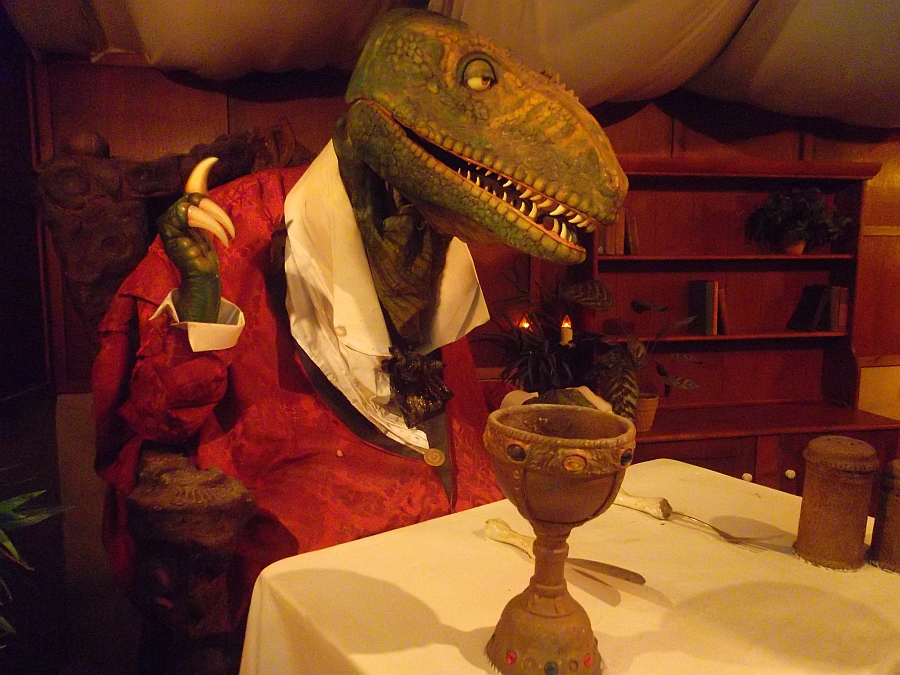
Several readers may recall Marc's having covered Blackgang Chine's The Triassic Club before. After our return this Easter to view the newly installed robosaurs of Restricted Area 5, I decided to finally complete this little project which I had actually begun a year ago, that of accurately illustrating the gentlemanly trio (which, for me, also meant accurate period garments, naturally). This was not only overdue but was especially necessary, since the inclement weather during the latter part of our Isle of Wight visit prevented me from drawing a dinosaur on Shanklin beach as I did last time.


All the drawings are art card size at 2.5 x 3.5 inches (so you're viewing them larger than actual size on screen). The lord and master of the trio, Darwin the Allosaurus was the first to have been drawn and completed last year. Louche, aristocratic and lasciviously suave to reflect his voice and speech. 'Come in. Oh, do come in...'


In completing the others this time round, I found myself unintentionally drawing them in greater detail and spending longer on each. Other than Darwin himself, we're never told which specific dinosaurs his companions are. Oscar the pianist is presumably an ornithomimosaur of some sort. He seems to have effectively become an extant ratite in this drawing, which is especially unavoidable when all one sees is his head and neck. I replaced the beer glass of the original model with a tankard. Whilst I've tried to keep the eyes of the others fairly avian in terms of their visible components, I deliberately drew Oscar's with a distinct iris and sclera to keep the wild-eyed, permanently alarmed expression of the original. It was too comical not to.


 I initially wondered if I could turn Wallace the butler into an Ornitholestes, given that his generic theropod appearance seemed to afford free rein, but I was reminded by Marc of the sickle claws on his feet. A dromaeosaur, then. I think he became my favourite drawing of the three. Though the new(er) audio recording of his voice is that of a squeaky, fretful, hapless underling, Marc informs me that he originally possessed an altogether loftier tone. I tried to reflect that slightly supercilious yet put-upon expression. 'The Master is expecting you. He's always expecting something. And guess who has to get it for him? Me, that's who!'


As a bonus, I thought I may as well share this, too. You are already familiar with our saurian portraits, but here are our avian ones (because I can, and because confusing people seems to be my fort�). Marc (the magpie) and I enduring that aforementioned inclement weather on Easter Sunday.


Thursday, April 24, 2014

Restricted Area Five

After 42 years and countless family photos, Blackgang Chine's much-loved 'Dinosaurland' is no more. The majority of the park's endearingly grotesque and climbable fibreglass creations have, alas, gone the way of their living counterparts. However, this is not to say that the park has given up on saurian-themed clifftop gardens - rather, they've been busy developing a revamped Dinosaurland, one in which the creatures aren't content just to stand there looking less-than-pretty. That's right - they've only gone and bought a load of rubbery robosaurs. Welcome, then, to the enigmatically named Restricted Area 5...home to the some of the largest ugly dinosaurs in Britain! So it goes.

All photos by me, unless marked 'NP', in which case they're Niroot's.


Predictably, Restricted Area 5 is presented as a sort of low-rent Jurassic Park, complete with flashing red warning lights and inadequate 'electric' fences, although park owner Simon Dabell has sadly not been seen wandering the grounds in all-white garb and carrying a cane while affecting the appropriate accent. There's a decent array of robosaurs on offer, and they range from the respectable to the downright atrocious. For whatever reason - and it's probably to do with designers not feeling the need to 'monsterise' them - the herbivores fare better than the carnivores. Among the best is the below Iguanodon, which certainly has its problems (wot, no pinkies?) but is a decent effort.

NP

Nearby is a sad-looking (and very large) Pachycephalosaurus, capable only of waggling its head up and down and making mournful moaning noises. Here, Niroot tries to offer it some consolation. Meanwhile, a Stegosaurus just down the way, while looking permanently startled, is still not as bad as all that - various features of its anatomy might be Plain Wrong, but it's a fetching model nevertheless (I'm sure the paint job helps a lot), and benefits from a particularly spectacular vantage point.


RA5's centrepiece is a gigantic sauropod (below), which (along with every other robosaur) remains frustratingly unidentified in the attraction, but has been named in the press as Argentinosaurus. It's odd that none of the dinosaurs have labels; although anyone with the slightest interest in dinosaurs will be able to spot what most of them are supposed to be, there are one or two oddities that take a little guesswork. One gaggle of small theropods (that wave their arms about and emit JP Dilophosaurus noises) appear to be Ornitholestes, based on their approximate size and erroneous 1990s-style nose horn, but it's impossible to say exactly. While a little frustrating, it might be for the best, in the end - without any museum-like labels, the attraction sheds all educational pretensions, making it apparent that the whole thing's just a bit of fun. Or quite a lot of fun, as it happens.

NP
One of the Ornitholestes-things.

The sheer size of the Argentinosaurus does impress, and I appreciate the row of dermal spines - a rare example of aesthetic flair on a model such as this. The towering height of the beast allows it to be seen, looming above the treetops, from the other side of the park. What with the cliffs of the Isle of Wight's southern coastline forming the backdrop, it's certainly quite a sight (it helps that the model looks, shall we say, more convincing from a distance).

The park's other truly giant star attraction is a honking great Tyrannosaurus, which at 16 metres from nose to tail is rather bigger even than the real deal. Clearly JP-based, it boasts hilarious googly eyes (with blinking mechanism), horribly deformed legs, and what seems to be a plantigrade posture. It's a real hoot to be around, particularly as the park have cunningly given its growling enough rumbling bass to dislodge fillings and cure any constipation among park guests.


It begs the question: why not just have a T. rex sit-standing on its feet, bird-style?

Hello everyone. NP

A typically Blackgang sense of humour is maintained throughout RA5. Various signs warn of the danger of literally losing one's head to a dinosaur bite, while another advertises the precarious position of 'T. rex keeper'. Unfortunately, they are sure to enrage dino-nerds everywhere by putting an apostrophe in T. rex. An apostrophe! What fresh madness is this!?

Insert 'Hitler reacts to Blackgang T. rex signage' Youtube poop here.

RA5's other theropods are, alas, predictable robosaur dreck. Naked dromaeosaurs (that make cougar sounds) are one, sadly predictable, thing, but a spitting Dilophosaurus with a bloody frill is quite another. IT WAS TWENTY-ONE YEARS AGO, GUYS. If there's one thing to be said for the Dilopho-thing, it does allow for a good photo opportunity (see below).

I've got one up on Nedry. NP
Awful model, FANTASTIC view. Two things that rarely go hand-in-hand, but that's Blackgang for you

Overall, RA5 is a worthy addition to Blackgang - a fittingly kitsch and silly update to the beloved Dinosaurland that's sure to entertain the park's many visitors from now until the time when the models tumble into the sea below (or their rubbery skins fall to bits - whichever is sooner). While it's sad to see the old Blackgang dinos go, a park like this can't trade on nostalgia forever, and one can hardly blame them for wanting to have something novel to pull in the punters.

That said, a small number of the old models do remain, and are just as popular (mostly as improvised climbing frames) as they always were. Among them is what I have christened 'Stegoslug', the hideous, sprawling stegosaur with a plain adorable face, alongside the Polacanthus, Scolosaurus and (for whatever reason) Doedicurus. Some things just never change.


NP

 One last thing worth mentioning...this pterosaur. Its face. That is all.


Wednesday, May 30, 2012

Blackgang Chine: Part 2: The old Triassic Club

In addition to its vintage 'Dinosaurland', Blackgang Chine has one other major Mesozoic-themed attraction. Much like the giant, brightly-coloured fibreglass mushrooms (occasionally with faces) that dot the hillside in various areas of the park, it is quite delightfully unhinged. Step right this way!

The Triassic Club was first 'discovered' in 1994, following a major landslide that necessitated the relocation of several major attractions (including a replica cowboy town). As is usual at Blackgang, the premise is explained by way of a pleasingly silly rhyme.

Lots of people have drawn dinosaurs in rather gentlemanly outfits, presumably because it's a vision that never ceases to be hilarious. Blackgang went one better, and stocked the Triassic Club with full-size robot beasts decked out in formal finery. Guests are greeted by Wallace, the butler, who complains witheringly about the master's demanding nature. He also requests that you kindly weigh yourself on a set of scales that denote which course of the feast you are most suited to becoming.

Once weighed, it's time to move on to the next room where the master awaits! He introduces himself as Darwin the Allosaurus - "whom some have the cheek to call the 'other lizard'" - and intones in a louche, aristocratic manner that his guests "sssmell sssscrumptioussss". Requesting that the starter come forward, he nevertheless rejects the notion of eating any vegetarians, explaining that they tend to stick in his teeth.

At a nearby piano - and apparently enjoying a hearty ale - is Oscar, whose wide-eyed, stern facial expression is just priceless. When realising that his drawling, salivating monologue isn't winning his guests over to the idea of becoming lunch, Darwin laments that he'll have to sing for his supper again. And so Oscar strikes a chord...

(You might have to turn your volume up a bit, sorry!)


I've always enjoyed this attraction. Except when I was a small child, when the idea of a leering, toothy dinosaur speaking in a haughty aristocratic accent scared the hell out of me. Granted, the animatronics are hardly Disney-calibre, but then it wasn't made on that kind of budget (and it's getting old). One final thing worth mentioning - before a refurb a couple of years back Darwin had a different soundtrack that was actually far creepier. Happily, someone's uploaded it for posterity! Enjoy!

top social