Showing posts with label museum visits. Show all posts

Monday, November 9, 2015

Mighty Bones: Museum f�r Naturkunde Berlin

Berlin's a fascinating city and all, drawing people for its rich, tumultuous history as much as its present-day reputation for 'cool' (whatever that is. Like I'd know). But in the end, dinosaur enthusiasts will only have one destination in mind upon arriving in the city - the Museum f�r Naturkunde, home of the certified Tallest Mounted Dinosaur Skeleton in the World�. I visited on my second day in the city, and let me assure you, man-sized humeri were just dancing in front of my eyes before that. No amount of refreshingly inexpensive beer was going to distract me on my pilgrimage to the holy hall of bones on the Invalidenstra�e. It doesn't disappoint.


Two skeletal dinosaurs compete for the status of the museum's 'icon' in the public imagination - and it's amusing to think how they are near opposites of each other. On the one hand, there's the towering mounted Giraffatitan - in reality a composite, not that most people will ever know. It feels almost industrial in its massive sturdiness, like it was designed by Isambard Kingdom Brunel with the purpose of allowing express trains to traverse a canyon while simultaneously flaunting the engineering prowess of the Saurian Empire. In short, it's every bit as breathtaking as you might expect.


Of course, the glorious setting helps enormously in showing the beast(s) off. The dinosaur hall is uncommonly bright and airy, and spacious enough to allow views of its centrepiece attractions from virtually every angle. It's one thing to finally be able to size up the museum's Giraffatitan mount in person, but quite another to be able to wander around it and take in the sheer size of its columnar forelimbs, the breadth of its ribcage, and just how high its (comparatively) tiny head cranes over the puny primates below. Yes, it's awesome. Poor old Dippy nearby can't help but be overshadowed.


Just because you'd otherwise require a decent pair of binoculars to view it, there's a cast of the skull mounted at ground level. It's a nice idea, particularly because one can forget the broadness of the muzzles on these animals when one's only viewing two dimensional skeletals. It probably didn't have a terribly pretty face, but then at least it wasn't Camarasaurus.


Of course, Giraffatitan is famously joined by other stars of the Tendaguru formation. To its right sits Dicraeosaurus, it of the curiously short neck and tall neural spines. I'm very fond of this mount of this compact sauropod - I think it's because it seems to be bending down to greet us, and smiling with it.  (You'll note that all of the Berlin sauropods sport just the single thumb claw on their hands. It makes me happy.)


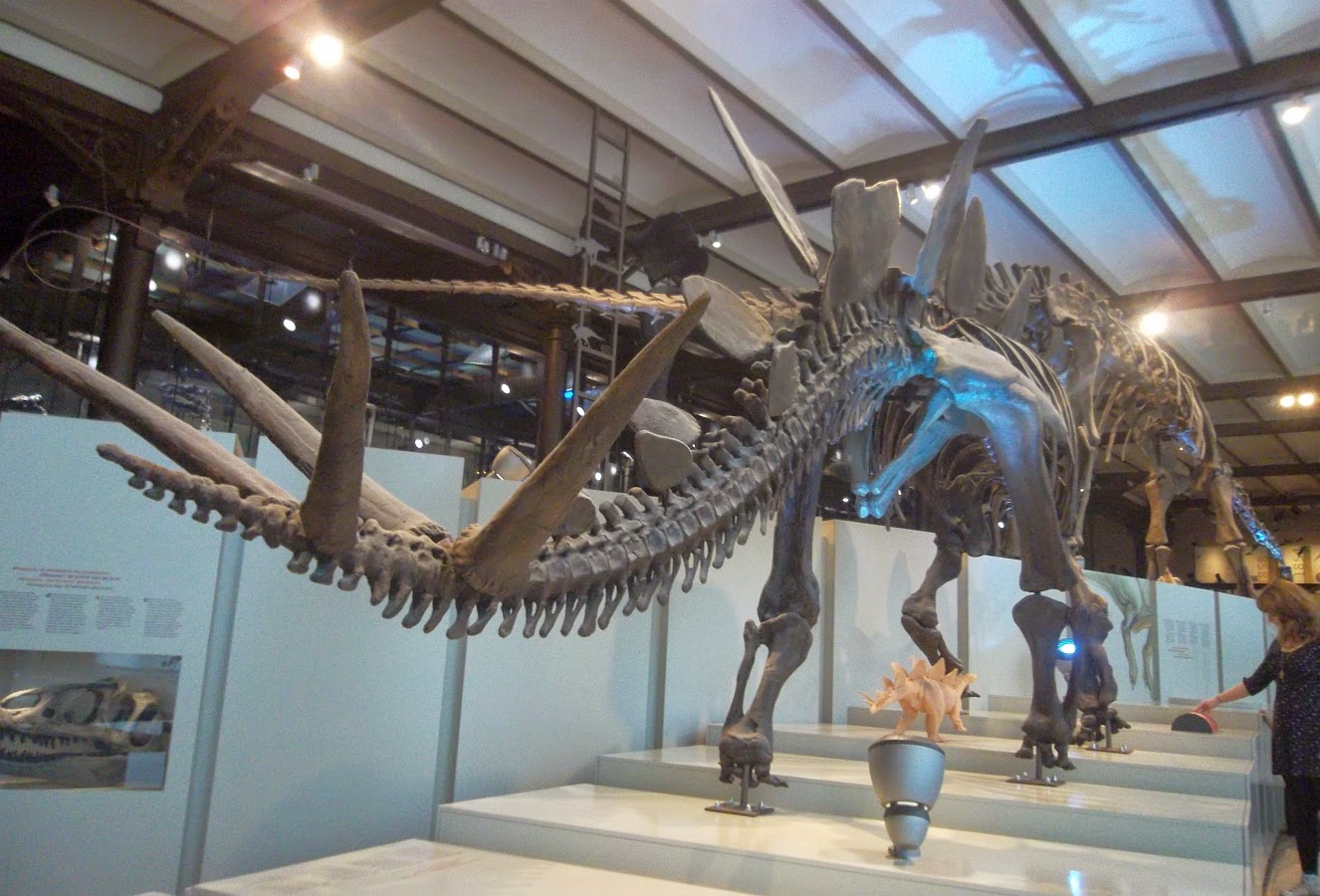
To the left and slightly behind the Giraffatitan sits Kentrosaurus, which while looking notably more dynamic than before its overhaul (that super-spiny tail is almost being brandished at passers by), it still sports curiously sprawling forelimbs. Huh. There's also the matter of that much-disputed pair of spikes, which sit on the shoulders...for now.


Oh, and there's also Dippy. Why the American Diplodocus carnegii among all these African animals? As was explained to me by a certain highly talkative German scientist (let's call him 'Dr M'), diplodocid material is known from the Tendaguru, but not enough to mount anything near a complete skeleton; therefore, Diplodocus is used as a stand-in. Also, the museum were given that cast back in the day, and it's just too cool not to use.


Ahead and to the left of Dippy, Elaphrosaurus is mounted as if pursuing Dysalotosaurus. For those more used to seeing Morrison formation animals, the latter is quite obviously a Dryosaurus-alike, and has indeed been sunk into that genus in the past. However, Elaphrosaurus is an altogether stranger proposition. This mount, posed as if running, emphasises the theropod's unusual legginess; it was probably quite fleet of foot for its size. However, what's truly bizarre is the combination of long legs with a very long, shallow torso. The arms and head on this mount are necessarily speculative and distinctly predatory in appearance. One can't help but wonder if, had these parts been sculpted following the publication of beak-mouthed Limusaurus, some rather different decisions would have been made. Still, it remains impossible to say exactly what this animal's dietary habits were.


A view from behind really helps emphasise how long and lean Elaphrosaurus was.


Adjacent to Elaphrosaurus is another Morrison stand-in - Allosaurus fragilis, which looks like a real bruiser next to the lankier African animal. Apparently, this mount was deliberately made as 'generic as possible' and is not intended to represent a single specimen, simply because it is really just a substitute for fragmentary Tendaguru allosaurs (and you thought his shoes were made of leather). A real Tendaguru allosaur femur is displayed in a case nearby. In spite of this, it can't help but draw attention to itself because of the stunningly detailed fleshed-out model head that somebody saw fit to affix to the front. Some have argued that it doesn't really work, but I'd argue that it does, if only because of the dividing glass partition (the head juts out into the admission kiosk/cloakroom area). It's also really gorgeous, and I'd like a copy for my living room, please. I'll update this post with a link to the Kickstarter campaign shortly.


I haven't yet mentioned that other iconic dinosaur; you know, the one that's the polar opposite of a gallumphing great sauropod to gaze upon, ye mighty, and despair. It's Archaeopteryx, of course; a delicate little fellow sequestered away in its own special alcove, an impossibly dainty and beautiful specimen treated quite justifiably like a masterful work of art. Cue heavenly chorus*.


The Urvogel isn't the only Solnhofen specimen on show of course; consider this beautiful Rhamphorynchus, just one among a huge number of stunningly preserved examples of the Solnhofen fauna. There is an emphasis on the contemporaneous (or near-as-damn-it) nature of the Solnhofen and Tendaguru ecosystems - helping to build a wider view of the Jurassic world, rather than one limited to one locality.


There's a lot more to the museum than this one hall, of course, including some sublime award-winning taxidermy featuring Archaeopteryx's extant relatives. And I may well get to all that in a future post. For now, however, let us close on a photograph of what Brian Switek tastefully referred to as 'dinobutt' over on our Facebook page. Enjoy.


*Credit to Peng.

Saturday, May 2, 2015

Down on the (former) Dinosaur Farm

The Isle of Wight seemed faintly magical to me as a child - I mean, there was Blackgang Chine for a start, but where else could you pull off a country road with stunning views of the sea, cliffs and open downland, drive down a track, enter a farmyard barn and be surrounded by fossils and dinosaur art? (No, don't tell me where else you can do that. I don't wanna know.) The Dinosaur Farm museum, as it was back in the '90s, was stupendously exciting to a dino-entranced kiddiwink - it felt raw and unpolished, with fossil hunters actually preparing their finds on-site, and seemed to show the (very fragmentary) reality of finding fossils. Unfortunately, the museum closed a few years ago - but it was swiftly reopened by former staff members, and is now better than ever.

(An aside: I visited with Niroot, who took most of the photos you see here. I will mark the pictures with 'NP' as appropriate. Also, I'll probably get various small details wrong here; please correct me in the comments.)

Dinosaur Expeditions CIC now run the old barn as their 'Dinosaur Expeditions Centre', a showcase for local fossil hunting (as the name suggests, they also run fossil finding trips in the area). In addition to a lot of fascinating old bones, there's also a special emphasis on palaeoart. The above diorama (featuring a former Minmi model being slowly transformed into a half-size Polacanthus, hence the head) features no less than the largest Sibbick painting ever as its backdrop. Our wonderful host Oliver Mattsson provides some sense of scale. Absolutely gorgeous, of course (and the painting's pretty good too).

NP
The painting features a host of Isle of Wight dinosaurs, including non-avian coelurosaurian theropods (here restored as small dromaeosaurs), iguanodonts, a brachiosaur and the spinosaur Baryonyx. The flora is also based on the authentic palaeoflora of the region, and includes at least one species (the broad-leafed plant next to Baryonyx in the below close-up) never depicted before. It's a stunning, richly detailed piece that rewards closer inspection, as more and more animals become apparent. The two birds resting on a log just off centre are particularly easily missed.

NP
Naturally, I'm drawn to the big theropods, and the Baryonyx has a typically Sibbickian colour scheme, with a dull grey-brown base being interrupted by vibrant blue, yellow and burnt orange striped and dappled patterns. This restoration appears unusually hump-backed at first glance, but this is mostly down to the stooped posture (and hey, Baryonyx did actually have some pretty tall verts, even if they weren't as ridiculous-looking as those on some of its relatives).

NP
The Minmi/Polacanthus-to-be that forms the centrepiece of the three dimensional part of the diorama is still very much a work in progress, and currently sports an adorable cardboard head. Oliver showed us a box of spiky osteoderms, sculpted by himself, that will be painted and attached in the near future. No doubt a Gastonia-like head will follow (the head of Polacanthus itself being yet unknown).

NP
Opposite the diorama, the Centre boasts an original Bob Nicholls piece, 'live-painted' during the BBC's Live From Dinosaur Island series back in 2001 (a week-long event during which, sadly, nothing particularly spectacular was found). It's another huge painting, so I thought it'd be worth picking a shot with another human scale bar - even if that happens to be me. Apologies. Unlike me, the Nicholls artwork is lovely - the Neovenator and unfortunate iguanodont sport very fetching stripy colour schemes, and the palaeoenvironment is wonderfully realised. Apparently, there would likely be more vegetation included if this scene were to be painted today - but such is the nature of the science.

NP
The Centre can even boast one of Mark Witton's lifesize giant pterosaur models, once exhibited in London (see Darren Naish's article from the time, featuring a seemingly teenage John Conway), saved from an ignominious fate of rotting outside Portsmouth University and serving as an impromptu bed for drunken students to pass out on (possibly). What a stunner! While it was unfortunately damaged during its time outdoors - and much of the beak was chopped off in order to get it into the barn in the first place - there are plans afoot to resculpt the missing parts and stick 'em back on as required. Hurrah!

NP
And speaking of giants...the Dinosaur Expeditions team are currently working on a mounted skeleton of the island's brachiosaur, based on scaled-up elements of a juvenile specimen. Upon completion, it's set to be the largest mounted dinosaur skeleton in the UK. There's still a fair way to go, of course, but it's worth noting that a fair number of elements, including ribs and vertebrae, are in storage nearby and due to be mounted in the near future. I'd love to come back next year and see how far along they are with this - it should be spectacular even before it's finished.

NP
In all the excitement over the wonderful palaeoart on show, it's easy to overlook the fossils - which are, of course, the very reason for the Centre's existence. Just as with the more 'blockbuster' Dinosaur Isle museum over in Sandown, there's a lot of original, unique material on show that a more casual visitor might miss. The above case contains rare bits of Polacanthus, namely the ilium and a small section of the sacral shield (fused armour over the hips), which is certainly special enough in itself. However, what to make of a tiny lump of bone nearby, placed on a stand all by itself?

NP
This small piece of Polacanthus armour is, in fact, the only one of its type known. Originally posited as being part of a small 'tail club', the exact nature of this bony chunk is currently a matter of contention.

NP
Elsewhere, this cut 'n' polished Neovenator caudal vertebra is particularly eye-catching, although perhaps I am just drawn, magpie-like, to Shiny Things. Niroot was also especially taken by this specimen - Penny Newbury certainly did an excellent job.


Perhaps the museum's most significant collection of theropod parts consists of the most complete collection of Calamosaurus foxii bits anywhere - some collected by Oliver. These include the only known remains of the animal's leg (a tibia and metatarsals). Precious little is known about this small coelurosaur of otherwise uncertain affinities, and the Favorite Co. Velociraptor skeleton model is there mainly to illustrate what a small coelurosaur looks like. (The '90s-style nekkid dromaeosaur toy seems like an odd pick, although Oliver, at least, does explain to visitors that coelurosaurs are now thought to have been feathered.)

NP
Somewhat more visually spectacular is this truly enormous Baryonyx vert, which absolutely dwarfs the Calamospondylus tibia placed next to it. Baryonyx seems to be rather overshadowed by its bigger, more specialised relatives these days, so it's good to be reminded that it, too, was still pretty bloody huge. The Eotyrannus restoration here is by Peter Charles Montgomery*, and is one of a series of pieces by said artist on display in the Centre, which also features the excellent work of Beth Windle; they're keen on championing up-and-coming palaeoartists.

NP
Elsewhere, iguanodont specimens are, of course, in abundance - back in the Early Cretaceous, you wouldn't have been able to walk ten metres without bumping into one of the spiky-thumbed ones, eating ferns and mooing and switching between a bipedal and quadrupedal posture like some sort of oversized circus cow. The Centre contains specimens attributed to Mantellisaurus (the smaller 'Iguanodon' mounted at the Natural History Museum in London, for those who've been), the poorly known Proplanicoxa and the 'proper' Iguanodon, I. bernissartensis. While the latter animal makes for the more spectacular fossils (being a proper big ol' lump of an ornithopod), it's always fascinating to see specimens of its lesser-known relatives.


They've got sauropods too, of course - after all, the discovery of the 'Barnes High' sauropod led directly to the creation of the Dinosaur Farm back in the day. Why, there's an entire lovingly-put-together display case containing various sauropod specimens, as (partially) shown above. Incidentally, the museum-quality replica on show here is the Wild Safari Brachiosaurus, which I happen to have standing in my kitchen.

NP
And finally...upon arriving at the Centre, one can't help but spy this old fella lurking in the background, looking rather worse for wear. As I recall, this model was created to promote the Dinosaur Farm, and was parked near the otherwise quite inconspicuous entrance in the glorious tradition of the USA's roadside dinosaurs. Decrepit as it may be, I'm glad that that someone decided to hang on to this old guy, rather than consign him to a Blackgang-style scrapheap.

In all, I'm very glad we took the time to drop in on the Centre. The dedication exhibited (almost literally) by the volunteers running the place is truly exceptional - inspirational, even. It's run by dinosaur enthusiasts, for dinosaur enthusiasts, with nary an apology in sight. Although there's already plenty of wonderful stuff to see, perhaps the best aspect of the Centre is the huge promise that it holds - and as I'm sure you can imagine, I'm particularly excited about its potential as a new centre for exhibiting and celebrating palaeoart. Many thanks to Oliver for showing us round and doing a sterling job of explaining the various specimens - I hope we can meet again next time Niroot and I are on the island! (The first round's on me.)


*Warning: slightly ugly website, may induce Geocities flashbacks

Wednesday, February 11, 2015

'It's your turn now.' Dippy and the Blue Whale

'It's your turn now.'
Ink on watercolour paper, 202 x 100mm.


Scarcely had I mentioned how well Sophie the Stegosaurus complemented the presence of the beloved Diplodocus at their respective entrances to London's Natural History Museum than news of the latter's planned retirement emerged, apparently splitting the public and experts alike into 'Team Dippy' and 'Team Whale' across social media.

Of course I'm sad -- very sad -- to see 'Dippy' retire (no, I don't much care for the name either, but that's another story).  For me as for so many others, it has been the museum's de facto mascot and symbol for as long as we can remember. And lest our readers forget, sauropods are among my favourite dinosaur groups. My own 'saurian portrait' is a Diplodocus, for heaven's sake.

 'However, change, or its refusal, is not within our gift.' I welcome the blue whale with happy, if subdued, acceptance. Of the many voices in its favour, Michael Rundle of Huffington Post UK encapsulates it best for me, not least because he puts forward the case with great respect and affection for both without any of the unnecessary aggression and derision I've seen accompany some arguments ('Dippy is fake! A lie!'). My illustration above attempts to reconcile this change in the same vein. The title of 'It's your turn now' speaks both of the whale skeleton's place in Dippy's stead and of the blue whale's fragile existence being celebrated now. I wanted to avoid that dreaded word, 'relevance', much bandied about in this case. Nevertheless, highlighting the blue whale's significance doesn't seem to me to signal a disregard for the Diplodocus. But perhaps I'm not cynical enough on that score.


N.B. This post was prepared ahead of Mike Taylor's post over on SV-POW on the same subject, in which he actually advocates having both skeletons together, a suggestion that I could only be too happy with, were such a thing possible.

Tuesday, January 27, 2015

'Sophie'

The unveiling back in early December of the world's most complete Stegosaurus skeleton at London's Natural History Museum won't have escaped many folks within the palaeo community. Naturally, as the UK contingent of LITC and being within easy distance of the museum, Marc and I were duty-bound to make our own visit to the new treasure, even if we were over a month late (where were our invitations to the official do, pray?).


With over 90% of the original specimen present, 'Sophie' is a permanent addition of which the NHM can be justly proud. Rather than being secreted in the now problematic Dinosaur Gallery -- about which much has been written here and elsewhere -- she is instead given prime position of her own in the Earth Hall, near the museum's Exhibition Road entrance, paralleling that of 'Dippy' the Diplodocus in the central Hintze Hall. Mounted in a dynamic, defensive stance, she occupies a rather swanky platform of serried steps, somewhat reminiscent of the atrium of New York's Guggenheim museum.


This individual was reportedly only a young adult when it died, as suggested by 'some features of the hips', according to the signage. The specimen is also perhaps notable for having nineteen back plates rather than the commonly recognised seventeen. The skull here is a cast, though information on the NHM website seems to suggest that fragments of the original did survive.*

Obligatory photographic evidence of the intrepid goons' actual visit, taken by Nicole Heins -- who once contributed her own guest post!

Our readers will have doubtless seen Bob Nicholls' stunning painting commissioned by the museum as part of the exhibit. From the sublime, therefore, you will now be treated to the ridiculous: this doodle I drew on a Moleskine leaflet a while ago in an unoccupied moment (Marc said to include it in the post, 'fo sho', so there it is).


*I've since been informed by a friend who works at the NHM that the museum does indeed have the complete skull, and that the one on the mount is a 3D print of it!


Friday, June 13, 2014

Dinosaurs of Brussels

Brussels is an intriguing city - home to the European Parliament, breathtakingly stunning buildings, more recent, butt-ugly buildings, fantastic beer, busy but untalented graffiti artists, and countless gift shops stuffed with tiny statuettes of a young boy taking a leak. It's also home to the Royal Belgian Institute of Natural Sciences*, also known as the Museum of Natural Sciences, and confusingly promoted about town using just the word 'museum' (often, but not always, accompanied by a John Sibbick-aping Iguanodon logo). The RBINS boasts the largest dinosaur gallery in Europe, occupying some 300 square metres. Fortunately for all concerned, it's a completely wonderful piece of work, packed with far, far more than the spiky-thumbed ornithopods you were expecting.


Even so, dinosaurs are the stars of the show here, and none more so than Iguanodon bernissartensis, that most quintessentially Belgian of stab-happy ornithischian herbivores. And quite right, too. The logo besides, visitors to the museum are greeted with a giant wooden statue of an Iguanodon in Louis Dollo-style, tail-dragging pose, positioned right outside the entrance. It's a welcome taster for what's inside...


Most natural history museum visitors will be used to seeing a single Dollo-style Iguanodon, a seemingly obligatory inclusion for its historical significance, and often maintained with its classic 'tottering tripod' posture. In Brussels, however, you'll gaze upon a whole herd of the brutes, beautifully presented inside an enormous glass box. A Mantellisaurus atherfieldensis is thrown in for good measure, too (see bottom photo above). It's a positive embarrassment of Iguanodon, and a really fantastic sight. But they're inaccurate, right? Shouldn't the museum point out that heroic Dr David 'Dinosaur!' Norman swept away this vision of Iguanodon back in the '80s? Don't worry, they've thought of that.


It would have been quite easy for the museum to explain it all away on a plaque, so a full mounted skeleton (or nearly full - it's a bit tail-less) is a wonderful inclusion. It maintains the link to the museum's history, while also providing a none-better illustration of how our views about these animals have moved on. Furthermore, it's actually quite rare to see Iguanodon mounted in this more accurate, quadrupedal fashion, and it radically transforms one's perception of this animal - from comedy waddling thumbs-upper to striding ornithopod powerhouse.


In most other museums, the Iguanodon would completely steal the show. Here, they must compete with a panoply of other saurians. On the theropod side, we of course have that most usual of suspects - a mount of the Tyrannosaurus known as 'Stan', or as I prefer to call it, 'Captain Dangleteeth'. Still, it's a nice mount. Gastralia! Vestigial metacarpal! Furcula! Yippee!


Mounted alongside Rootin' Tootin' Rexy is Velociraptor, thus prompting every museum visitor's girlfriend to ask - "How come they were so big in Jurassic Park, then?". (Clearly, I haven't been working hard enough.) There's even an Archaeopteryx In A Box - a rare example of a 3D mount of this dinosaur. While it's lovely to see handsome mounts of the famous names - and especially lovely that one can walk around and admire them from every angle, without any glass screens to get in the way - the museum does also cater for more...unusual tastes.


...Although having said that, Cryolophosaurus is pretty well-known these days. The skull on this cast is more Allosaurus-like than is now thought likely, but this is still an impressive mount,  stressing the surprisingly large size of this quite early dinosaur. Again, the opportunity to examine and take photos of this cast from every angle - the front, sides, even from the balcony above - is to be applauded. Nearby, an interactive display explains the story of how Cryolophosaurus was found.


Cryolophosaurus was one of many 'firsts' for me in Brussels, as was Eoraptor, the basal saurischian that the fossil record seemingly regurgitated purely to bring about an intense furrowing of brows. This mount is easily missed by those running around gawping at the big spectaculars, but is an ideal inclusion in an exhibit that looks at where dinosaurs came from and their continued evolution. It's also a celebration of their massive diversity, and that's where poser sauropods come in.


As someone who grew up with the Natural History Museum in London, I am used to viewing Diplodocus as a stately behemoth, a noble beast to be presented in a solid standing posture on a highly polished plinth, like some mighty military figure of the Jurassic. The RBINS' more modern approach is, therefore, a real delight to behold - here, the traditionally stoic Dippy clambers over the top of the gallery's displays and peers down at a chicken. It's a fantastically playful mount. (NHM veterans may also wish to note the single claw on the hand, a tell-tale sign that this is a much more recent creation.)


Ornithischians (other than Iguanodon) do get their due, too. Near Sir Dodgy Dentures, several of them are clustered together on one base, all the better to compare their various bodily proportions. Perhaps the most famous of the bunch is Olorotitan, and a beautiful cast shows just what is currently known of this animal (although a display nearby promises more to come).


There's also a mount of the lesser-known Amurosaurus, a contemporary of Olorotitan. Here, the incomplete skull cast allows a fantastic glimpse at the animal's frankly absurd dental battery. Again, accompanying displays offer details on the animals' discovery and research conducted by RBINS scientists, which is always a welcome inclusion.


The gallery's spacious interior also leaves plenty of room for this hadrosaur, never knowingly depicted without a nest...


...And a certain spiky-tailed thyreophoran. Actually, I was very excited about this one - it's the first full Stegosaurus mount that I've seen (there aren't any in the UK that I'm aware of). I'm sure there's nothing particularly remarkable about it (in fact, I'm quite certain that this cast is on display in a number of museums in the States in particular), but it provided a heart-warming moment of geekery for me, at least. At last, here was the fancy-backed one in all its chunky-limbed, pin-headed glory...something I've wanted to see since my childhood.


That other great herbivorous dinosaur staple, Triceratops, puts in an appearance too; it's a fittingly dynamic pose, even if that frill looks a bit iffy (or is it just me?). Observant readers may have noted the small models placed beside the skeletal mounts - unfortunately, most of these aren't especially good, with the Triceratops being particularly derpy.


Oh dear. But never mind that; this remains one of the greatest dinosaur galleries I have ever had the pleasure of visiting in a natural history museum (although I'll admit to not having seen so many). It's so enormous, the RBINS can cram in numerous large dinosaurs and still leave room for terribly bored significant others to pace about and shrug, and for children to run around shrieking and generally being a nuisance, as they are wont to do. Although there is a clear route around the exhibits, one is free to wander off, explore, and analyse the specimens from every angle. There are even gorgeous wrought iron staircases and balconies. In short, it's the perfect space to display dinosaurs, and it's utilised brilliantly.

All this, and I haven't even got to the best part. Whereas certain other museum dinosaur galleries shy away from declaring birds to be Actual Living Dinosaurs, the RBINS makes no bones (arf) about it. The place could be dubbed Feduccia's Nightmare. Not only is the message stated explicitly, it's delivered in the most deliciously subtle way through the judicious employment of stuffed birds throughout. While those standing by the skeletons are obvious, I completely missed the numerous specimens hanging from the ceiling at the gallery's entrance, and, well, there's a reason for the chickens. What's more, Cenozoic bird specimens (real ones!) are presented as evidence of the dinosaurs surviving the K/Pg extinction. Presenting: Messelornis, from over 45 million years ago.


Beautiful. I'd love to write more about the RBINS, but my tour was a little whistle-stop. Nevertheless, I think the new mosasaur room deserves an airing, so I'll try and cram in a post about that soon (there are a lot of very cool original specimens in there). But this weekend, I'm off to see more dodgy robosaurs...


*Dutch: Koninklijk Belgisch Instituut voor Natuurwetenschappen, French: Mus�um des sciences blahblah something

top social