Showing posts with label Roy Chapman Andrews. Show all posts

Thursday, April 3, 2014

Vintage Dinosaur Art: All About Dinosaurs - Part 2

Onwards with All About Dinosaurs, a book written by the awesome Roy Chapman Andrews, he of Gobi fossil-hunting fame, and illustrated by Thomas Voter. Now, you know you're reading a vintage dinosaur book when...


Swamp-o-pods! Mind you, All About Dinosaurs must surely lose points for lacking a full-length depiction of brachiosaurs immersed up to the very tip-tops of their nasal crests in murky water. Instead, the animals are rather more convincingly depicted wading their way through a swamp, opposite some seriously gigantic palm fronds. I mean, they're nicely drawn and all, but...geeze. They must be a good four metres long! This isn't to say that mysteriously non-floating sauropods aren't mentioned...


...of course they are. "Sometimes [Brachiosaurus] would poke its head above the surface and look about, just as men in a submarine use the periscope to observe the scene above water." Great stuff. Such a nostril placement would remain the convention until into the 21st century, when someone finally dared to move them a little further down the snout (that Witmer guy might have had something to do with that). It remains the norm in toys, animatronics, and CG artworks...or at least, the crappier ones.

You know, someone ought to gather together some thoroughly outdated illustrations of underwater brachiosaurs - preferably out of copyright - and send them to Ken Ham, politely explaining that they depict animals being overwhelmed by the Biblical flood. It'd be worth a few giggles should he publish them somewhere, or pin them up in his Not-A-Museum. (Blame Darren Aronofsky for this digression.)


Snorkel-o-pods are one thing, but of all the images in this book, I think none quite so neatly encapsulate a bygone age of palaeoart as much as the above. Volcano. Monkey puzzle(-like) tree. Tail-dragging Triceratops. It's a lost world all of its own. The intended focus of this image is the ankylosaur in the foreground, labelled with the obsolete name 'Palaeoscincus'. What's perhaps most notable about this depiction is that, for the time, it's actually very good - unlike many contemporary (and even later) illustrations, the animal has reasonably long legs, a tail that, while too short, isn't ludicrously stumpy, and - sweet Hatzegopteryx above!  - a neck. As is typical of illustrations of 'Palaeoscincus' (another of those genera based on teeth), the animal appears to combine aspects of Edmontonia and Ankylosaurus.
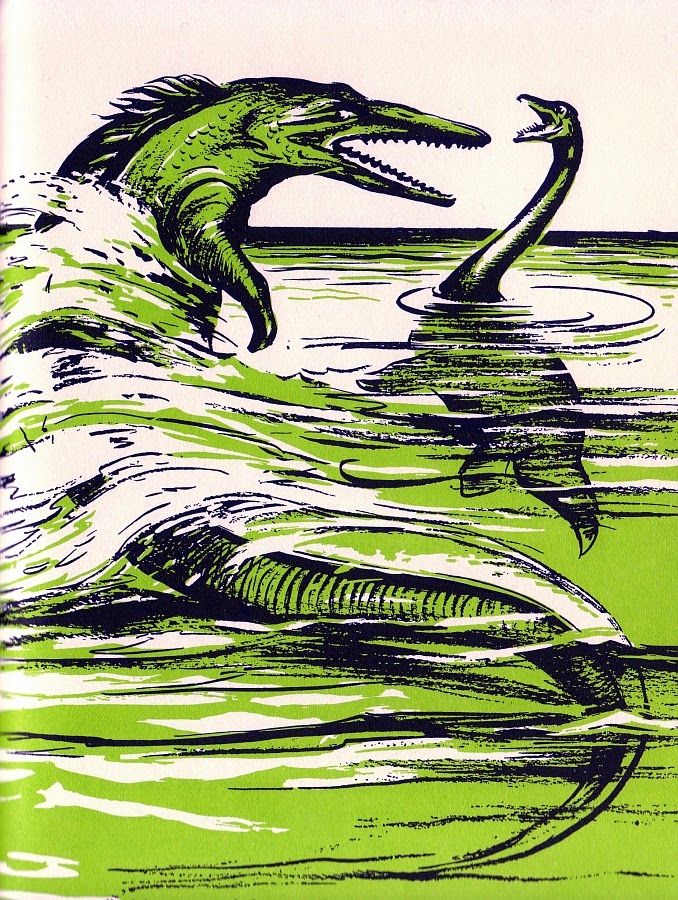

A mosasaur taking on a plesiosaur is another illustration that is simply obligatory for any vintage dinosaur book worth its salt. Er, in spite of the fact that neither were dinosaurs. Typically, the scene will pitch the ferocious aqua-lizard Tylosaurus against the freakazoid plesiosaur Elasmosaurus - a classic clash of the titans to rival even T. rex v Triceratops. Unfortunately, the plesiosaur in the above illustration appears to be a tiddler, and thus looks understandably alarmed at having to face such an enormous, handsomely crested opponent.


Vintage depictions of pterosaurs tend to be as unflattering as descriptions of their palaeobiology (always unable to fly properly, implausibly fragile, and completely useless when grounded). While not all of the pterosaur illustrations in All About Dinosaurs are quite so bad, the above 'pterodactyl' is pretty monstrous - all bat-like wing folds and pointy scales and sinister black eyes. Brrr.


While life restorations are, naturally, what we're most interested in, a great chunk of this book is dedicated to Andrews' fossil-finding exploits in the Gobi - and rightly so. This section is also illustrated throughout, with some of the pieces depicting Andrews' discoveries as they appeared in situ. Hopefully, most enthusiasts of things prehistoric will be able to identify the above remains, belonging as they do to Oviraptor. Voter's work makes it clear that the animal's head has been rather smushed, as if it had walked into the wrong part of Nottingham one night. It's also missing most of its crest, which would later lead to the 'nose horn Oviraptor' meme - in reality, it would have had a tall crest not unlike its relative, Citipati.


Voter's depiction of Andrews' team finding one of their most precious prizes - dinosaur eggs! - is suitably dramatic, with a lone scientist perched atop a monolithic Flaming Cliffs outcrop, with a dazzling sunburst behind. Monoliths...dazzling light...fantastic discoveries...why, there could only be one soundtrack for this. Or you can just shout "I'm king of the world!" But we'll all look down on you for that, culturally snobbish as we are. Particularly as you're sitting there in your underwear.

In any case, Andrews makes it clear that his team went nuts for dino eggs:
"'Bigger and better eggs' was our slogan. Almost every man in camp hunted eggs from morning till night. I found several as did all the others. But George Olsen became the champion dinosaur egg hunter of the world. He had amazing success."
Attaboy, George.


And finally...this illustration is very lovely. Scientists toiling away to reveal the ghostly remnants of long-lost worlds. The theropod, at least, looks approving. Voter turns what might have been a banal illustration of plaster-wrapping into a marvellous reminder of the sheer hard work that goes into the palaeontological science that the rest of us just sit back and enjoy. Wide-brimmed hats off, I think, to Andrews, his team, and palaeontologists through the centuries.

Monday, March 24, 2014

Vintage Dinosaur Art: All About Dinosaurs

While it's exciting enough to get my mits on a book as genuinely vintage as All About Dinosaurs (1953), that this book was written by the legendary Roy Chapman Andrews is an extra special treat. This is a book that's part palaeontology lesson, part autobiography, with Andrews unable to resist relaying a few tales of derring-do. Illustrations are provided by Thomas W Voter, and essentially live up to expectation - these are the tail-dragging, slothful, reptilian flesh-barges of old, the 'great fossil lizards' that now seem as long-dead as the real beasts that inspired them. Oh yes, and a certain sauropod is stubbornly referred to as "Brontosaurus".


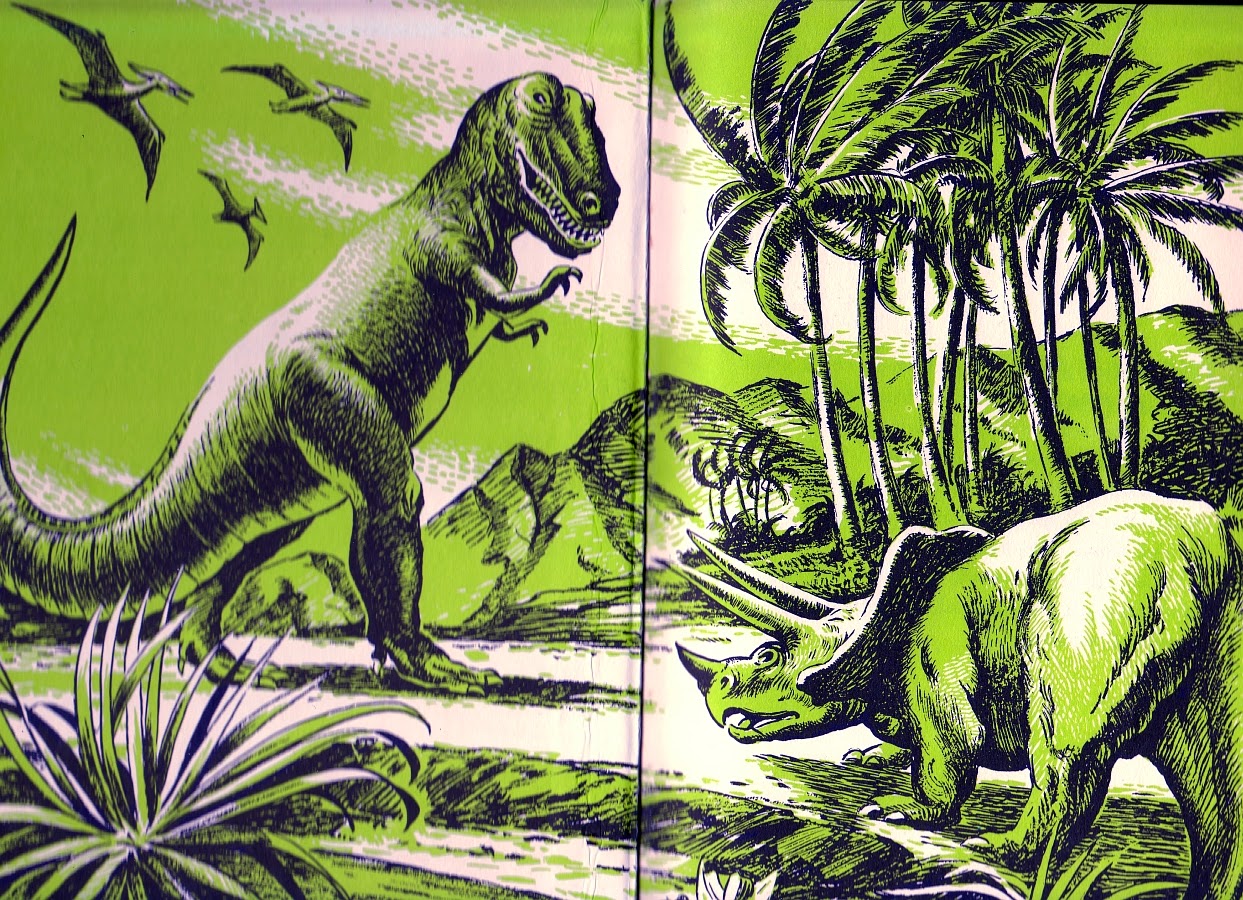
While the cover depicts a theropod that is presumably Allosaurus (based purely on the fact that it has three fingers and is quite large, which is enough to go on for most books of the period), Sexy Rexy manages to appear twice before the title page. The cover's pretty enough, but it certainly can't match the Tyrannosaurus v Triceratops piece below for visual impact - the composition effectively emphasising the towering height of old-school Nonsense Rexy, who seems to be chuckling quietly to himself. I love the palm trees, too - it seems that we rarely see strong winds in palaeoart, and they add that extra dash of drama. Poor Triceratops ends up looking rather lumpen and misshapen here, rather than a well-matched opponent a la Knight. One can't help but imagine the T. rex rolling it along with one foot like a barrel.


The book's second T. rex illustration is a more straightforward depiction of the animal in lateral view (or everything but the tail, anyway), and seems to be inspired by the old T. rex mount at the American Museum of Natural History. An amphibious (or, let's be fair, just swimming) sauropod adds some interest. But we all know what we're here to see.


Deadly dinosaur duels! Rather than play fair and pick on something with its own pointy things with which to defend itself, Rexy here sinks his teeth into "fat, hulking" "Trachodon", the unfortunate, web-handed fodder du jour. Still, the flipper-fingered one does at least put up something of a fight, albeit a half-hearted one:
"There is frantic thrashing for a time as the colossal beasts roll in the slippery muck. Then the Trachodon lies still. Its head hangs loosely, almost severed from the neck by six-inch teeth."
Ouch. Still, what a way to go - at the waggling atrophied forelimbs of "the most terrible creature of destruction that ever walked upon the earth!" (Don't be silly, Roy - everyone knows that's humans. Yeah, take that, conspecifics!)

Just lovely stuff. You can't beat an old-fashioned, salivating description of reptilian behemoths having at it, even if the illustrations are a little more convincingly bloody these days.


Happily, hadrosaurs aren't just depicted as an easy lunch in All About Dinosaurs. As is typical of a mid-20th-century work, they are imagined to have been amphibious and depicted as such, with their crests imagined as aqualungs (a concept so screamingly silly, only a pre-1960s palaeontologist could possibly have thought of it). The creatures do suffer a little from the 'gangly dork hadrosaur' meme that was popular into the 1970s, but I do still love the depiction of Corythosaurus contentedly doggy-paddling its way through a lake (below). There's some great characterisation going on here too - it's possible to sense the furtiveness of the foreground individual, frond in beak, as it glances to the shores where tyrannosaurs might be lurking.


If there is one creature that looks truly, irredeemably derpy, even for the standards of the time (forget not the great work of Burian), it is this unfortunate slug-bottomed monstrosity masquerading as ornithopod pin-up Iguanodon. On the other hand, I have the strangest feeling that this illustration has been 'inspired' by another, although I can't find it for the life of me; reader assistance would be most welcome.


While Stegosaurus fares considerably better in the illustration department, it is once again the recipient of much mockery aimed at its apparent brainlessness. Speculating on why the dinosaurs went extinct, Andrews posits that their tiny brains may have played a part; after all,

"In Stegosaurus, which must have weighed four or five tons, the brain was no larger than that of a small kitten. With such a brain, the animal could barely eat and sleep and muddle through life. The Thunder Lizard  and the other great sauropods were not much better off in brain capacity."

While it's fun to have a giggle at what are to us, all the way over here in Space Year 2014, amusingly outmoded concepts, it's worth noting that Andrews, unlike his contemporaries, did not view dinosaurs as evolutionary failures. In fact, he is dismissive of the notion that dinosaurs were the victim of "racial senescence", or basically just being too long-in-the-tooth (so to speak), and is quick to point out that a panoply of animal clades snuffed it at the end of the Cretaceous, not just dinosaurs.


Of course, a refusal to accept that dinosaurs were the result of Evolution's Difficult Middle Years doesn't prevent Andrews from occasionally being a bit unkind toward them, albeit in a rather tongue-in-cheek manner. This is perhaps best exemplified in the caption for the illustration below, which happens to depict a creature named after him. In the text, Andrews describes P. andrewsi thusly:
"...he was one of the ugliest of all the small dinosaurs. His short, toad-like body seemed to be mostly head. A piece of bone from the frill projected downward on each side of his face. It looked like a long wart. His short legs were badly bowed. The tail was fat and thick. He crawled on his belly. No leaping or running for him...No, I can't be proud of his looks."
Andrews' delicious description of Protoceratops, in addition to Voter's accompanying illustration, probably helped cement the image of the ceratopsian as a sprawling fatty even into the 1990s.  Modern depictions are rather different, but Andrews' unflattering portrait of the animal still raises a smile.


Of course, Andrews is keenest on mentioning Protoceratops in connection with eggs - he was the man who famously discovered the first dinosaur eggs, after all. Unfortunately, Voter's Protoceratykes are quite terrifying - rather than lacking frills (as Andrews describes them), their faces appear to be entirely frills, with eyes and a beak bolted on. The foreground individual reminds me of Mr Sweet from the Doctor Who episode The Crimson Horror. That beak...brrrr.


Next time: more Andrews/Voter! Hooray.

top social