Showing posts with label Tetzoocon. Show all posts

Wednesday, November 18, 2015

TetZooCon 2015

There can't be many conventions that have spun off from a popular zoology-themed blog and equally popular podcast about new tapirs and charging for rambling answers to questions about bipedal combat in deer, so it was very heartening that the first TetZooCon was such a success. Successful enough, in fact, to spawn a successor event, once again host to an impressive array of speakers covering an eclectic range of topics. Only at TetZooCon will you be so well informed about legendary pygmy elephants, bizarre ichthyosaurs, condom-inflated pigeon carcasses and the right circumstances to ask to use your very wealthy friend's Rolls for promotional purposes. It was, once again, a resounding success. (All photos by Niroot unless otherwise stated.)


Darren Naish once again kicked things off, this time with a brief history of the cryptozoology of sea monsters and, in particular, how it evolved during the 20th century. While the 'prehistoric survivor' paradigm was popular earlier in the century, as time and science progressed, so such creatures were ditched in favour of more imaginative beasties, often with their own highly elaborate (and quite bonkers) phylogeny. The Belgian-French author Bernard Heuvelmans, prone to all sorts of flights of fancy regarding poorly documented sightings, is regarded as the 'father' of modern cryptozoology, and rightly occupied a sizeable section of Darren's talk. All very entertaining stuff.


Next up was author and waistcoat wearer Matt Salusbury and the tiny elephants which, it transpires, probably don't exist. One might detect something of a theme, but, quite unlike the likes of Cadborosaurus, the Yellow-Belly and Bighoot, it's quite plausible that a tribe of tiny elephants could exist, and the idea has captured the imagination of explorers, scientists and circus charlatans for centuries. In fact, there are many people who still maintain that there are dwarf heffalumps out there, and when one such individual contacted Matt it spurred him on to an envy-inducing journey to exotic locales and - ultimately - to write his latest book. Matt's was a fascinating tale of the endless, slightly puzzling quest to find miniature proboscideans (non-fossilised), of specimens submitted to museums, dubious sightings rebuffed comprehensively by experienced field guides and mahouts, and PT Barnum's filthy, filthy lies.


Jessica Lawrence Wujek's favourite animals certainly did exist, but definitely aren't alive today - the ichthyosaurs. This was a very entertaining talk, taking a look not only at the bizarre anatomy of the marine reptiles in question, but also the lengths that researchers go to in attempting to collect, study and even categorise them. (Marine reptile phylogeny is quite up in the air, it would seem.) Those of us who are more into dinosaurs and, at a push, if you insist, plesiosaurs, had our 'you know, those daft dolphin ones' perception completely dashed. Who ever knew just how utterly crazy ichthyosaurs' flippers were? (Well, apart from Jessica and the three other ichthyosaur researches in the world, of course.) A pavement of tiny bones, sure - but how about 10 digits, often forking into extra digits, or even digits splitting then being subsumed into other digits? Not to mention the giant eyes and sheer variety in shape, size and dentition, from serpentine early forms to later ones with shell-crushing flattened teeth. Brilliant.


Last year, Darren discussed speculative zoology, and just had to mention the 2002 TV series The Future is Wild, a program chock full of hypothetical futuro-beasts. This year, series writer Victoria Coules was on hand to inform us in entertaining detail just how the program was made. Unsurprisingly, this involved dealing with a fair number of irritating TV network middle-management types, and attempting to make a fun family show for the Americans and a more, you know, serious programme for Europeans at the same time (as the networks demanded). An especially amusing anecdote concerned Animal Planet's demand to know exactly where all the humans had gone, something the programme makers thought didn't really matter. (In the end, Animal Planet decided quite of their own accord that they had all left for planets new on some sort of Space Ark.) The show's CGI hasn't aged especially well, but the scientific thinking behind some of the future creatures was certainly intriguing. If you haven't seen the show, in 100 million years mammals will be reduced to being farmed by spiders, and in 200 million years they'll be entirely extinct, while gigantic squid roam the forests. Of course. I hope PZ Myers hasn't seen it.


David Lindo was up next - birder, broadcaster, writer, naturalist and all-around Superb Bloke. David was full of memorable stories, from his childhood love of birding, his alarming flirting with the twitcher side, his rather poor flirting with women (who didn't much agree to being taken to bleak, windswept islands), and much more besides. Best of all, David was behind the campaign to vote for a national British bird, and had plenty of very funny tales to tell about the campaign - promoting it and people's reactions to it. And to him. Because there are a fair number of racist morons in Britain (thus also explaining the Daily Mail's sales figures). Not that that mattered - with the backing of cor-blimey celeb chef Jamie Oliver and well-meaning friends in PR with a penchant for semi-naked women in masquerade masks, not to mention the birdy NGOs, the campaign was a huge success. David's aim was to increase awareness of the wonderful birds that surround us even in what would appear to be our otherwise quite mundane, grey surroundings in urban and suburban Britain, and he succeeded with aplomb. But which bird won the contest?


This is why democracy is a bad idea.

Palaeontologist David Unwin was due to speak next, but unfortunately had fallen ill. Thus, we moved straight to the palaeoart workshop. This time, the audience were split into 4 teams, guided by Johnway, Mark Witton, Bob Nicholls and Darren. The task was to restore Pterodactylus (represented by John's quite terrible fossil casts), but each table had to do it with a particular preconception in mind; namely, that it was a mammal, lizard-like reptile, or bird. The final table could just draw whatever the hell they wanted.

Photo by Darren Naish.
Niroot and I were on the 'bird' table, which mainly produced a variety of alarming gannets and cormorants with mutant wing-supporting fourth digits (as per Niroot's artsy drawing below). Elsewhere, the mammal table largely produced bat-like creatures, while the lizard table produced sprawling, scaly monstrosities. From the freestyle table, one of the submissions appeared to simply satirise mid-20th century views of pterosaurs; in fact, as I only discovered later in the pub, it was Katrina van Grouw's quite honest attempt at guessing what the animal must have been like. You could write an article on the implications of that, I'm sure...

Speaking of Katrina, she was the final speaker, discussing her magnum opus The Unfeathered Bird, as very favourably reviewed on this blog by someone who is, I'm sure, a delight to meet in real life (and will definitely buy you a drink). I'd heard many of Katrina's tales pertaining to the making of the book before but, honestly, they'll never get old. It's a story of triumph over adversity, how the best meetings happen in pubs (true that), and why it's worth marrying Dutch people...who are good at assembling skeletons. With infectious enthusiasm, Katrina flicked effortlessly from boiling bird carcasses and inflating pigeon crops with a condom to discussing the preposterous anatomy of some of the birds covered in the book. Consider the trumpet manucode; among the birds of paradise, it may appear rather drab, with is business suit of iridescent black-blue plumage. But it can't half make a racket. How so? Why, it has an absurdly long trachea that is coiled up in its chest. Or how about the (multiple) birds with ultra-long tongues that wrap around their heads? You'd never tell from looking at them in the wild, and that's just one of a very many reasons why The Unfeathered Bird is so superb. As I was saying to people on the day, you need this book.

Photo by Darren Naish
Then we went to the pub. The same one as last year, where they have Fuller's ESB on cask. Consequently, I am now broke. Please send tins of beans and the latest dinosaur toys of respectable quality.

All in all, it was another excellent day and a credit to everyone involved. I'm very happy that not only is this evolving into a regular event, but that Darren and John have grand plans afoot to turn the whole thing into a multi-day festival of the TetZooniverse. Now that would be totally awesomebruh.

Tuesday, July 15, 2014

The TetZooCon was on

So, TetZooCon 2014 happened, and you won't hear a bad word said of it among those of us who attended. The event was a spin-off of the incredi-popular Tetrapod Zoology blog, authored by fish-hating mega-brain Darren Naish, and also the similarly named podcast, hosted by Darren and partner in tapir in-joke crime, John Conway. I'm sure neither will need an introduction around these parts; suffice it to say, the event reflected the incredibly diverse range of topics discussed on the blog and podcast, ranging from Dougal Dixon future-bats to false azhdarchid head nubbins, and from mermaids made from papier mach� and string to having a seabird land on one's head. And there was a quiz. And it was bonkers. But more on that shortly. (All photos by Niroot.)

Darren Naish


I'm afraid to say that I didn't have my onetime-coulda-been-a-journalist hat on for this one; quite apart from the fact that it doesn't fit very well any more, I'd paids my money and the choice I tooks was to sit back and enjoy the show. Therefore, I'll be taking the lazy option and basing my (brief) report on the schedule we were all given. I'm sorry. Sorta.

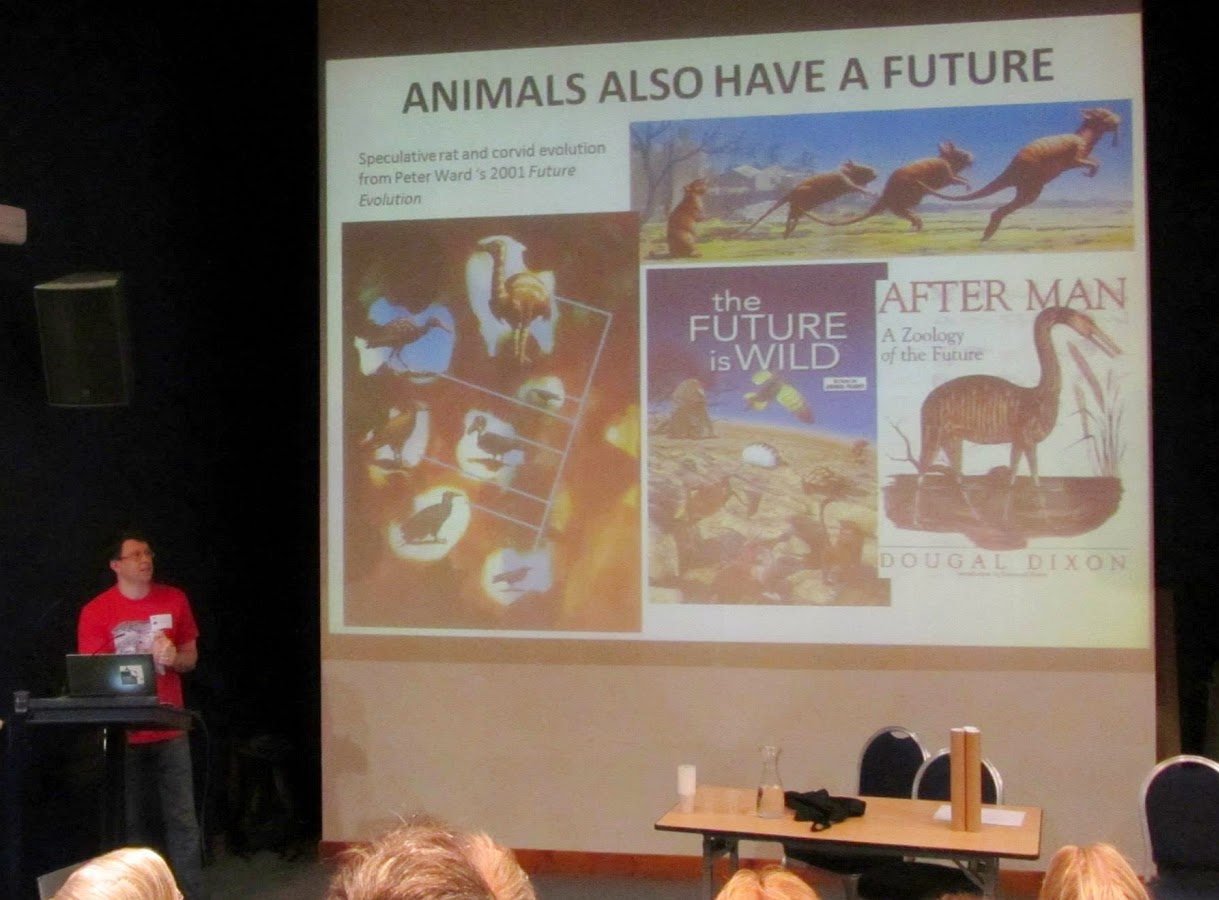
The Con was held at the London Wetland Centre, and opened with a talk from Darren himself on speculative zoology - its history and why we should give a flying flish about it. In doing so, he drew upon distinct strands of speculative zoology, including horrifying visions of the future, making (scientifically informed) shit up about the past, and inventing alternative timelines in which sapient iguanas won World War II. A personal highlight was a look at the work of Dougal Dixon, whose speculative zoological works included dinosaurs that (more-or-less) have since been discovered, silly dinosaurs, the aforementioned flightless bats, and Man After Man, which is not discussed in polite society. Darren also pointed out how, in spite of its apparently 'nitch' appeal, speculative zoology has proven to be incredibly popular; this prompted perhaps the most in-jokey slide of the show, which got a hearty chuckle from the audience. Here's looking at you, Raven Amos.

Mark Witton
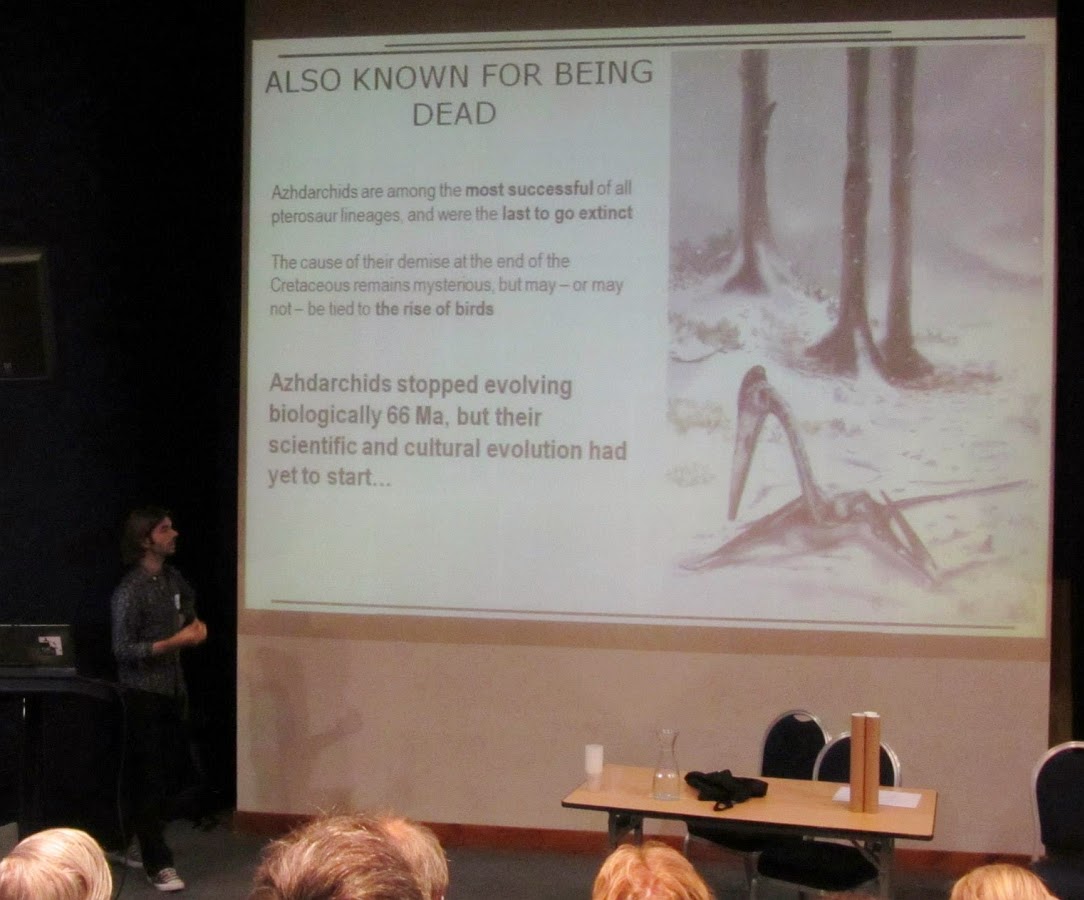
 Darren's talk was followed by Mark Witton's, and the pair gave each other high-fives as their giant medallions swung about their necks (no, not really). Mark was there to discuss the history of research on azdarchid pterosaurs, they of the huge heads, wing spans and, of late, media presence. In doing so, he illuminated the thinking behind a number of palaeoart memes related to these animals, and Quetzalcoatlus in particular (a topic that has been covered on the Tet Zoo blog). Perhaps most notable for readers of this blog, we saw how a very brief paper on bits-and-pieces of pterosaur resulted in illustrator Giovanni Caselli tasked with drawing an animal that was 'really honkin' big', and otherwise left to his own devices. And so, the pin-headed nightmare monster was born. Later came Sibbick's Quetzalcoatlus, itself (like everything else by Sibbick, ever) copied endlessly in spite of mistakes borne of misinterpreted material.

Paolo Viscardi
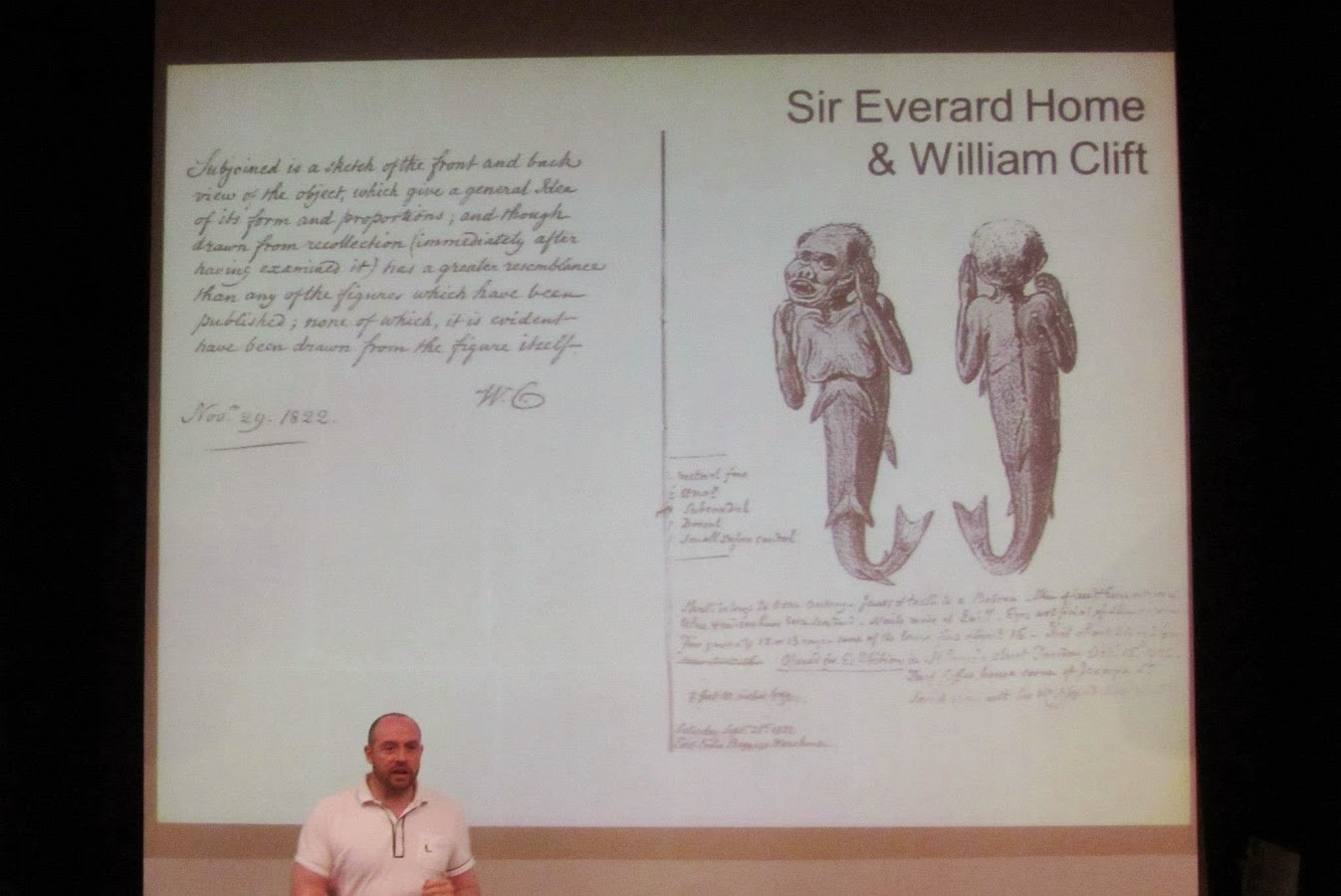
The following two talks both concerned cryptozoology - a recurring subject on the blog, and also tying in neatly, of course, with the Cryptozoologicon Volume 1, which Darren and John worked on alongside Memo Kosemen. Paolo Viscardi's hugely entertaining history of 'Feejee' mermaids revealed how meticulous scientific analysis can yield surprising results from even obviously fake specimens. Long thought of as 'monkeys sewn to fish', it only took a cursory examination of the teeth to show that this most certainly wasn't the case - they had fish jaws! In fact, while the lower half (or at least the outside) was indeed a fish, the top half of each 'mermaid' - as revealed by CAT scanning - was composed of whatever odds and ends the manufacturers had to hand, including paper, wood and even balls of string. As revealed by Paolo, gullible Europeans parted with unimaginably huge sums of money for these forgeries, and - thanks to PT Barnum famously getting his hands on one - there are now forgeries of forgeries. Of course, there was also a look at the history of mermaids in folklore throughout the world, which gave the talk an intriguing anthropological bent.

Carole Jahme
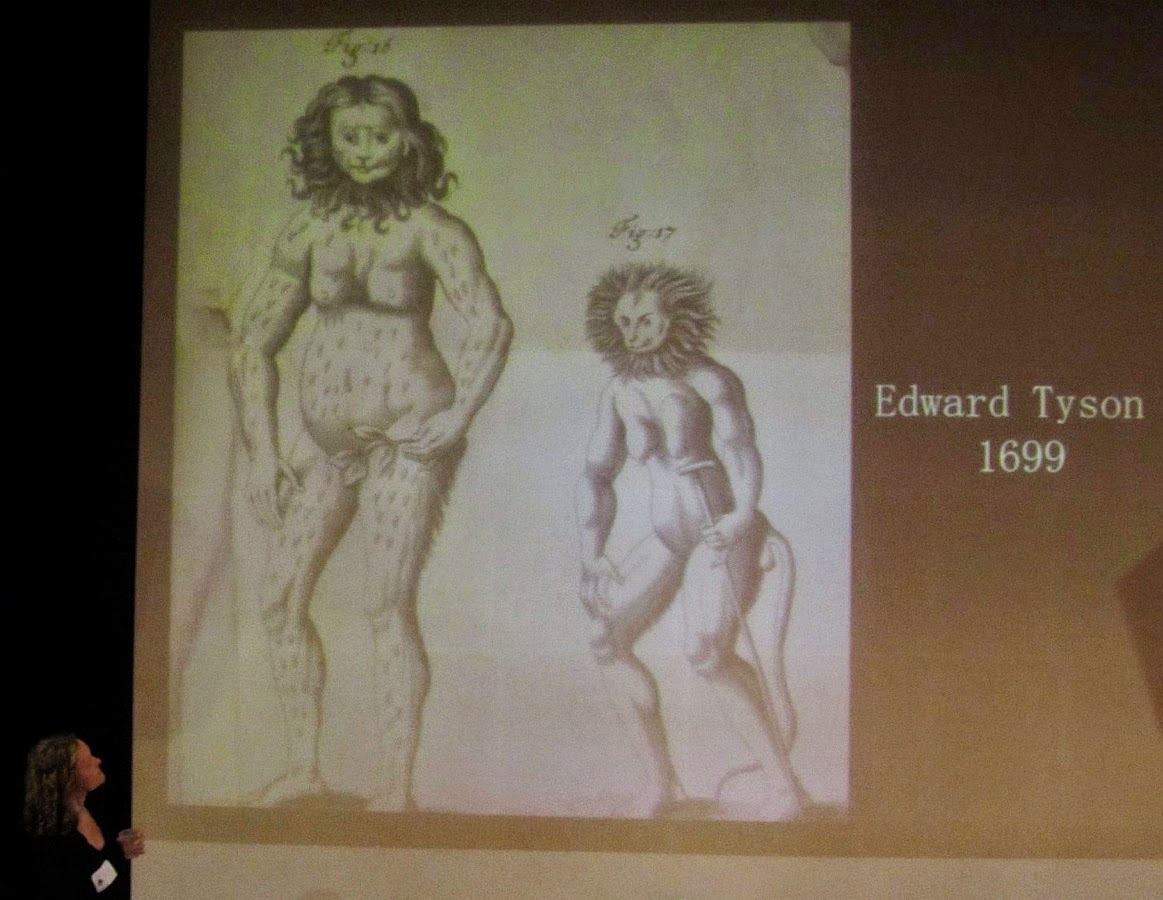
 Similarly, Carole Jahme's talk - 'Was Caliban an Orang Pendek?' - was a concise, but thorough, look at the history of legendary 'wild men', supposedly happened upon by European explorers in Southeast Asia. So authoritative were such accounts, Linnaeus saw fit to include the likes of 'Homo sylvestri' in his Systema Naturae, albeit under the 'Paradoxa'. The title alluded to the notion that, given that Shakespeare moved among the circles of explorers, sailors and scientists, and often incorporated the latest scientific ideas into his plays, perhaps it wouldn't be too fanciful to suppose that Caliban was inspired by accounts of 'ape men' cryptids from exotic lands.

Then there was lunch, with fine company and a nice, cool beer. My first of many that day (I'm like that when I get chatty).

Helen Meredith
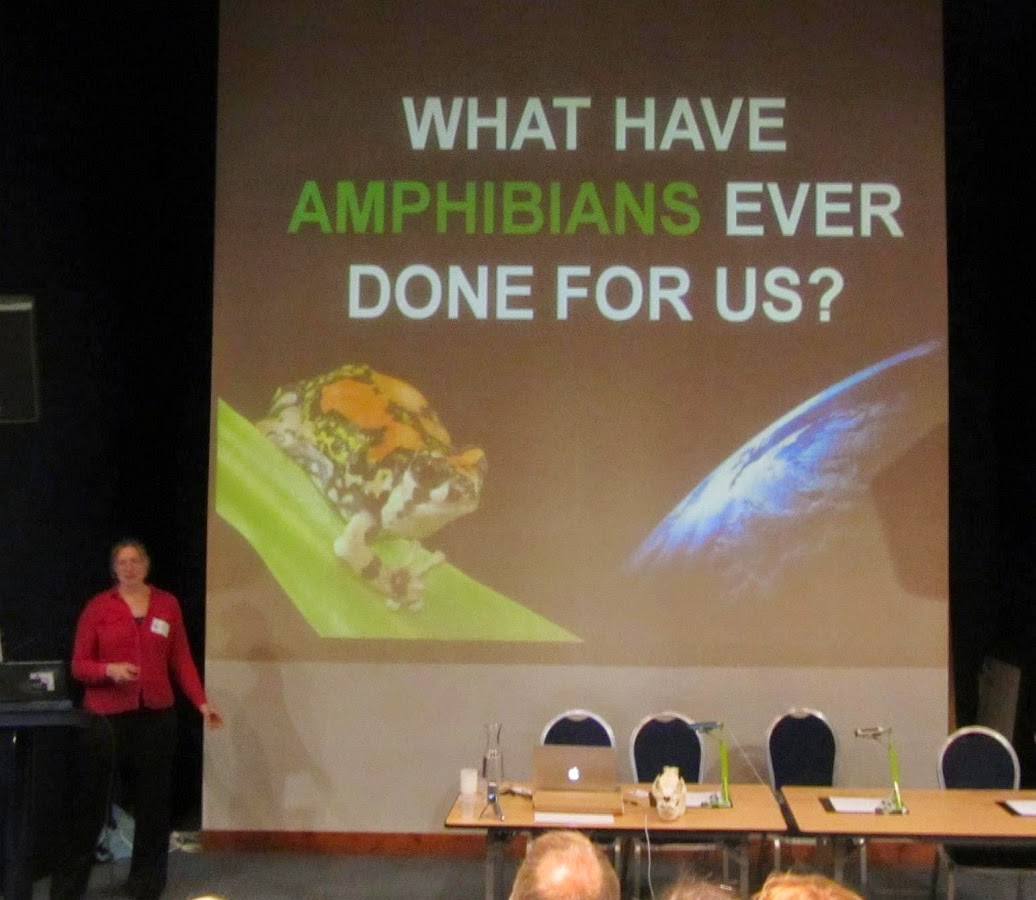
The beer was a tough act to follow, but Helen Meredith did an admirable job. Her talk posed the question: "What have amphibians ever done for us?" (Yes, there were Monty Python references.) Determined to convince us of the worthiness of the squishy-skinned ones, Helen made the case on several very important grounds. They're an important part of countless ecosystems throughout the globe, of course, and they're far more diverse and crazy than many people realise - ranging from terrifyingly gigantic Japanese giant salamanders to minuscule, limbless caecilians, which excite the herpy types no end (as Helen demonstrated with photos of herself and colleagues in the field). But there's more - we can still learn so much from amphibians that can be applied, in particular, to the field of medicine. Of course, there was also a highly entertaining sojourn into the world of frogs secreting psychotropic substances from their skin. You know, licking toad, man. All in all, brilliant stuff.

Mike Taylor
 You'd be forgiven for thinking that Mike Taylor (of SV-POW!) was tripping on frogs when he was reeling off facts and figures pertaining to the awesomeness of sauropod necks, but then such is the ridiculous massiveness - and neckiness - of those most preposterous of dinosaurs. Mike was there to reveal the secrets of sauropods' success; a combination of a big, sturdy gut-platform, a small head, an efficient, avian-like respiratory system, and highly specialised (and numerous) neck vertebrae. It's something that mammals, limited as they are by their evolutionary inheritance, will never manage - even if Mike conceded that giraffes do a pretty good job given their unfortunate circumstances. Oh, and he apologised again for the whole Giraffatitan thing. He hates the name, you know, but what can ya do...

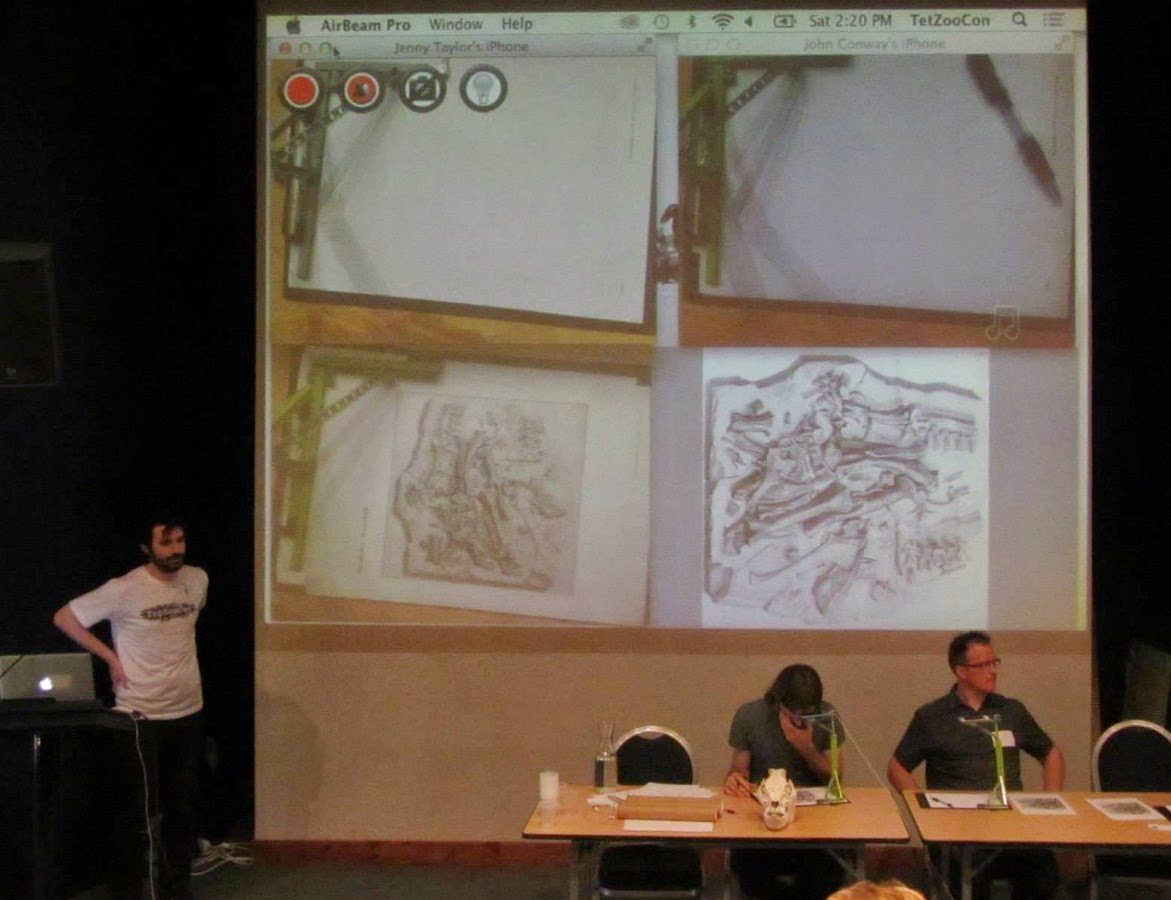
The workshop - the audience could view the artists' progress on-screen. L-R: MC John Conway, Mark Witton, Bob Nicholls.
Dinosaurs continued to dominate in the palaeoart workshop, during which the audience - along with artists Mark Witton, Bob Nicholls, and John Conway - were asked to fashion a life restoration from a jumbled set of bones. With scientists in the audience chipping in with additional anatomical info, the three palaeoartists were able to conclude that the creature was an archosaur with long, sturdy hind limbs and a fat behind, but nevertheless came up with three very different imagined creatures.

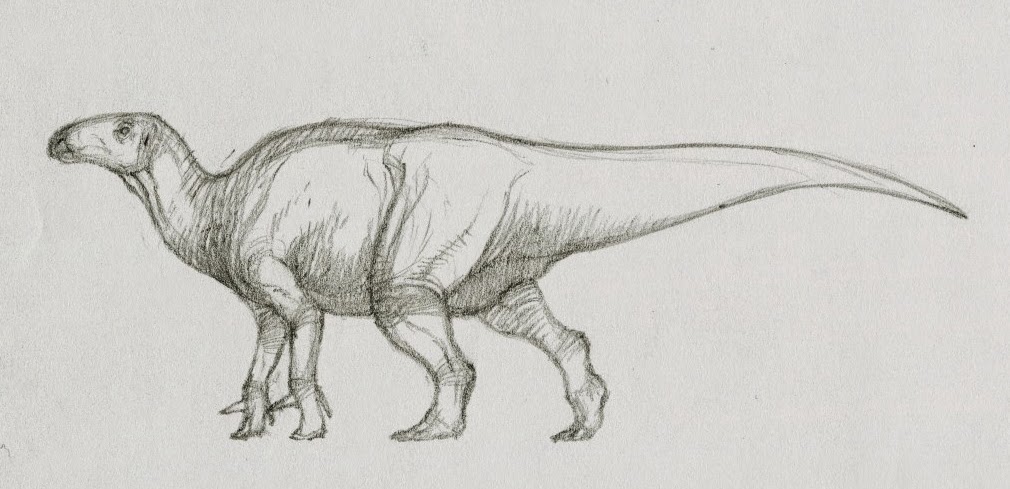
Niroot's creation. ROTTEN CHEATER!
And no wonder - the illustration they were working from was of the Mantell-piece. Of course, quite a number of people in the audience realised this (including me), and consequently handed in any number of variations on an 'old-school Iguanodon'. And yeah, I contributed one of them. I'm a git.

Neil Phillips
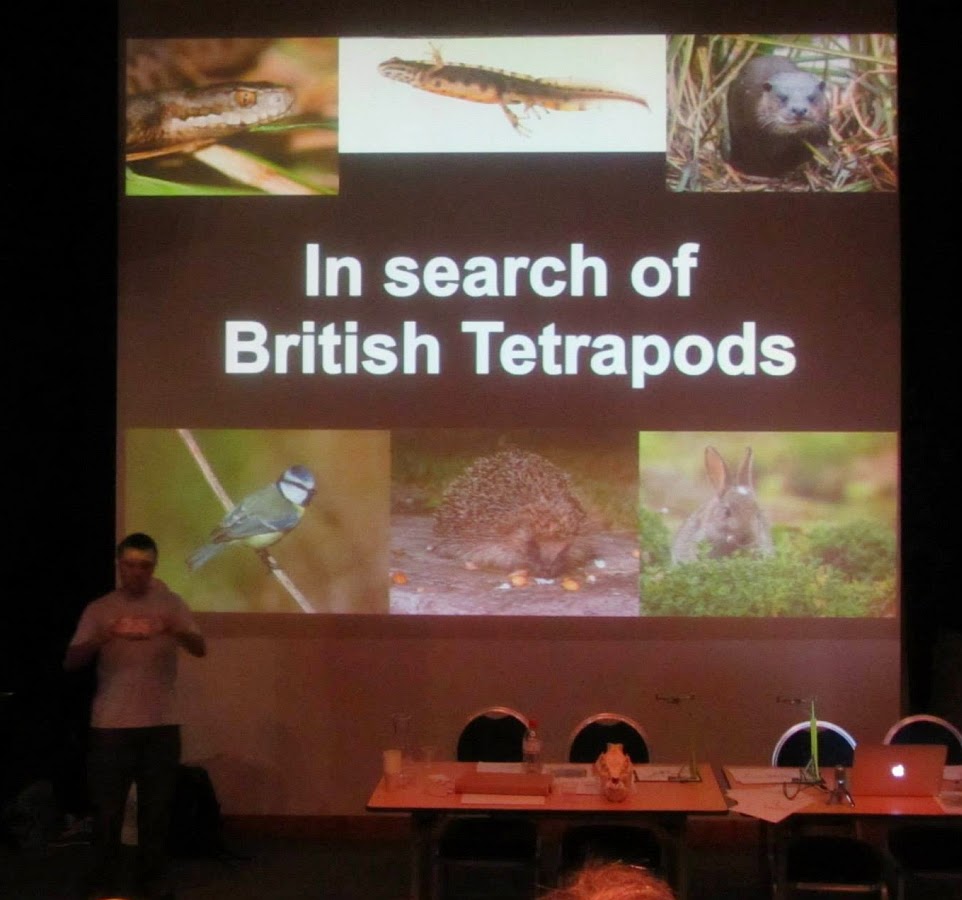
 Photographer Neil Phillips was next, and what a treat he had in store - a series of stunning photos and videos of British wildlife, with all the entertaining anecdotes to match. Neil's been climbing around rocky islands, scrambling about in the darkness, freezing his arse off in a hide in the depths of winter, had birds run at him, attack him and land on his head, and smugly beat fellow photographers with expensive kit to the best shot. What a guy.

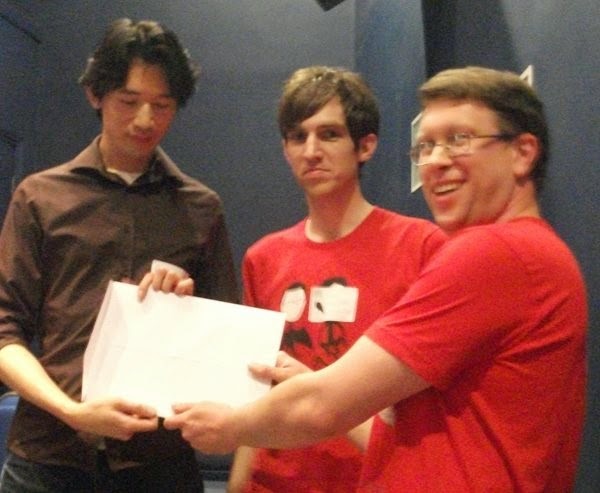
Then there was the quiz. The first question was easy - Tyrannosaurus rex, duh. Then it got difficult. Then it got stonkingly difficult. Niroot and I bashed our heads together and managed to walk away with third prize. First prize - a domestic pig skull - went to Kelvin Britton, who managed a frankly absurd 23 out of 30, the swine (djageddit?), while Richard Hing took second. The quiz ranged from the generic names of plesiosaurs, to shrews, to crocs, to bats, to whatever the hell the 10,000th comment on the blog was. (I still can't remember.)

Oh boy. (This photo courtesy of Darren.)
And finally - we went on a tour of the wetland centre. Then went to the pub, where I probably had one too many. You can't blame me - they had Fuller's ESB on cask. Fantastic beer.

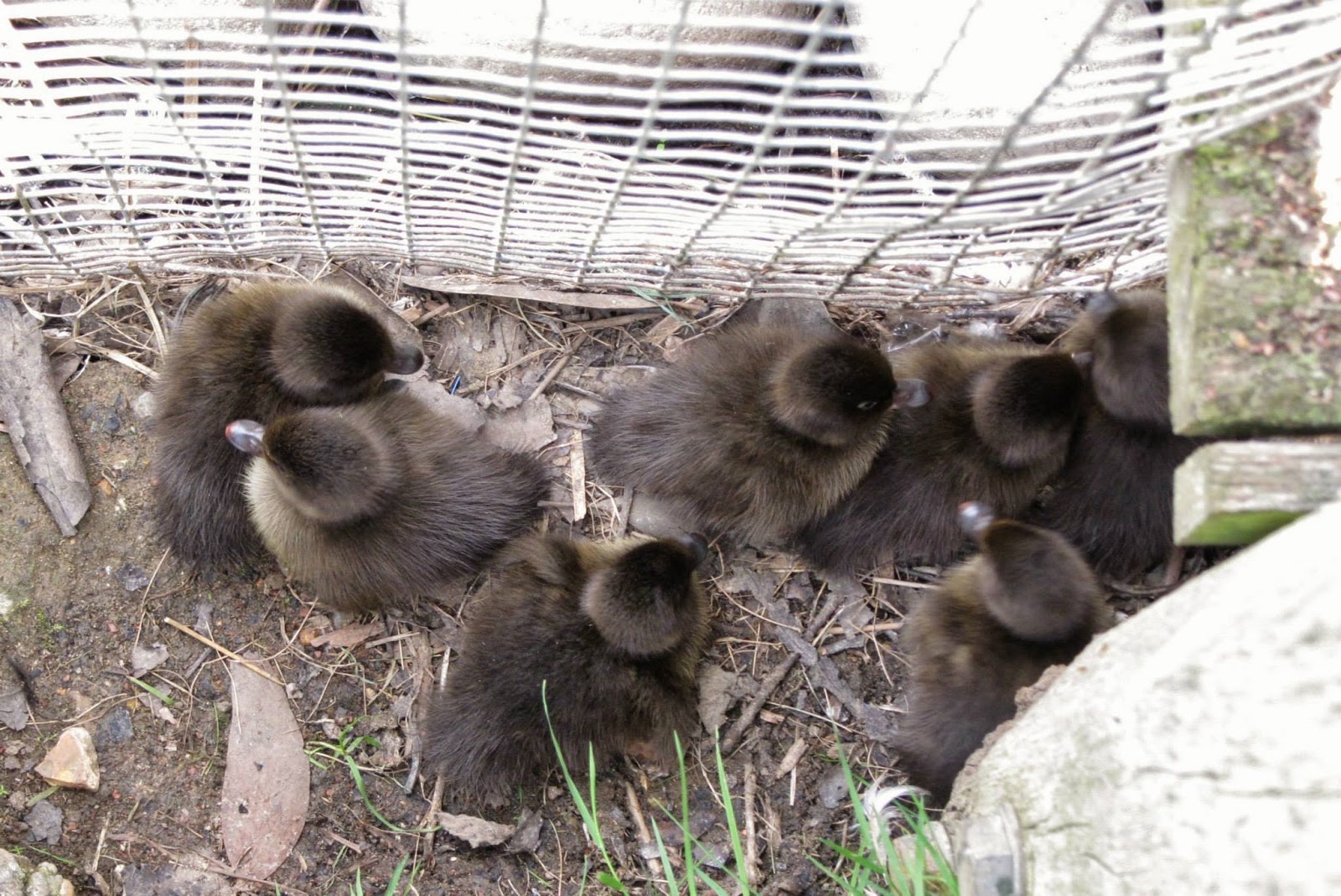
NOT THE DUCKLINGS!
To conclude; a wonderful time was had by all, and I'd sincerely like to thank Darren, John and everyone involved in organising the day, not to mention everyone who put up with my inebriated ramblings at the pub. It was a rewarding day, I met wonderful people, and I hope to see even more there next year. (Oh yes, there'd better be a next year!)

top social