Just about a year ago, the world was introduced to Aquilops, a darling little primitive ceratopsian from the early Cretaceous Cloverly Formation of North America. Farke et al's PLOS ONE description of the animal also brought the world one of the most breathtaking pieces of paleoart in recent memory, a dynamic scene by Brian Engh. Marc wrote up an in-depth analysis of the piece here, a must-read if you missed it. Since then, the hits have kept coming, with a series of hilarious (and possibly disturbing, YMMV) illustrations for the #BuildABetterFakeTheropod hashtag he originated, a pair of clashing apatosaur illustrations, two musical releases (the Jungle Cat Technique mixtape and his newest album, Gather Bones), and a gorgeous scene commissioned for the Mill Canyon Dinosaur Trackway, depicting the origin of the site. That piece can be seen at the head of this post, and you can buy prints from Brian at his website.
In 2011, invited by Glendon Mellow to take part in the ScienceOnline Sciart panel, Engh's wild Sauroposeidon illustration was a cornerstone of my portion of the chat, as I spoke about the developing paleoart paradigm that has since become known as the "All Yesterdays Movement," based on the seminal book published by Darren Naish, Memo Kosemen, and John Conway in 2012. His artwork continues to hold a prominent place in my imagination.

In addition to his paleoart, Engh is a filmmaker, puppeteer, rapper, creature designer, and he makes art of the non-paleo variety. This disparate body of work is all imbued with a definite Enghitude. To me, it's clearly the work of a restless, adventurous spirit. He questions what is possible, never settles, and sees no obstacle that can't be turned into an opportunity. I recently interviewed Brian about his work, and I'm thrilled to share it with you.
Your first piece of published paleoart was of Spinosaurus, for the 2010 Tor Bertin paper. How did that opportunity come about?
That opportunity just came out of the blue. Tor saw my work on my website and asked me and I was super stoked to have an opportunity to get some work published, and especially a huge weird aquatic theropod. Even though he was just an undergrad and could only pay me $100, I put about a month of work into researching, sketching, gathering reference - including making a model and photographing it - and finally illustrating it.
That would have been 2009 or so, right? What was in your portfolio at that time?
Man... Honestly I don't even know... I think I've taken most of that early era stuff off my website because it's embarassingly feeble & innaccurate. I think the only piece still on my website from that era is this Acrocanthosaurus reconstruction, which was one of my first forays into combining traditional pencil drawing with painting in Photoshop. Also, most of the drawings in the "MONSTERS!" section of my portfolio are from around that time (I really need to update my website).
You've given talks about paleontology and paleoart. As a fellow paleo-freak who always looks for ways to talk about this stuff with normal people, I'm wondering what you've learned in that regard - what do you think is worth focusing on, what do people respond to?
First, and most importantly, natural sciences make sense to pretty much everyone when you explain them in simple terms, using as little jargon as possible. Paleontology is really just animals and plants doing animal and plant stuff, then dying and getting buried and all that stuff stacking up for unfathomable expanses of time. When explained in those terms I've seen people get it. On the flipside, I've been disappointed to find that people just don't care about plants. When I get to the section of my talk about plants I've literally watched people get up and leave. Which is a huge bummer, because plants are foundational to damn near every ecosystem and it's fundamentally impossible to understand any animal without them. Also they're beautiful and weird and dynamic and are texturally delicious. Whenever I go to a botanical garden I'm always touching everything up, and I really need to figure out how to translate that fascination so that people feel themselves walking in the living landscape of the deep past.

You once wrote that you'd never seen a reconstruction of T. rex that felt "right." Has that changed?
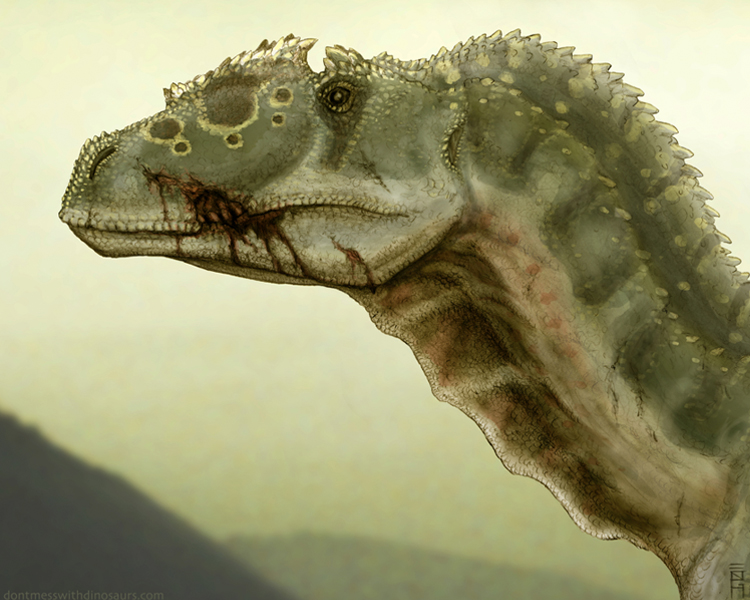
No. I still feel like T. rex is too deeply mired in our cultural consciousness for anyone to really see it. The more people study large tyrannosaurs the more it becomes clear that they were doing something pretty unique. They were huge, insanely high metabolism predators whose bodies changed dramatically as they matured and whose jaws and dentition were specialized for bone crushing. Oh, and they probably had bird-like skin & possibly feathers. So goddamn weird. Sometimes when I stare into the eye sockets of really complete skulls and I see the gnarled rugosities surrounding them I start to get a weird feeling of this bizarre giganto bird monster with deep facial scars and mouth infections and a bulldog neck for yanking triceratops apart. But the whole time I have the sneaking suspicion that the soft tissue was doing things that we just can't imagine. Try to imagine a big male lion without ever seeing even complete soft tissue impressions of a housecat. You'd never guess he had a mane and ruled over the land with that intangible formidability that those beasts emanate... But I am currently working on an illustration of an Allosaurus that's almost starting to come close as far as character goes... almost.
I've written a bit at LITC about my perpetual dissatisfaction with dinosaur movies and documentaries, and have sort of given up hope, concluding that our best hope to recapture the adrenaline jolt of the first Jurassic Park will be games like Saurian. How hopeful are you that we'll see a major, mainstream piece of dinosaur entertainment that knocks us on our butts again?
I dunno. It could maybe happen. I've worked in the entertainment industry a bit and all my closest artist friends work full time as animators or in other aspects of the industry and there are a lot of people working really hard to make the best stuff they can. That said, the corporate side of things is definitely messing with the creative process and that makes it hard for a strong grounding in science or really any new or innovative concepts to work their way into movies. New or foreign ideas (like dinosaurs with feathers that don't roar every time prior to charging their prey) are seen by corporate executive producer types as risky, especially when the production is big and there's an ungodly mountain of money being invested into it as is pretty much always necessary to make elaborate dinosaur films.
That said, I think part of the blame for shitty representations of dinosaurs and other prehistoric animals in media should be placed squarely on the shoulders of the paleontological community. There are a lot of mediocre to downright terrible reconstructions that come out of the science side and those all influence how people on the tv/movie production side visualize prehistoric animals. Also, there's a lot of disagreement in the paleontological community, and for people on the outside who don't have a strong biology background it can be really difficult to get a sense of who actually knows wtf they're talking about. And a fair number of paleontologists, (some well known ones in particular) simply don't have a strong enough background in the biology and anatomy of extant animals. But that's changing... And so is paleoart. And so is the entertainment industry. Everything is in flux right now, and it's awesome.
So short answer: if we support good paleoart, the entertainment industry will have more good examples to draw from, but in particular support my work because I also make videos with practical creature effects and I have an idea for a low-budget dinosaur horror film that I desparately want to make because I believe in my ape viscera that a 20 foot long bipedal bird-like creature with razor sharp teeth and clawed forelimbs would make a really goddamn scary movie monster (but I need, like, 300 grand to produce the project).

How much contact, if any, have you had with prominent paleoartists? Any pieces of advice or insights they've shared that have stuck with you?
I went to SVP this year and met a handful of paleoartists, but I suppose the most prominent one I met was Julius Csotonyi. We only talked briefly, as he was working in the lobby on his laptop on his recently announced shark book. In the brief conversation I asked Julius how long a big book project like that takes and he said something like "oh, a few months" to which I had to reply "whoa! so you're putting out a new [gorgeous] illustration every 2-3 days or so??" That was a real kick in the pants. I'm meticulous and obsessive and good at thinking up a million concepts, but all of that eats up time. Julius is able to concieve and execute near-photoreal illustrations at a pace I can currently only dream of. Suddenly his success in an under-funded super-niche creative field finally made sense. He's able to blast out work at a rate that enables him to sustain a living income. But it should be impressed upon non artists that his accomplishment in that regard is herculean.

You seem like the kind of artist who is just constantly collecting inspiration, no matter where you are. How does that influence your paleoart process? When researching a new commission, how to you organize all the disparate tendrils of inspiration? What do those earliest stages look like as you settle on a composition?
I have big trees of folders of pictures, papers and sketched out ideas on my computer and I try to make a discipline of clearly naming new files and dropping them into the folders they seem like they belong in. I also record tons of ideas on my phone when I'm away from my desk. But a lot of the inspiration for a big paleoart piece comes from the paleontologists I'm working with and the resources they provide me with. The best collaborations happen when I'm provided with tons of reference material, especially visual stuff like high res images of fossils, fossil sites and modern environmental analogues. At some point I'm going to put up an blog post outlining the best practices for paleontologists working with paleo artists, and at the top of that list of good practices is providing tons and tons of reference material.


When it comes to working out the final composition I make a lot of rough sketches based on discussions about behavior and ecology and send them to my collaborators to see what people like. Ultimately though, my final composition is often strongly influenced by going outside and trying to find environments with similar characteristics to the prehistoric ones being reconstructed. As discussed in my talk and blog post on Aquilops that meant going to redwood and Sequoia forests and thinking "where would I hide in this forest if I were a rabbit sized Deinonychus snack and Sauroposeidons were moving through grazing on the giant trees?"


In the case of my Mill Canyon Dinosaur Trackway art that process got even more specific, in that I went to the actual trackway and stood where the illustration would be placed overlooking it, and I shot a photo panorama with ReBecca Hunt-Foster and John Foster (and even their 5 year old daughter Ruby as the dromeosaur) pacing out the various trackways so I could map them out precisely from that vantage point. I then used that exact point of view to come up with a couple dozen possible layouts which I then sent to ReBecca to see what she liked. I also camped out near the site and visited it all different times of day to find the best lighting for seeing the tracks (which turns out to be just after sunrise, as depicted in the final illustration), and I also walked all around trying map out and trace the shoreline of the ancient lake so that I could reconstruct that as accurately as possible in my image. When you take the time to really look at the environment you see some interesting things. Like, the bank of the lakeshore with the most croc slides is the one best angled to catch the first rays of morning sun. I got goosebumps when I saw the sun creeping accross that ancient shoreline. I cannot emphasize enough how important going outside and looking at rocks and climbing trees and catching frogs and snorkeling is to my process. I couldn't come up with this stuff by myself. Our prehistoric planet is alive all around us.
Besides the gross anatomical stuff that tends to be whipped like a dead horse (bunny hands and the like), what are a few habits or trends in paleoart that frustrate you? Your pet peeves, as it were.
Monkey puzzle trees and the same pruned cycads and naked horsetails being the only plant life in the Mesozoic. And just generally sparse undergrowth and clean ground. It's a symptom artistic laziness and the academic view of nature that we've all been raised with. We read "Araucaria-like trees" in the literature and we look up "Araucaria" and we pick the one that looks the most unusual & "prehistoric", ignoring the fact that the umbrella topped Araucaria only grow in really specific environments and that even today there is a wide diversity of growth forms among the Araucaria (and only 2 modern species form the umbrella topped things depicted in ever paleo painting ever). Also there was without a doubt a HUGE diversity of similarly leafed trees that lived at various points over the last 200+ million years, most of which we only have fragmentary fossils of, so their actual phylogenetic affinities are really really shady, especially considering the phenotypic plasticity of many plants, conifers being no exception.
So the repetition of the same shaped trees and forest architecture in paleo art is purely memetic mimicry and not a reflection of any real knowledge about the paleoenvironment being illustrated, which therefor calls into question ideas about the behavior of all the animals depicted in that environment. What's worse is that then paleontologists sometimes start thinking that's what the landscape actually looked like and then start interpereting everything based on an imagined landscape bizarrely warped by lenses of preservation (or lack thereof), interperetation, depiction in art, mimicry of that art, and then reinterperetation of the fossil record based on that now concrete mental image. At times it gets so wonky that I start doubting that paleoart is actually even helping the science. In a perfect world, with unlimited time and money, new paleontological discoveries should be announced with a number of different artistic interperetations showing a variety of possible behaviors, environments or environmental phases. I'd love to have the time to depict Aquilops' Sequoia forest right after a seasonal brush fire (which the fossil record indicates happened there), or even a series of images depicting seasonal change in that one environment...

I'm insanely jealous of young kids today, getting to grow up in a world with an internet. Assuming you're somewhat younger than me, what role did it play for you as a budding paleontology nut?
I'm 30, so good dinosaur information wasn't freely circulating on the internet until I was in college. In those days there was wikipedia, and the dinosaur mailing list threads. A few years later, wordpress and blogspot blogs by paleontologists started popping up. It was about that time that I realized I should start trying to make a discipline of improving my dinosaur art, as drawing dinosaurs at a young age was foundational to the development of every other subsequent creative skillset. Also, most of the paleoart I was seeing online was garbage and I thought maybe I could help change that. In the process of researching and putting out work online I discovered SV-POW (Sauropod Vertebra Picture of the Week, for the uninitiated). I loved that it was written by working paleontologists, was super technical and specialized, and yet was really easy to read. So I contacted Matt Wedel just to say thanks for making all that science available. That conversation basically lead to where I'm at today, conversing with the online paleo community and working with several paleontologists to make the best reconstructions of ancient lifeforms I possibly can.
That said, I'm definitely not jealous of young kids today because a lot of parents nowadays (when they themselves aren't obsessively reliant on their device) hand kids a device to keep them busy, rather than saying, "go outside" or "go make something." And the web is weird, and not well suited to our natural means of communicating with facial expressions, non verbal cues, jokes etc. And for a lot of kids communicating and understanding the world through the internet has become the primary, formative experience. For me it was playing in the back yard and looking for bugs under bricks and catching lizards and making things out of clay and pencil on paper. I'm somewhat concerned that in some cases people cultivate a purely academic understanding of nature, an that the internet is contributing to that. But, no matter how good the wikipedia page on western fence lizards is it definitely doesn't give you a real sense of who they are and how they behave and react to the world around them and to people. And yet the internet leads us to believe we have real knowledge about them.
And to be clear, I'm guilty of this too. I don't know how many times I've been looking at a living thing and trying to figure out what it is, and then somebody tells me the name and I go "ok, that's a Townsends Warbler" and then i stop looking at it because i now have a label by which to look it up later if it should interest me to do so. But to me, animals and plants aren't just objects to memorize names of and trivia about, or data points to be categorized according to a phylogeny, they are us. They're our family members, our fellow outgrowths of this bizarre teeming planet. That wikipedia page on fence lizards might let you know a few broad, concrete things about the group of animals we call by that name, and that's fine for building a concept of big picture patterns and relationships, but it definitely doesn't tell you that if you approach certain confident individuals, particularly dominant males with bright coloration, from a low angle, moving very very slowly, and not looking directly into their eyes, you can sometimes tickle them on their chin. I have done this. It is good.
I'm grateful to Brian for taking the time to answer my questions. For more insights, be sure to read his interviews with Dinologue, Cultured Vultures, and William Norman. Also check out Asher's post from 2014 on the "Earth Beasts Awaken" videos.
And for crying out loud, visit his website, pledge at his Patreon page, follow him at Twitter, check out his tunes at Bandcamp, and spend copious amounts of your hard-earned money at his new Redbubble shop.