Showing posts with label purnell. Show all posts

Tuesday, October 20, 2015

Vintage Dinosaur Art: Purnell's Find Out About Prehistoric Animals - Part 2

Because I can't in all good conscience review a book with 'Prehistoric Animals' in the title and only cover the dinosaurs, behold various non-dinosaurs from Purnell's 1976 guide to long-dead beasties. (There's also a tiresomely long section on how MAN evolved to DOMINATE the Earth by being SUPERIOR to the other creatures by virtue of having a large brain, dextrous hands, and other noted attributes of MANLINESS. It's as 1970s as an brightly-coloured Ford Cortina, which you'd be far better off looking at. Here you go.) Where better to start than with a pterosaur being munched? Stupid pterosaurs.


As I mentioned last time, none of the illustrations in Purnell's are credited, which is always a real shame. However, it seems a fair bet that the above piece is by Sibbick - just check out that minute detailing. While the pterosaur fuzz is commendably up-to-date for 1976, the plesiosaur's head is way off; it somewhat resembles that of a generic theropod dinosaur. Of course, it could have the mop-haired, bulbous noggin of the Mayor of London stuck on there for all it matters - the sheer Sibbickness of it all makes every last skin fold completely believable. You could take a fuzzy photograph of this, send it to a cryptozoology periodical and become famous. Among a very select group of people. Now there's a thought...


Plesiosaurs may be the most famous non-dinosaurian long-necked reptiles, but Triassic weirdo Tanystropheus has surely made quite a name for itself, too. Given its preposterous proportions, I've got to commend the artist for taking on such a tricky perspective; you've also got to love those bulging red eyes. "This very peculiar animal must have led a difficult life," the accompanying text intones, but the example illustrated here looks like it's having a ball.


Back to plesiosaurs, although Kronosaurus was of the short-necked, big-headed variety. Beautiful shading, but the artist may have given the animal an unduly long neck and tail - the eyes are also misplaced, although at least the nostrils are commendably retracted [EDIT - in fact, the eyes and nostrils are in the wrong holes, as pointed out by Adam Smith in the comments! Can't believe I missed that one]. (Famously, a Kronosaurus skeleton was once reconstructed with far too many vertebrae, leading to hyperbolic size estimates in kids' books that the real animal can't quite match. It was 6 or 7 metres long, akin to Liopleurodon, which itself was once restored as a kaiju, but that's another story.) There's an enjoyable sense of motion about this piece, particularly where the animal is swinging its head around to snap at passing fish.


The same artist (seemingly) also illustrated the giant mosasaur Tylosaurus in full old Chaz Knight mode, complete with darling dorsal crest. Yes, the head is...a bit weird-looking, but, blimey, what a dramatic image. The big old lizard looks positively terrifying as it lunges after Archelon, the only extinct turtle anyone's ever heard of, here depicted seemingly as a skeleton with fins and a face. The deranged look in the mosasaur's eyes as it lunges forth is just fantastic.


While mosasaurs are almost always given a full set of luscious lizardy 'lips', there's a strange tendency in palaeoart for the infamously serpentine whale Basilosaurus to be drawn without them, even to the point of having completely exposed teeth, croc-style (as above). As I understand it, there's no evidence that Basilosaurus had a 'melon' or similar organ, but there's also no reason to suspect that it didn't have lips (readers are welcome to chime in). In any case, this is otherwise a fairly decent reconstruction with a very Burianesque feel, especially with the swirling, inky gloom surrounding the animal.


Purnell's makes plenty of room for extinct mammals of all sorts, of course, and here we have a fine example of an illustrastion of Paraceratherium, aka Indricotherium, aka Baluchitherium, etc. etc. There's a faintly terrifying sinewy muscularity about this beast, somewhat reminiscent of certain '70s illustrations of sauropods, only here it makes rather more sense. Clearly an animal suited to professional wrestling and appearing on the cover of certain...very specialist magazines. Rippling, glistening, and very well shaded, actually. Not that you'd dare insult it, anyway.


Lovely as the monochrome plates are, there comes a time when one cries out for a little colour. So here it is, in the form of the slightly strange not-rhinoceros, Arsinoitherium. Although superficially rhino-like, and normally illustrated as such (as above), it was actually more closely related to modern-day elephants; unlike rhinos, its horns had bony cores. While the above piece is probably modelled on modern-day rhinos a bit too closely, the use of perspective is marvellous, as is the quite impressionistic foliage; one feels like it's possible to reach out and touch that wrinkly grey flesh. At which point you'd probably be horribly gored. I don't like the look in its piggy eyes.


And finally...a dinosaur! Because I'm just a terrible, terrible liar. On the other hand, it is Archaeopteryx, which was always filed away under 'non dinosaur' in kids' books back in the day and the Natural History Museum's dinosaur gallery right now. Anyways, this is fairly typical of the genre, what with the individual with outstretched wings and misplaced digits, although I very fond of the rufous red colouration of the plumage, and the animals' wings are quite beautifully drawn otherwise. Not too much of a lizardy git face going on, either, which is always pleasing to see. A salute to you, uncredited illustrator, wherever you are.

Coming up next time: I'm not sure. But I'm off to Berlin next week (finally!), so perhaps I'll write something about that...

Monday, October 5, 2015

Vintage Dinosaur Art: Purnell's Find Out About Prehistoric Animals

Not for the first time, here's a fantastic 1970s book on prehistoric animals from Purnell, purveyors of fine model photography and anachronistic pop-up battles. Find Out About Prehistoric Animals is considerably more hefty than any Purnell to previously feature on this blog, and it's gloriously packed full of wonderfully retro illustrations from a number of artists. While individual pieces aren't credited, we are at least informed that the artists included Eric Jewell Associates, Illustra, John Barber, Angus McBride, Sean Rudman, Dan Escott, Colin Rattray, Vanessa Luff, Gerry Embleton, Phil Green, George Underwood and - oh yes - John Sibbick. Nine years before even the Normanpedia. Blimey.


Could Sibbick have been behind the main cover image? Maybe - the skin textures are certainly quite Sibbickian, but this bizarre, super-'70s Corythosaurus is far from the Sibb we're familiar with. The poor web-fingered freak appears to be stuck in a very painful squat, while its speckled belly resembles an enormous egg. It looks like it should be wearing an oversized white apron (with the legend 'KISS THE KREST') and carrying a spatula.


While there isn't half as much saurian diversity as the previous weeks' '80s fare, we are still treated to some large, often quite imaginative reconstructions of the Usual Suspects. These Diplodocus are beautifully painted,  with lovely dappled skin patterns, and the composition is certainly unusual. Interaction with conspecifics - you wouldn't have seen that in a '60s book. Of course, the animals do appear disoncertingly eel-like (eely? Eelish?), and why does only one of them have a seam-like frill adorning its neck? Sexual dimorphism?


These brontosaurs are altogether more familiar-looking...as well they should be. This is undoubtedly one of Sibbick's; not only is the technique a dead giveaway, but Sibbick would go on to produce a strikingly similar brontosaur piece for WHEN DINOSAURS RULED THE EARTH. While WDRTE's blunt-headed, enormously fat creatures were quite inexplicable in the 1980s, at least the blimp-o-saurs make rather more sense here (given what his contemporaries were producing). Note the hand of the background individual, which sports no fewer than five little claws on its fat stumpy fingers. Of course, none of this is to say that it isn't as astonishingly, intricately detailed and shaded as one would expect from Sibbick - just as in the Normanpedia, he's a dab hand at making what would otherwise be hilariously obsolete-looking creations appear far, far too convincing.


While Sibbick's brontosaurs need to cut down on their pork life, mate, and get some exercise, this artist's brachiosaurs have managed to remain quite svelte - it's a wonder what a diet of low-lying fern cover will do for one's figure. The background individual appears quite conventional, albeit very muscular. The foreground animal, however, has a number of odd touches, not least the remarkably thin neck, smooshed-looking head and neck seam (what is it with those?). The arms remind me of Blackgang Chine's old model, which has now gone to the Great Skip in the Sky (or more likely, at the bottom of the sea). Noteworthy: all of the sauropods here are out on dry land. This was a key evolution of 1970s palaeoart; books that feature swamp-bound sauropods are a sure indicator that the author, artists, or both really didn't know what they were doing.


Of course, you were all wondering what that caption was about in the top right. Well, here's your answer. Apropos of nothing, brachiosaurs at play! Take that, All Yesterdays! Who's to say that pea-brained twenty tonne lummox-o-pods were bereft of a touch of mischief, or even sportsmanship? A brachiosaur would be ideally suited to the fine game of rugger. Werner at the back is currently playing for the Welsh side. Of course, such horseplay comes with more than a little rib-crushing danger, but it's nothing that your average pro rugby player isn't used to.


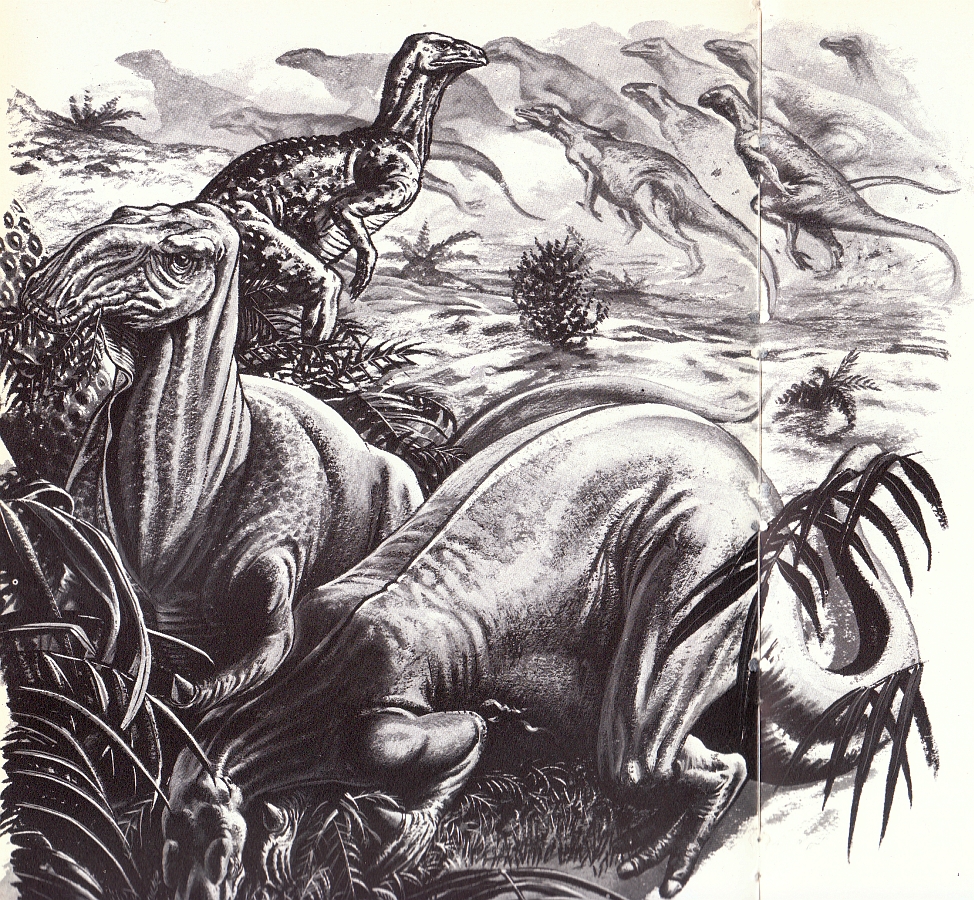
The same artist (or so it seems; again, individual pieces aren't credited) provides an illustration of a marauding horde of Iguanodon, off on their way to carelessly fall into a crevasse in Belgium and die (too much Gulden Draak?). While some of the background animals strike amusing poses, at least they've managed to unflex their elbows - the two in the foreground are afflicted by an unfortunate case of Chronic Palaeoart Trope. As was seemingly quite often the case in '70s illustrations of Iguanodon, they also have very thick vertical creases running down their stout necks, although they are not exaggerated as much here as elsewhere. If anything, the muscularity of these creatures is to be commended given the time. Furthermore the shading is, again, quite lovely. I'm even quite fond of the gnarled-looking noggin of the beast on the left. Who's to say that Iguanodon was a noble-looking reptilo-horse? Maybe it really was a bit offensive to look at.


Now, everyone knows that Iguanodon had its famous stabby thumbs - in addition to its (no doubt) terrible complexion - with which to ward off the great predators of its day. But what of other dinosaur prey items? Happily, Purnell's is on hand to explain, and with illustrations, too! In the above piece, we see a superb example of a cryptically camouflaged Camptosaurus, hiding from a salivating glove puppet with tiny, creepy, humanoid arms. Beautifully done with the camptosaur, but that warty spindle-armed fellow is one creepy brute. He needs a monocle.


Elsewhere, we see herbivores get a little more 'proactive' in their defence, 'taking the initiative' and showing that they can 'work well independently as well as part of a team'. In the above piece, clearly heavily inspired by Burian, a sprawled, squat scolosaur defends itself from a seriously wide gauge Gorgosaurus, the victim of a lack of three-dimensional references available to the artist. Remember, kids - tyrannosaurs did not resemble a ripe squash. Although if you did enter this tyrannosaur into your local village fete, it'd win first prize every time. Take that, Scolosaurus! Your peculiar nose horn won't save you from landing the wooden spoon.


Gorgo might be a little lardy, but at least he doesn't suffer the fate of Rexy, who inevitably ends up getting a little too close to the problematic end of everyone's favourite extinct horned beast that didn't have any hair, Triceratops. While images of T. rex v Triceratops face-offs - even gory ones - are more common than rock doves in a labyrinthine multi-storey car park, it's rare that Rexy ends up with a metre-long horn stabbing him right in the neck. Ouch.


And finally...because one simply can't have enough Rexy-on-Trike action, Purnell's gives us Round 2. Here, Rexy just looks like he wasn't looking where he was going - no doubt distracted by what an unusually beautiful day it was, the poor chap has managed to stumble straight into a multi-tonne animal with a big beak and a bigger temper. This appears to be another early Sibbick (although I could be wrong), in which case the differences between this, the Normanpedia, and his '90s work are very interesting. If anything, the head on this Tyrannosaurus makes more sense than the croco-rex of the Normanpedia, but is worlds away from his '90s work. Nice neck seam, though.

Next time: Purnell's non-dinosaurs! Because I can't not include pterosaur-nabbing plesiosaurs.

top social