Monday, October 13, 2014

Book Review: Tales of Prehistoric Life by Daniel Loxton

This spring, Daniel Loxton published his third and final children's book in the Tales of Prehistoric Life series: Plesiosaur Peril, the story of the dangerous life of a young Cryptoclidus in the Jurassic. It was proceeded by Ankylosaur Attack (2011) and Pterosaur Trouble (2013). Today I'll cover all three. The TL;DR version: they're great.


Daniel Loxton's name is probably recognizable to the portion of our readers who also follow skeptical media. He cowrote Abominable Science with Donald Prothero as well as writing and illustrating the children's book Evolution: How We And All Living Things Came to Be. Loxton is also well-known for his work editing the Junior Skeptic section of Skeptic Magazine. Illustrator Jim WW Smith, who has also worked for Junior Skeptic, provides work on the models for the Tales of Prehistoric Life series. Loxton provides the finishing textures and colors, as well as photographing environments.

I especially appreciate Loxton's series for taking up the mantle of the Rourke titles we've covered so many times during the Vintage Dinosaur Art series. Like the Rourke collection, each Tales of Prehistoric Life book is a narrative story, detailing interactions between temporally and geographically appropriate animals. I love this approach. When grounded in modern paleontological understanding of the life and times of the animals involved, it's both engaging and educational. Like the Rourke titles of yesteryear, each book in this series also wraps up with a brief explanation of the scientific grounding of the story.

The Cryptoclidus family swims through a teeming Jurassic sea. � Daniel Loxton.

The animal interactions are firmly in the realm of plausibility. There are moments that seem a bit of a stretch, such as a veritable army of Saurornitholestes laying seige to the Quetzalcoatlus hero of Pterosaur Trouble. However, there's nothing more outlandish than Dinosaur Revolution's more slapstick moments. Since I'm on the record of admiring much of what that series did, you can predict my reaction here. When the Quetzalcoatus quad-launches to escape his attackers, one of them inadvertently hitches a ride before being flung onto the head shield of a Triceratops, and I couldn't help but crack a smile.

3D dinosaur art is too often only mentioned when picking out the worst offenders, so it's easy to forget that it is often done very well, and Loxton's work here is a prime example. For the most part, the animals are integrated into their photographic environments very smoothly, and interact with them believably - there is a sense of weight and heft to the animals as they walk on sand, browse vegetation, or fall into water. The experience is an immersive one, with illustrations filling entire spreads. The point of view is often right in the middle of the action. Loxton's attention to detail rewards free exploration of the environments and their inhabitants. Feathers float on the air in the midst of combat. Age and experience are obvious, as in an old ankylosaur with battle-damaged armor or a pycnofibre-covered pterosaur.


Quetzalcoatlus soars over the late Cretaceous world. � Daniel Loxton.


An Ankylosaurus couple browses in the forest. � Daniel Loxton.


Coloration is handled conservatively. There are no Rey-style color schemes. Proto-birds and dromaeosaurs are given the most colorful integument. I particularly liked the ruddy tones of Saurornitholestes, reminiscent of the Brown Thrashers who inhabit a similar woodland habitat in my neck of the... er, woods. I also enjoyed touches like subtle sexually dimorphic coloring on the Triceratops, and a seaweedy-green on the Cryptoclidus family at the heart of the most recent book. The tyrannosaurs who appear in Ankylosaur Attack and Pterosaur Trouble could do with some plumage and a splash of color (as well as some more neck musculature, which to my eye looked a little skinny). On the other hand, it's refreshing for the tyrant king to step out of the spotlight.


A Saurornitholestes pack smells something big and tasty on the wind. � Daniel Loxton.


Loxton's choices in depicting behavior are the strongest aspect of the stories, as pains are taken to focus on details of Mesozoic life lent us by recent paleontological research. Quetzalcoatlus falls prey to small dromaeosaurs because of tooth marks found on actual fossils of the great azhdarchid. It bears repeating that the pterosaur is depicted performing a quad-launch, too (a touch which pleased Mark Witton greatly). The family unit in Plesiosaur Peril is based on evidence that these marine reptiles were viviparous. It's a stretch to lump Loxton's book series in with the All Yesterdays Movement. But it is certainly complimentary in its dedication to anatomical fidelity and reasonable inference, while offering views of prehistoric life which reflects the way extant animals act rather than what Hollywood dinosaurs are asked to perform for the masses. There's no need to layer on excessive personification or spectacle after spectacle. Loxton's adherence to this is the main reason the books succeed.

The Cryptoclidus family feeds on belemnites. � Daniel Loxton.

My only major critique is that a more readable typeface for the body copy of the books could have been chosen, but that's a small quibble in the big scheme of things. This is as good as prehistoric fiction gets. The life restorations are exactly the kind that the new generation of paleontology fans should have access to: contemporary, not stuck in decades-old knowledge. All books in the series are available at major booksellers or via Skeptic.

Around the web: Check out Loxton's post about Plesiosaur Peril at SkepticBlog. Darren Naish wrote a detailed post about the book at TetZoo - fitting since he served as technical consultant for the whole series. Adam Stuart Smith reviewed Plesiosaur Peril at Plesiosauria.com. Dispersal of Darwin's Michael Barton reviewed Plesiosaur Peril in March (and reviewed the other titles in the series previously). Ankylosaur Attack recieved positive reviews from Quill and Quire, Kirkus, and SkepticDad.

Friday, October 3, 2014

Mesozoic Miscellany 65

After a really super-long break, we're back with the 65th post in the Mesozoic Miscellany series. I really haven't meant to do these posts so sporadically, but I had some freelance jobs come up that took up a lot of time over the last few months. Sorry about that! I hope to get back on a more regular schedule with them.

Around the Dinoblogosphere

At Life Traces of the Georgia Coast, Tony Martin wrote a touching post in the wake of his mother's passing, reflecting on how he came from a childhood in poverty to pursue his passion for learning about nature. It's a must-read.

A new site dedicated to Mesozoic paleontology has launched, called Dinologue, and is also active on Twitter. Dinologue also features the writing of Brian Switek, who also hosts short video features such as this one, in which Brian fields a question about whether Mesozoic dinosaurs lived in the mountains.


Surely you've heard of the minor kerfuffle kicked off by the new Spinosaurus material revealed by Nizar Ibrahim and team? Ben Miller at Dinosours! gives us a look at the exhibition tied to the publication at the National Geographic Museum.

Darren Naish, Mark Witton, and John Conway collaborated on an article for Palaeontologia Electronica, State of the Palaeoart, looking at the continuing difficulties of paleoartists wishing to be paid fairly in an atmosphere that rewards original, creative work.

Beasts of Antiquity: Stem-Birds in the Solnhofen Limestone, the new book by Matt Martyniuk, has been released in Kindle, iBook, and print formats. As he wrote at DinoGoss, there are "other books written on Solnhofen, but this is intended to be more of a synthesis of current research and understanding of it and its stem-bird fauna accessible to a general audience." Best of all, it's the first in a Beasts of Antiquity series.

The pneumaticity of bird skeletons and their evolution was covered by Liz Martin at Musings of a Clumsy Paleontologist.

Over at Jersey Boys Hunt dinosaurs, Chris DiPiazza treats us to a peek inside Jamie Oliver's American-themed diner in London. Why? Because it's packed with dinosaur stuff. There's a nice assortment of derpy, clever, and just plain neato art and sculpture, so check it out.

Maija Karala is back, and has been writing a series called Botany for Paleoartists at the Humming Dinosaurs blog (Parts 1 on ferns, 2 on fruits, and 3 on grasses). And if you didn't see it then, check out my interview with Maija published in July.

LITC contributor Asher Elbein was published at Bitter Southerner, writing about the phenomenon of snake-handling churches in the southern US. It's a terrific piece. Congrats, Asher!

Paleoart Picks

Hard to pick just one, so here's a brief round-up within the round-up of cool stuff that's crossed my path recently.

Shields and Spears is the title of the new art show from Raven Amos, Scott Elyard, and Zach Miller, opening at the Yak and Yeti Caf� in Anchorage today, October 3. I've been enjoying the works-in-progress shared on social media, including this great time-laps of Raven's great Leptoceratops piece.


Read more at Coherent Lighthouse.

Speaking of ceratopsians, Julius Csotonyi's "Ceratopsian Cornucopia" is available as a poster, a beautiful piece demonstrating the diversity of headgear among the ceratopsians.

Angela Connor, known as Amaruuk at DeviantArt, Newgrounds, and Twitter, also has a great Redbubble shop. Paleo Portraits is a charming series of various extinct taxa, available in a variety of formats.

Wednesday, October 1, 2014

Atlas of Dinosaurs, The Return

Our sole criterion for a book to qualify for the blog's Vintage Dinosaur Art series is that it is 20 years old. (And yes, because of that, I am very guilty of stretching the definition of 'vintage' to breaking point.) Atlas of Dinosaurs is rather newer than that, but as was plainly seen last week, it might as well be straight out of the 1980s. Following the panoramic illustrations in the previous post, I'd like to dedicate this one to depictions of individual animals. Warning: levels of plagiarism and the positions of eye sockets may vary.


For all the blatant copycatting, there are a few neat ideas here. Behold, tree-climbing Deinonychus! Well, why not? Although I'd be interested to know what the text says, taken in isolation, this is an intriguingly different take on the beast, laudibly free of blood, guts, roaring, and Bakker imitating. (You ever seen a Deinonychus with a huge beard and cowboy hat? They look ridiculous.) All the same, there are some serious problems. For one, it's completely unfeathered (far less acceptable in the late '90s-early '00s than in the early '90s). For another, its eyes have migrated forwards and now sit in the wrong holes. Oops.


It couldn't have been that long ago when I noted that Mononykus, along with Avimimus, was one of the very few non-avian theropods to be almost ubiquitously depicted with feathers since the 1980s, if not even earlier. (Proper feathers, that is - not just a few half-hearted quills on the head and a sandwich board reading 'MISSING LINK!!!!!') Unhappily, there are always exceptions. Behold, the full horror of lizardy, figure-skating Mononkyus! Are those feathers on its arms, or weird flaps of flabby excess skin? Why does it just have that single line of bristly things on its head? Why does its neck articulate with its jaw? Why? Why? WHY? Wah!


Mononykus might appear rather undignified, but at least it doesn't have testicles hanging from its chin - like the fellow above-left. This creature is Shuvosaurus, and is likely based on the original interpretation of the animal as a Triassic ornithomimosaur (it's now recognised as a non-dinosaur archosaur closely related to Effigia). At the bottom we have an even more problematic animal - Protoavis, here depicted, very unusually, without feathers. Beloved of BANDits, it's been described as a bird more 'advanced' than Archaeopteryx, but living in the Late Triassic. In reality, it's a handful of badly damaged bits and pieces that have proven very difficult to conclusively identify. Whatever the case, this version looks more like a 1980s troodontid, but given those animals' close relationship with birds, that's probably not so surprising.


Strangely, better-known animals often take on a more retro appearance than those only recently discovered, or known from scrappy material. This probably has something to do with the fact that a lot of decades-old artwork depicting these creatures was more readily to hand. Take the Sexy Rexy duo - while the foreground animal has a comparatively 'modern' stance (weirdly directed left foot aside), the background one appears to be based on Burian's famous Tarbosaurus. Both are made to look more 'reptilian' by having the upper tooth row extend under the eye socket, contrary to the animal's actual skull.

At the bottom, we have a mosasaur with that good ol' Knightian crest. Sometimes, I almost start to miss 'em. On the other hand, modern mosasaur restorations are much cooler-looking.


Furthering the retro-'80s theme, here we have a copy of Sibbick's unduly chunky Dilophosaurus from the Normanpedia. Sibbick's isn't the only historic example of Dilophosaurus drawn as a Big Generic Theropod, Now With Crests!, but like so many of his creations, it's the one that tends to get around. Sichkarya's version faithfully reproduces the Normanpedia pose, but manages to make it look even more, er, 'robust', like it's just swallowed a comedic money-grubbing computer programmer whole. Meanwhile, Dimorphodon actually looks less silly than the real thing. Go home Dimorphodon, etc.


In the end though, while the Dilophosaurus might harken back to the days of leg warmers and big hair, this Polacanthus is so retrograde that it's lost its favourite pipe and slippers and is very suspicious of those well-dressed men who've moved in together across the street. Having said that, it's not dragging its tail along, so that's something.


The brachiosaur on the above page is also quite retro, and the Compsognathus is quite Sibbickian. But of course, you aren't looking at those. Your eyes have been drawn to the white and pink Pteranodon, head retracted back to its body, pelican-stylee. It does look a bit barmy, and has its share of anatomical problems. Still, it somehow seems preferable to yet another boring, brown, Burian-style Pteranodon. At the very least, it's an inventive take. Which brings me to...


...The exact opposite. A Sibbick copy so unashamed, even the colour scheme is the same. Same red head. Same backward-facing skull nubbin. Same everything. If only some people were making a stand for originality in palaeoart - for quality, for accuracy, and against plagiarism. Why, it just so happens (TOPICAL!) that they are! I realise that I've linked to Mark, Darren and John's article on Facebook already, but if you haven't checked it out already then I must insist that you do; it's an indictment of all the ill-practice in palaeoart that I've spent the last few years whinging about.

But I digress. Thanks again to Vladimir Nikolov for all his trouble, and I hope this sojourn into the world of Russian books has proven to be entertaining. (If it hasn't, may I suggest sending crates of the finest Belgian beers to my address in order to improve future post quality.) Coming up next: the return of regular Vintage Dinosaur Art! Will it feature Sibbick rip-offs? Probably. Poor John Sibbick.

Friday, September 26, 2014

Further adventures in Russian: Atlas of Dinosaurs, part 1

Following last week's 'Russian interlude', palaeoartist and (I'm very happy to say) LITC reader Vladimir Nikolov has offered up another slice of Russian-language non-quite-vintage dinosaur art. Behold, one and all, the glorious Atlas of Dinosaurs and other Fossil Animals. It's a far more recent book than you might think...or hope.


This second edition dates from 2001, but you might be surprised to learn that the first edition was published as recently as 1998. While the cover is dominated by a dirty great mammoth (boo!), that hadrosaur in the top left is conspicuously Burianesque for a book from the '90s. Based on the cover, one could reasonably expect illustrator A N Sichkarya's work inside the book to be similarly old-fashioned, but the truth is far more wonderfully complicated than that.


Given that the book slogs through the entirety of the history of animal life on Earth, I asked Vladimir to just scan the Mesozoic bits - it's them what we's interested in. Sichkarya illustrates a series of panoramas, each depicting a packed assembly of fauna typical of a given time period. Predictably, the Early-Middle Triassic scene (above) is one of the emptiest, and actually looks a lot more natural as a result. The animals could be worse; the Lystrosaurus look rather familiar, but I do like the birdlike sit-standing posture of the Staurikosaurus (number 6). It's also nice to see Mastodonsaurus, with its freaky jaw-piercing tusks, make an appearance...although the tusks aren't really shown here.


Early-Middle Triassic scenes are always a bit dull, though, and thankfully there's a bit more action afoot in the Late Triassic. Two plateosaurs (4) are threatened by an Herrerasaurus that seems to be running like Scooby Doo, Coelophysis pops in to make its contractually obliged appearance at bottom left, and a phytosaur is threatened by two...what are those, exactly? As it happens, they're supposed to be rauisuchians. Now, while rauisuchians did resemble large theropod dinosaurs in some respects, this illustration may be taking things a bit too far. I mean...they've got legs up to here. While not labelled as such, one can't help but wonder if they're based on outdated depictions of the rauisuchian Teratosaurus, which was once thought to be a primitive 'carnosaur'.


On to the Early-Middle Jurassic now, and a herd of Barapasaurus ambling away from a lush forest and into a featureless wasteland for some reason. These tail-dragging beasts definitely owe a debt to much earlier palaeoart, as does the nondescript 'carnosaur' directly below them. Interestingly, a group of 'protosuchians' here fill in for the more usual heterodontosaurs or Lesothosaurus in the 'small to medium reptile' category. [EDIT: Oops - they're actually Scutellosaurus, the basal thyreophoran dinosaur. Thanks to Mark Robinson for pointing this out, and apologies to Vladimir, who did label them correctly for me! Point still stands about the unusual choice, though...ish.]


Now this is more like it. So many 'big name' dinosaurs lived together in the Late Jurassic - Allosaurus, Stegosaurus, Diplodocus, Brachiosaurus, etc. - that artists often have trouble cramming them all into 'panorama'-type scenes. In this case, Sichkarya has seemingly thrown perspective out of the window, his Burianesque plesiosaurs apparently able to scramble their way up sheer cliff faces. The horribly confusing jumble isn't helped by the fact that a lot of the animals are copied from an assortment of other artists' work. At the back, there's a weirdly ribbon-necked Hallett-style Diplodocus (marked "Seismosaurus"), its body contorting like it's trying to get into the back seat of a small three-door hatchback. At the front, we have a rather Sibbick (circa Normanpedia)-like Diplodocus, contrastingly retro, tail-dragging and hunch-backed. To the left, we have a Gurney Giganotosaurus repurposed as an Allosaurus, its skull and jaw going in different directions as it chases hoppity-hopping Ornitholestes and a very blue Archaeopteryx-like bird. And smack in the middle, there's a bipedal Stegosaurus saying "huh?" and a sauropod chilling in the ocean with Jaws and a show-off ichthyosaur. It's baffling.


By comparison, the Early-Middle Cretaceous scene seems quite peaceful and uncomplicated. With the exception of Iguanodon (top right), which is seemingly here because, hey, you've got to have Iguanodon, these are all Asian beasties; the big animal is Probactrosaurus, with Psittacosaurus at bottom left and the pterosaur Noripterus overhead. While the Probactrosaurus definitely looks familiar, I can't quite place the original artist - any help would, as always, be much appreciated (it has a rather Jim Robins air about it, I think). Noripterus, aka "Phobetor", was a dsungaripterid pterosaur, so it's a little odd that it's here been restored as a chubby, dumpy version of Sibbick's Quetzalcoatlus. Cute, though. Oh, and non-specific champsosaurs to add some colour. Hooray.


And finally...it's the Late Cretaceous! As easily deduced by the appearance of Sexy Rexy's not quite so sexy relative, Tarbosaurus. Having said that, this Tarbosaurus is definitely based on Mark Hallett's '70s and '80s depictions of The King�, complete with angry triangular horns and dashing dorsal spines. As with the previous scene, this piece predominantly depicts Asian (in fact, Mongolian) animals, with Saurolophus filling in the back (in a very 1960s tripodal guise) and Velociraptor and Oviraptor also making an appearance. While the ill-proportioned Oviraptor is a little harder to place, the 'I'm hard, me' arm-dangling Velociraptor is directly based on Sibbick's highly reptilian Normanpedia take on the beast. With the ankylosaur being (of course) Saichania, and the crocodile being Shamosuchus, this just leaves the mystery birds in the middle. As it happens, they're intended to represent Presbyornis, which lived in the, er, Eocene. Although they could just as well be a Presbyornis-like bird, I guess.


And finally...in addition to the 'panorama' spreads, the book also contains a large number of freaky-deaky 'profile' images of dinosaurs, many of which make them look suspiciously lizard-like by sticking the eye in the wrong hole in the skull. Easy mistake, I suppose. Somehow, this is all the more troubling in the case of typically cute-as-buttons Hypsilophodon than with magical floaty Megalosaurus. But more on them next time!

Wednesday, September 17, 2014

A Russian interlude

What's all this then? Well, I was recently contacted by Dave Hone, well-known palaeontologist, blogger, and exuberant fellow. Dave and I have met a few times, and he even lent me a pile of his old books on one such occasion. This time, Dr Dave had another treat for me. In a letter sealed with wax and carefully delivered by a dashing man in a hat, he had written:
"Dearest Marc,

I do hope this letter finds you well. On a recent field trip to the badlands of somewhere-or-other, one of my students mentioned a glorious 1990s dinosaur book filled with brightly coloured, haphazardly proportioned and occasionally obviously plagiarised dinosaurs, and I had to think of you. Please find a series of photographs enclosed.

Cordially yours,

Dr David Hone."
 Or he might have just sent me an e-mail. But check it out - Russian vintageish dinosaur art! Hurrah.


Dating from 1999, B MNP ANHO3ABPOB is partly a straightforward, factual book about dinosaurs, and partly a puzzle/activity book with wordsearches, colouring pages, and amusing/disturbing chimeric animals (but more on that later). The illustrations draw obvious inspiration from the classics (Burian, mostly), but also from other sources. That jolly Triceratops, for example, is somewhere in between a Mark Hallett painting and a Dinamation robot. Like many dinosaur books from the '90s, it has a curious mix of the old and the new...but errs towards the old.


The fun begins on the title page, as a lo-o-ong Stegosaurus (how many plates?) faces off against a Generic Theropod (we may presume Allosaurus), while Pteranodon circle overhead because, well, you've got to have Pteranodon.


The book features the typical tour back in time, with a charming chart illustrating the changing fauna through the ages - complete with what appears to be a phytosaur, Paraceratherium, and a suitably sparkleraptor-style Archaeopteryx. On the right of the spread we have that Triceratops again, this time accompanied by a baby. D'awww.


The sauropods in this book have some seriously strange stuff going on, mostly pertaining to stumpy, sprawling limbs and snake-like bodies. In particular, the apatosaur on the right appears to be slithering about the place in an especially serpentine fashion. I do quite like the rather lairy orange on that Diplodocus, mind you, even if it doesn't really suit the conventionally Burianesque plain, wrinkly body. Stick some spines, dewlaps and all-round disc brakes on there, and we'd be onto a winner.


Further Burian-derivatives appear in the form of Sexy Rexy (above), reminiscent of the great man's Tarbosaurus. There's a definite perspective fudge going on here - as if the artist drew in Rexy and the top half of the hadrosaur, then realised they'd made the hadrosaur a little too diminutive. Either that, or Rexy's picking up the poor ornithopod with just one of his supposedly puny arms (although that shadow suggests otherwise). Either way, things aren't looking good for the blue guy - there are ribs on show and the Dino Damage piece has been lost down the back of the sofa. Rexy, on the other hand, is thoroughly enjoying himself.

And on the right...there's an Ankylosaurus. Love those backward-sweeping head horns.


While the book does feature those Mesozoic 'others' (token ichthyosaur, token plesiosaur, and bloody Pteranodon), they share a spread with an ornithomimosaur for reasons that elude me. Mostly because I don't speak Russian, in spite of the fact that I drank an awful lot of a stereotypically Russian beverage while at university. Noteworthy: the Pteranodon is again rather Burianesque, but with stunted wings, while a charming ammonite is illustrated alongside the ichthyosaur. You know, there's a giant concrete ammonite stuck on a roundabout in a town not too far from me. I should take a photo sometime.


As I've previously mentioned, the book features fun games and things to do, in addition to the educational bits. The above spread appears to be a board game of some sort, and is rather reminiscent of a game that I had as a child. Based on the positioning of the arrows, it appears that friendly dinosaurs (such as the amused-looking hadrosaur, the sauropod, and the Dachshund-stegosaur) help you on your way, while pointy-faced carnivores send you scurrying back towards the CTAPT.

You know, that plesiosaur's clearly outgrown his pond. Should've moved to Scotland, waited for a certain glacial lake to form millions of years later, and then jumped on in there.


All this, and I haven't yet mentioned the name of Dave's student, the one who actually owns the book! For shame. Thank you, Anastasia Doronina. Your dot-to-dot and colouring skills (as seen above) are without par.


There's something quite wonderful about the way children inevitably give carnivorous dinosaurs (and sabre-toothed stinky mammals!) blood-stained teeth. I mean, it's a bit of a shame that Anastasia didn't manage to complete this page, but I do appreciate the pretty flower, speculative ceratopsian frill patterning and allusions to horrible, bloody violence.


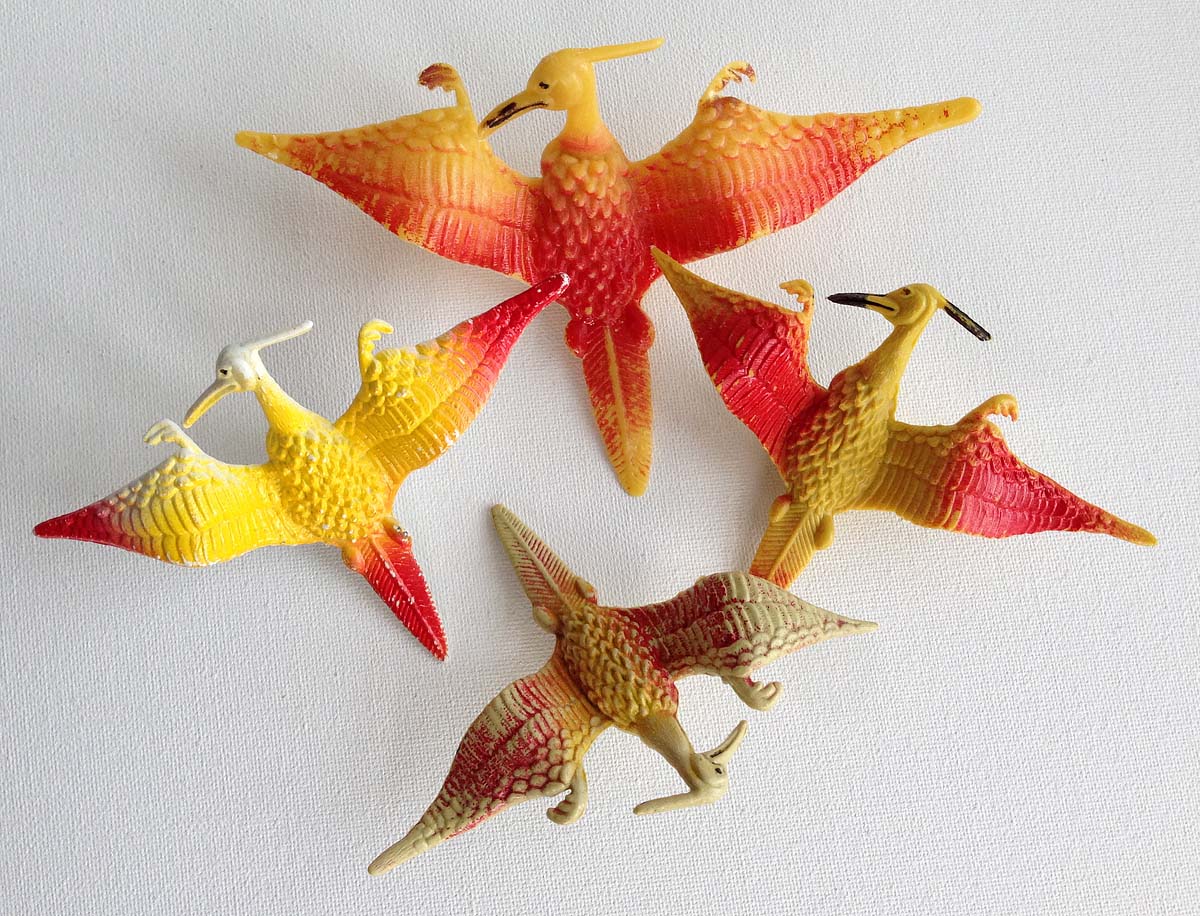
And finally...while these creatures wouldn't look too out of place in some of the more bargain basement dinosaur books out there, I'm quite certain this is a puzzle exercise with the aim being to identify which animals have been combined to produce these...things. So yes, they're deliberately wrong, which always takes away some of the fun. Nevertheless, I think they're brilliant, especially the Godzilla-like stegotheropod, the plesiosaur with sauropod legs, and the Pteranodon/bird. A lot of them resemble some of the more hideous cheapy dinosaur toys out there, especially the Pteranodon, which I'm pretty sure I owned as a child. Wonderful.

Many thanks again to Anastasia and Dave for sharing this one!

LATE UPDATE: Meanwhile, somewhere in Dinosaur Provincial Park...

While the 'letter' from Dave was an obvious joke, it is true that the matter of this book came up while Dave and his students (including Anastasia) were out in the field. Dave's sent me a photo from the trip, depicting a lovely stretch of Dinosaur Provincial Park.


Wednesday, September 10, 2014

Vintage Dinosaur Art: The Doctor Who Dinosaur Book - Part 2

So it turns out that Doctor Who is quite popular - who'da thought? As such, there was much demand for a second instalment of The Doctor Who Dinosaur Book (1976), featuring everyone's favourite Doctor* - the Fourth Doctor, played by Tom Baker - wandering around and posing like a prat among dinosaur art faithfully traced from the pages of earlier books. I do hope you enjoy.


I didn't mention any thyreophorans last time - but they do feature in the book, so please allow me to rectify the situation forthwith. Spiny-flanked Blackgang Chine fibreglass dinosaur massacre survivor Polacanthus puts in an appearance here, in full-on, 1950s-style retro guise. This restoration is nothing at all like the one we'd see today - it resembles an alarmingly armed lizard of some sort, and doesn't have the stocky, flat-topped appearance that ankylosaurs are noted for. No wonder the Doctor looks so unimpressed. If only some properly wide-gauge ankylosaurs could pop along to cheer him up...


...Ah, excellent! As you can see, the Doc is tickled pink at the sight of these stout fellows, who represent the other end of the retro ankylosaur restoration spectrum (yes) - wide, yes, but also short-tailed, no-necked, and with legs shorter than their heads. Vintage restorations tended to conflate true Ankylosaurus, Edmontonia, and Scolosaurus, often under the guise of 'Palaeoscincus'. TDWDB does refer to this animal as 'Ankylosaurus', but the meld of characteristics is quite obvious here.


Ankylosaurus' contemporary Triceratops, meanwhile, suffers from a bizarrely huge and fat tail and perspective-related head issues (horns go where?). In fairness, that's only because the original - from Album of Dinosaurs, illustrated by Rod Ruth - also had these problems, and this is a pretty faithful copy. Mind you, Ruth also managed to insert his creatures into a superbly painted, lush, atmospheric backdrop, whereas these two Triceratops appear to be fighting in the Late Cretaceous equivalent of the Final Destination stage from Super Smash Bros. At least we can admire the tartan detailing on the Doctor's waistcoat. Mmm, tartan.


Following my last post, a few people (not least Gary Campbell in the comments) mentioned the 1974 Doctor Who serial Invasion of the Dinosaurs as something that might be worth a look in the near future. Incidentally (PLUG ALERT), I have already written about it over on Dave Hone's Guardian blog, so do check that out if you love adorable puppets, Madame Vastra, and an unsubtle disdain for London. For its part, TDWDB does feature an illustration that looks very much like a puppet, complete with a flexible join where the head's attached - namely, the above ichthyosaur. The source for this one isn't too obvious, although it is rather generic; any suggestions are welcome.


Before we leave the Mesozoic behind, it's definitely worth mentioning that TDWDB isn't free from that contemporary dinosaur book staple of allosaurs gnawing on the necks of completely helpless gigantic sauropods, who could quite easily roll over and crush the bastards. Alas, the poor dears suffered a terrible inferiority complex - since they lacked sharp claws and teeth, or spines protruding from their sides, they thought themselves completely hopeless in a fight. Tiny brains, you see. For whatever reason, sauropods are portrayed with oddly pointed teeth in this book...


...Including when they're dead. In spite of being a time traveller with a lifespan extending into millennia, the Doctor has never quite got around to finding out exactly what killed off all the (non-avian) dinosaurs. Therefore this book, alas, offers us only speculation - mentioning insatiable egg-eating mammals (imagine the farts!) and Bakker's Dinoflu Pandemic Hypothesis. Still, the Doctor does manage to rock up a little late and perch on a boulder, looking thoroughly depressed at the sight of giant skeletons and a landscape more featureless than the Lincolnshire district of South Holland.


Having delivered on its title and shown the Doctor and dinosaurs side-by-side, TDWDB decides to expand its remit and move beyond the K/Pg extinction. A number of important prehistoric representatives of the Age of Hairies show up, including the loveable giant sloth Megatherium (above). Given the animal's considerable size, it seems that the Doctor can add 'lifting impressively weighty timber' to his list of superhuman attributes. Cute though this is, I'd rather have seen the Doctor giving Megatherium a hug...or maybe even riding it. Someone make this happen, please.


And finally...the Doctor documents the evolution of the most terrible killer of them all. That's right...MAN. For, in suitably chauvinistic 1970s style, it is most definitely MAN. With a capital M (and A, and N). On a spread entitled 'AN ANIMAL CALLED MAN', he outlines why MAN is so dangerous:
"He can think better than any of his rivals. He lives in a group, and co-operates with his fellows. And he's a tool user...those clever paws of his can hold and shape things. Weapons, in particular. He began with clubs and spears - and in time developed weapons capable of destroying his own planet."
Now, you might scoff at the idea that any modern day weaponry - even every nuclear warhead in the world - could 'destroy the planet'. Irradiate it for millions of years and kill off most lifeforms, sure, but not destroy it completely. Of course, you forget that the Doctor has seen mankind in the future. In the future, blowing up a planet with a bomb the size of a briefcase will be quite trivial - although it'll only be done to stop marauding armies of Cybermen. Mark my words.

But I digress. Three whole spreads are devoted to stinking MAN, but at least we are treated to the sight of a nude primitive stabbing a Smilodon straight through the face (above). All that's missing is a dramatic geyser of blood, and we'd be in proper horrorshow territory. Great stuff.

Coming up next time: definitely something different!


*What do you mean, you like David Tennant best? Call yourself a geek? Pish.

Monday, September 1, 2014

Vintage Dinosaur Art: The Doctor Who Dinosaur Book


It's a very good day for those interested in palaeoart - its history, trends over time, the current consensus on restoring certain animals, and where it might be going. Firstly, there's Mark Witton's article in Palaeontology Online, in addition to one on the 'new' Spinosaurus on his own blog. Secondly, Darren Naish's latest blog post is also a look at the changing appearance of dinosaurs in art (what, again?).

Here at LITC, we like to think we do our bit in aiding public understanding of the history of palaeoart; in particular, how certain trends are adopted by illustrators perhaps less accustomed to drawing dinosaurs, frequently resulting in grievous errors being repeated ad nauseam. The best palaeoartists will often find that their very particular take on an animal will take on a life of its own, appearing all over the bleedin' shop until it becomes the de facto 'genuine' restoration. This week's book is an exemplar of these tendencies in palaeoart. It also has Tom Baker in it. "You have a woman's bottom, my lady!"


The Doctor Who Dinosaur Book (or at least, this incarnation of it) appeared in 1976, and was illustrated in rather accomplished fashion by George Underwood. Accomplished in terms of technique, that is; most of the animals are brazen copies of restorations from other books. If anything, the copies are a bit too good - as Niroot remarked when he had a look, there's a glaring disparity between the highly detailed, hyper-realistic look of the Bernard Robinson copies, and the more stylised appearance of the Rod Ruth copies.

It's all a little bit shameful. On the other hand, it's hard not to smile at a book that features the Doctor grinning while feeding an Apatosaurus.


The book's text (by Terrance Dicks) is written as if by the Time Lord himself, and Tom Baker's Fourth Doc (scarf and all) pops up in almost every scene - and not only as a handy scale bar. Minor perspective issues aside (is the Doctor standing in the swamp, there?), seeing the behatted extraterrestrial interacting with a highly Burianesque, wrinkletastic sauropod is superbly surreal. The whole book has a faintly unreal air about it, like Tom Baker's invaded a gallery of vintage palaeoart. Which is actually rather close to being a literal description.


Occasionally, the Doctor is content to just pose moodily while retro saurians mill about in the background, as if he took a holiday in Neave Parker's sketchbooks. All of the sauropods in TDWDB adhere rigidly to the 'great fossil lizard' stereotypes of old, dragging their tails about, looking grumpy and sporting heads that indicate a lack of decent reference material. I'm enjoying the pastry dish crust on that Diplodocus, though.


Speaking of nondescript heads, this Brachiosaurus begins reasonably well (lengthy forelimbs, upward-sloping back; check and check), but for some reason is topped off with a rubbish, nondescript nubbin. To illustrate the animal's size, the Doctor is reduced to miniature size...not for the last time.


Those hankering for close-ups of Tom Baker's curly mop and rictus grins shouldn't fret, though - there are plenty of glorious close-ups to be had, as the Doctor gets a bit more hands-on with various angry reptiles. Here, the nefarious alien has snatched a Protoceratops egg from the nest, attracting the attention of a very squat, angry parent.


In perhaps the best of all the plates in this book, the Doctor actually grabs a dinosaur by the throat and tail in order to, I'm sure, inspect it more closely (and definitely not to wring its neck, pulp its remains and sell it to a Gallifreyan kebab outlet). It's scarce wonder that the Doctor looks so baffled here - while this creature is ostensibly Compsognathus, it seems to have morphed into some sort of lithe, bipedal lizard with four (count 'em) fingers and splayed limbs. This basically contradicts everything known about Compsognathus anatomy (noted as being highly birdlike even in the 19th century), but hey. There's no arguing with a centuries-old interloper in dashing costume.


Bigger and badder theropods pop up, too - they'd definitely be salivating over a bite-size intergalactic hero, if only their poses weren't strictly limited by the dinosaur books the artist found in the local library. Sexy Rexy (above) is a dead ringer for Rod Ruth's cover illustration for Album of Dinosaurs. You'll have to forgive me for missing the head off - but on the other hand, if you've seen Ruth's work, you already know what it looks like.


Everyone's favourite brontosaur botherer, Allosaurus, makes an appearance too - but this time, the animal's a Bernard Robinson knock-off. As already noted, Robinson's highly detailed style, meticulously detailed down to the last tiny scale, contrasts markedly with Ruth's, which gives this book a disjointed feel.

The Doctor, meanwhile, is meant to be fleeing in terror. However (and as pointed out by Brian Engh on our Facebook page), the eyelines don't match up at all. All the same, I love the pop-eyed Tom Baker look going on here. Classic stuff.


And finally (for now)...not all of the plates in this book feature the Doctor. Occasionally, TDWDB becomes just another 1970s dinosaur book - which is to say, filled with animals of highly questionable anatomy. While the basic shape of the above beast makes it clear that it's supposed to be an ornithomimosaur, the indie kid stick-thin legs, bizarre plantigrade-but-not feet, and tiny, creepy doll hands are strange indeed. It's Struthiomimus as constructed from bargain bin spare parts, and it's too baffling to even begin to point out where it's going wrong. It's just a perfect whole of wrongness that defies your nerdy pedantry. And that's a tyrannosaur clambering down a sandbank on the right, by the way.

Next week: more from this (if there's call for it), otherwise - something else!

top social